



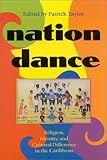
Patrick Taylor, ed. Nation Dance: Religion, Identity, and Cultural Difference in the Caribbean. Bloomington: Indiana University Press, 2001. xii + 220 pp. $19.95 (paper), ISBN 978-0-253-21431-7; $39.95 (library), ISBN 978-0-253-33835-8.
Reviewed by Robert J. Stewart (Trinity School, New York City)
Published on H-Caribbean (September, 2002)
The Caribbean Religious Space at Home and Abroad
The Caribbean Religious Space at Home and Abroad
The Caribbean can be seen as a religious region as distinctly as it is a region in geographical, historical, linguistic, literary, and musical terms. It is a place where world religions have flowed together, and where theoretical distinctions of secular and sacred, church and state, and human society and divine community have been defied. Historically, Caribbean religious world-views have been an interplay and overlay of those of Tainos and Caribs, European Christians and Jews, African slaves and post-emancipation African arrivants, indentured Asian migrants, especially from India and China, and of both black and white missionaries and immigrants from North America. Sociologically, Caribbean groupings according to race, ethnicity, or class have almost always been validated by religious mythology. At the same time, creole innovations in religion and progressive ecumenism among churches have furthered the as yet unfinished business of defining Caribbean identities that transcend African, European, or Asian origins. In the twentieth century, Caribbean religions became globalized by the outward migration of believers and practitioners to world metropolises. This migration has so expanded the psychological Caribbean space that reverberations from outside the geographical limits of the Caribbean inevitably affect post-colonial identities within the region.
Caribbean religion is, thus, a huge and intricate topic. Any writer or editor who approaches it needs to have a comprehensive view while being clear on the limits of his or her article, monograph, or anthology. An editor also needs to be resourceful in choosing an organizing principle for a collection of diverse essays. Patrick Taylor, the editor of Nation Dance: Religion Identity, and Cultural Difference in the Caribbean, has made an admirable attempt to be as comprehensive as possible in a collection of fourteen essays that probe religious and cultural experiences in the Anglophone, Hispanophone, and Francophone Caribbean. The writers discuss theoretical issues, such as identity and memory, and examine specific religious institutions and experiences, ranging through mainstream Christian churches, Christian fundamentalism, a variety of African-Caribbean religious forms, and Indian-Caribbean and Chinese-Cuban worldviews. Certain gaps in treatment are to be expected, and scholars of Caribbean religion will notice them. The experience of Caribbean Jews is typically sidelined in studies of Caribbean religion, and is absent from this collection. The late-twentieth-century development of militant Islam among descendants of Africans in the southern Caribbean, which has had socio-political impact in Trinidad especially, is also not examined. And although Pentecostalism enters into several of the essays, its phenomenal growth throughout the region warrants a more thorough treatment. Readers might notice other lacunae. While not all aspects of Caribbean religion need be covered in an anthology such as this, one looks for more specific acknowledgement of the gaps than the editor gives in his introduction.
Taylor chooses the metaphor of the Nation Dance as the organizing principle of the book, and invokes Paule Marshall^Òs novel Praisesong for the Widow (1984) to introduce the concept. Avey Johnson, the main character in the story, participates in the Nation Dance ceremony, also known as Big Drum, on the island of Carriacou. She becomes spiritually engaged in an Afro-Atlantic experience in which she connects the Caribbean with her youthful participation in the Shouters Church in South Carolina. Taylor extrapolates his theme from Marshall^Òs novel, a theme of a diasporic claim to a Caribbean homeland and the necessary linking of Caribbean modernity with living religious traditions. The book^Òs cover captivates with Canute Caliste^Òs primitivistic painting ^ÓBig Drum,^Ô in which the dance of Caribbean nations is celebrated in one sacred space.
The editor^Òs introduction is promising. After launching the image of the Nation Dance, he discusses the viewpoints that can be employed in describing and analyzing Caribbean religion and related issues of identity: syncretism, mestizaje, creolization, symbiosis, pluralism, diaspora, and so on. He astutely defines the issues surrounding these viewpoints without taking a position on their adequacy as analytical models for Caribbean society. He leaves it to the essays that follow to offer critiques of these concepts.
The fourteen essays that constitute the body of the book are organized into three sections. The first section, ^ÓSpirituality, Healing, and the Divine,^Ô begins with the voices of actual practitioners, one who was based in Cuba and two who are part of the Caribbean diaspora in Canada: Eva Fernandez Bravo, an espiritista in Santiago de Cuba until her death in 1997; Yvonne B. Drakes, founder and Queen Mother Bishop of the Trinity Divine Spiritual Baptist Church in Toronto; and Deloris Seiveright, Archbishop Doctor Mother Superior of the Shouters National Evangelical Spiritual Baptist Faith in Toronto and Hamilton. The other two sections in the book are ^ÓTheology, Society, and Politics^Ô and ^ÓReligion, Identity, and Diaspora.^Ô
By keynoting with voices around the altar, as it were, the editor establishes a criterion for assessing the entire book. The critical question becomes: how clear and incisive are the Caribbeanists, writing from within the academy, in explicating the experience of those living within the religious space? Using that critique, I suggest that Nation Dance could have been an excellent volume if half the number of essays in it had been either carefully revised or not published. The essays in question read as if they are graduate seminar papers, useful as springboards for vigorous argument around an academic conference table, but not adequate for publication for a wider readership. Several of the writers are enthralled by postmodern critical theory and discourse analysis. In George Orwell^Òs 1946 essay ^ÓPolitics and the English Language,^Ô he warned writers against letting words and phrases choose one^Òs thought and meaning rather than the other way about. The same warning could be heeded by cultural theorists who obscure or bury the concrete topic of their writing in verbiage that, as Orwell wrote of political language, gives ^Óan appearance of solidity to pure wind.^Ô Frank F. Scherer, for example, in his essay on Sanfancón, the Chinese-Cuban saint, is more concerned with critiquing Orientalist discourse than with exploring Chinese-Cuban religious experience. Another example is Abrahim H. Khan^Òs essay ^ÓIdentity, Personhood, and Religion in Caribbean Context.^Ô In an eleven-page essay, the author gives us seven pages of theoretical considerations of identity and personhood before four pages of specific Caribbean focus. The organization seems unbalanced. And in Frederick Ivor Case^Òs essay on Obeah and Kali Mai in Guyana, too much waving of the flags of semiotic theory obscures what is otherwise a fascinating and important topic, ^Óthe intersection of the codes of two different cultural and spiritual traditions^Ô (p. 40).
Some of the scholarship in the book is not as thorough as it should be for publication. Juanita de Barros, in ^ÓCongregationalism and Afro-Guianese Autonomy,^Ô combines some solid history of the London Missionary Society in British Guiana and evidence from a field study of a congregation in Berbice to draw a conclusion that seems imposed: ^ÓCongregationalism in British Guiana provided a site for poor Afro-Guianese to exercise a degree of local autonomy and constituted opposition to the status quo^Ô (p. 98). That may or may not be true, but more research is needed to support it, as de Barros herself suggests in her conclusion. The publication of her essay seems premature. Petronella Breinburg, in her intriguing essay on the language of Surinamese Winti, is curiously vague in assigning simply African or West African provenance to Creole day names without specifiying Akan etymology. And I question Ivor Case^Òs historiographical sense when, in ^ÓThe Intersemiotics of Obeah and Kali Mai in Guyana,^Ô he characterizes the Jesuit Joseph J. Williams as ^Óinsensitive and ethnocentric^Ô (p. 42) in his analysis of the belief system that produced Obeah. Case^Òs bibliography includes Williams^Òs 1934 Psychic Phenomena of Jamaica. By today^Òs standards of cultural analysis, Williams^Òs limitations are clear. But in the tradition of missionary commentary in which we can place Williams, he attempted in his writings in the 1930s to depart from the racist sensibilities of previous Jesuit and Protestant missionary writers on Jamaica, and his work was the most advanced in that tradition to ground missionary observations anthropologically. To criticize Williams without this awareness is a kind of presentism with regard to sources that should be avoided.
Nation Dance's strengths are in Taylor^Òs introduction and in seven of the fourteen chapters of the book. In chapter 1, ^ÓAcross the Waters: Practitioners Speak,^Ô Eva Bravo, Yvonne Drakes, and Deloris Seiveright give witness to the experiential links among various traditions in Caribbean religion. María Margarita Castro Flores, in chapter 5, ^ÓReligions of African Origin in Cuba: A Gender Perspective,^Ô proceeds on the presupposition that in Cuban history ^Óthe feminine was subordinated not only to the colonizer, but also to the colonized male^Ô (p. 55). She then examines gender in religions of African origin in Cuba, specifically Palo Monte, the Abakuá secret societies, and Regla de Ocha. She argues that there is an internal gender conflict: that the survival of African derived religions relies on their cultural transmission by female practitioners who, in the same transmission, reproduce models of female self-limitation.
Patrick Taylor^Òs chapter 6, ^ÓSheba^Òs Song: The Bible, the Kebra Nagast, and the Rastafari,^Ô defies categorization. It is oral history, documentary history, scriptural exegesis, philology, and Glissantian discourse analysis. It is an absorbing meditation that leads the reader through Biblical, Ethiopian (the Kebra Nagast), and Rastafari texts toward a poetic understanding of the Rastafari counter-narrative of Caribbean experience. In the following chapter, ^ÓThemes from West Indian Church History in Colonial and Post-colonial Times,^Ô Arthur C. Dayfoot writes what is largely traditional ecclesiastical history without denominational apologetics, a straightforward survey of the Christian churches in the Caribbean from early Spanish colonization to the late twentieth century, with emphasis on the Anglophone West Indies. The chapter is not purely chronicle, but also a consideration of the nature of the trans-Atlantic transformations of European religious institutions. Dayfoot places church history in the historical contexts of the relations of church and state, religious toleration and freedom, emancipation, independence, and ecumenism.
One of the most insightful essays in the book is Judith Soares^Òs chapter 9, ^ÓEden after Eve: Christian Fundamentalism and Women in Barbados.^Ô The author looks at the role of Christian fundamentalist spirituality in the daily lives of Barbadian women. The fundamentalist and Pentecostal gender hierarchy is being challenged from within fundamentalist theology itself, as formulated by Soares^Òs informants in Barbados. She articulates a way of thinking that distinguishes the institution of church, as patriarchical preserver of the status quo, from the Kingdom, God^Òs rule of dignity and justice, including gender equality, in the daily lives of believers. The attempt to resolve the tension between church and Kingdom, Soares shows, has motivated a movement for social change in Barbados (she cites specifically the work of the Apostolic Teaching Centre) in a way that would seem to be uncharacteristic of fundamentalists.
Laennec Hurbon^Òs brief chapter 10, ^ÓCurrent Evolution of Relations between Religion and Politics in Haiti,^Ô provides a context for understanding the chaotic events in Haiti from the collapse of the Duvalier dictatorship. The essay seems to lose precision in translation, but manages to show the conflict and compromises both within and among Protestantism, Catholicism, and Vodou in Haiti^Òs current period of transition. Barry Chevannes^Òs excellent chapter 11, ^ÓJamaican Diasporic Identity: The Metaphor of Yaad,^Ô examines the living space of the yard as the central reference point of self-definition among African-Jamaicans. The religious implications of the yard are its ritualization of community relations among the Jamaican poor, its meaning as an almost mythological point of departure and return in the Jamaican diaspora, and its mystical appropriation by the Rastafari to signify Zion, where Jah dwells. Chevannes^Òs analytical skills are equaled by the elegance of his language. He is a pleasure to read.
Nation Dance concludes with a helpful supplementary bibliography, a veritable course of studies on Caribbean religion for those who wish to pursue it. Specialists might notice the absence of important texts, but I suspect that the editor chose to include fairly accessible books for a general readership. I would suggest the addition of three books published within the last seven years that the editor either overlooked or chose not to include, or that came to his attention after his manuscript went to copy. Anthony M. Stevens-Arroyo and Pérez y Mena^Òs Enigmatic Powers: Syncretism with African and Indigenous Peoples^Ò Religions among Latinos (New York, 1995) is relevant to several of the chapters in Nation Dance. Nicole Rodriquez Toulis^Òs Believing Identity: Pentecostalism and the Mediation of Jamaican Ethnicity and Gender in England (Oxford, 1997) is essential reading in Caribbean diaspora studies. And the anthology Religion, Diaspora, and Cultural Identity: A Reader in the Anglophone Caribbean (Amsterdam, 1999), edited by John W. Pulis, anticipates several of Nation Dance^Òs basic themes.
If there is additional discussion of this review, you may access it through the network, at: https://networks.h-net.org/h-caribbean.
Citation:
Robert J. Stewart. Review of Taylor, Patrick, ed., Nation Dance: Religion, Identity, and Cultural Difference in the Caribbean.
H-Caribbean, H-Net Reviews.
September, 2002.
URL: http://www.h-net.org/reviews/showrev.php?id=6711
Copyright © 2002 by H-Net, all rights reserved. H-Net permits the redistribution and reprinting of this work for nonprofit, educational purposes, with full and accurate attribution to the author, web location, date of publication, originating list, and H-Net: Humanities & Social Sciences Online. For any other proposed use, contact the Reviews editorial staff at hbooks@mail.h-net.org.

