



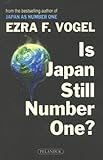
Ezra F. Vogel. Is Japan Still Number One? Subang Jaya: Pelanduk Publications, 2000. 141 pp. $12.00 (paper), ISBN 978-967-978-728-3.
Reviewed by Andreas Hippin (Independent Scholar)
Published on H-US-Japan (August, 2002)
Japan as Number 30
Japan as Number 30
Twenty years ago Ezra Vogel's Japan as Number One hit the bookshelves all over the world. Timing was excellent: In the 1980s Japan was the "next thing." The consensual Japanese model was as hot as internet startups in the late 1990s. Readers who flip through the pages of this book nowadays might take it as a reminder that New Era thinking has always been en vogue. The subtitle, "Lessons for America," gave an idea of Vogel's concerns at that time: America weakening in the wake of the Rising Sun. "I have no regrets writing Japan as Number One," Vogel writes in the introduction (p. 8). "When I was writing the book, I had America's interest at heart. I wanted America to do better and to respond constructively to the challenge that was coming from Japan" (p. 38). The book appeared at a time Americans were experiencing a crisis of faith and sold beyond anybody's expectations.
Vogel's new book Is Japan Still Number One? appears at a time the Japanese are experiencing a crisis of faith. The nation has been written off as a viable economic force by many observers. According to the most recent World Competitiveness Yearbook published by the Swiss International Institute for Management Development (IMD), Japan has fallen back to number 30 in 2001.[1] Now Vogel provides lessons for Japan. Since Comeback has been published in Japan under the title Reflections on Japan as Number One, you might call it another sequel.
The book consists of three parts. The first sixty-seven pages of the book are of interest for those who want to know more about the origins of a piece of popular literature that has changed our view of the world. The second half of the book can be divided into chapters dealing with interior reforms and with Japan's role in world policy. First Vogel describes how he got the idea for the book while doing research in Japan, why it became a bestseller, and how he became the expert of choice in Japanese affairs. At the same time it is the story of the rise of postwar Japan. His memories show his major sources of inspiration: "I wanted to present a broad systematic way of thinking about society that I had learned from one of my professors, Talcott Parsons" (p. 34). He describes how he built his contacts: "through my friendships with Japanese who had fellowships at Harvard, I was also able to form my own network of high-ranking Japanese bureaucrats" (p. 35). It makes you wonder how big the influence of the small, internationally minded elite sent to Harvard might have been within the Japanese leviathan. Unfortunately Vogel's story of his own success lacks that kind of critical reflection.
In the chapter "Lessons Learned" he tries to prove how America learned from Japan. But for some reason quality control and subcontracting systems--"the two specific Japanese business practices that had the greatest impact on American business"--were not part of Japan as Number One, Vogel admits. "However, the new interest in learning about Japan led American leaders to think about how they could profit by studying specific issues such as quality control" (p. 58).
The second part of the book--"Lessons for Japan"--starts in chapter 5: What went wrong? the author asks, repeating the common view that more flexibility is needed to meet the challenges of the global marketplace. In Vogel's view the almighty Japanese bureaucracy has to give up its powers: "Only politicians can carry out the bold changes that require public support and broad coordination. Only politicians can align bureaucratic policies and decisionmaking with the fast-paced changes in today's domestic and international environment" (p. 72). Apart from the terrible reputation politicians enjoy in Japan, breeding this kind of new leaders might be a problem. Send them to Harvard? Vogel might think so. He has been teaching at Harvard from 1967 to 2000. His book is an ongoing laudatio on the school "which plays a major role in advancing intellectual frontiers and developing talent around the world" (p. 121). So fortunately, Harvard is "probably the most popular U.S. educational institution amongst Asians" (p. 35). Maybe that is why Vogel met most of the promising talents he introduces in his book there.
Chapter 6 explains what he wants the new breed to execute: "Reforms from Top to Bottom Boldly." In short, "Japan today needs a third wave of reforms as forward-thinking and as comprehensive as the reforms instituted in the Meiji era and during the early postwar era" (p. 86). Vogel demands "sweeping changes not only in finance" (p. 89) but also in educational reforms to enable the nation to adapt to the service sector. To do this it will have to provide "an environment that allows more individualism, initiative, creativity and multicultured contacts and higher levels of skill in English" (p. 91). In short: rebuild Japan from scratch. It is not a new idea. The new thing is that it is articulated by someone who used to be called a "Chrysanthemum kisser" by those called "Japan bashers" in the 1980s.
The third part deals with the role Japan should play in world politics. Vogel thinks the U.S.-Japan Partnership should basically remain the way it is. A triangular relationship between China, Japan and the United States is emerging. Now it depends on how each of the regional powers is going to deal with it. Vogel concludes that "it is not in the interest of the United States to pressure one country by making use of a third country" (p. 102). However he has to admit that not enough U.S. policymaker have begun to bear that in mind. He critizises former U.S. president William Clinton for not mentioning Japan during his trip to China in 1998. "What he should have said was that the United States wants to improve relations with China but not at the expense of relations with Japan. Because he did not say that, he made the Japanese anxious and worried while he made some people in China feel that they might be able to push the United States into weakening its ties with Japan" (p. 102).
Chapter 8--"Taking a Positive Stance in World Affairs"--is about Japan's role in Asia and comes to the obvious conclusion: "Before the Japanese can present their agenda in a more forceful manner, they must speak frankly about what happened in World War II" (p. 108). Vogel thinks that Asian countries have little to fear from Japanese nationalism. He sees foreign aid as a way Japan could play a more important role in the international arena. It could even show up a new approach to international aid drawing on its own experience as a developing country. The Asian Development Bank might serve as a medium as the Japanese provide a large part of the funding. In chapter 9, his thoughts from chapter 7 about the "Triangular Partnership" between the United States, China and Japan are repeated. Apart from anecdotal evidence that China is changing rapidly, it is full of questionable statements like these: "Korea has for over a millenium existed as a united country" (p. 117) or "In probing for the cause of World War II, one can make a strong case that two rising powers--namely Japan and Germany--created concerns in other nations and that the cycle of mutual fear led to tensions that precepitated the war" (p. 115). After all, the author comes to the conclusion that managing triangular relations is not an easy thing to do.
Unfortunately readers do not learn much about Vogel's role as a National Intelligence Officer for East Asia/Pacific from studying chapter 10, "Government Service." This would have been a chance to tell the world what is going on behind the curtains of one of Washington's most secret societies. However what Vogel has to offer does not go far beyond the official communiques. Readers are well advised to skip this chapter and the epilogue, which consists of more praise for Harvard.
After all, the book summarizes the more well known Western reform ideas for Japan and gives an idea of the thinking of the man who wrote Japan as Number One. Readers looking for new concepts will be disappointed. The first book in the series sold more than 700,000 copies in Japan. Japanese officials still like to refer to it. This one will most likely not do that well.
Note
[1]. The WCY Overall Scoreboard can be found on the Website of the Swiss International Institute for Management Development (IMD): http://www01.imd.ch/wcy/ranking/ (visited August 24th, 2002).
If there is additional discussion of this review, you may access it through the network, at: https://networks.h-net.org/h-us-japan.
Citation:
Andreas Hippin. Review of Vogel, Ezra F., Is Japan Still Number One?.
H-US-Japan, H-Net Reviews.
August, 2002.
URL: http://www.h-net.org/reviews/showrev.php?id=6671
Copyright © 2002 by H-Net, all rights reserved. H-Net permits the redistribution and reprinting of this work for nonprofit, educational purposes, with full and accurate attribution to the author, web location, date of publication, originating list, and H-Net: Humanities & Social Sciences Online. For any other proposed use, contact the Reviews editorial staff at hbooks@mail.h-net.org.

