



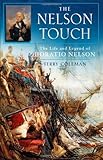
Terry Coleman. The Nelson Touch: The Life and Legend of Horatio Nelson. Oxford: Oxford University Press, 2002. xx + 424 pp. $35.00 (cloth), ISBN 978-0-19-514741-4.
Reviewed by Edward M. Furgol (The Navy Museum, Naval Historical Center, Washington, D.C)
Published on H-Albion (August, 2002)
Based on massive primary research and a solid command of the significant secondary sources, Coleman has produced a biography of Nelson that "teases out the man from the legend" (p. 7). The author dissects the hagiographical trends that originated not only following Nelson's death (chiefly sponsored by his brother William), but also from his writings and efforts throughout his life. If Nelson strove to establish credentials that would immortalize him, Coleman has used his meticulous examination of documents to render him less than Olympian.
In twenty-seven chronological chapters Coleman portrays Nelson the man and naval officer. His reputation in the first category suffers from the author's intense scrutiny. Coleman sustains Nelson's brilliance as a naval officer, but introduces some caution to the usual sui generis tale of an impeccable gentleman. Nelson contended that he achieved promotions without interest or patronage, which would have made him exceptional for an eighteenth-century British naval officer. Coleman refutes these claims convincingly, showing that his maternal uncle Maurice Suckling, and other naval officers such as Sir Peter Parker and Samuel Hood secured positions and promotions for the parson's son. However, friendship with Prince William (the future king) had negative consequences for his career as may be seen in chapter ten.
Accounts of Nelson's battles have generally accepted his own word for his distinct contribution. Coleman points out in case after case (Cape St. Vincent and the Nile, for example), that Nelson immediately took a hand in manipulating the record. Generally circumstances favored the Nelsonian version and posterity enshrined that interpretation. Hence the roles of William Parker at St. Vincent and Thomas Foley at the Nile have failed to receive the appreciation that is their due. The reader will not be surprised to learn that the story from Copenhagen (of Nelson viewing the recall signal with telescope over an eye patch) is a pure fabrication from an early biographer. Twice the author quotes the earl St. Vincent's statement that "Animal courage was the sole merit of Lord Nelson, his private character most disgraceful in every sense of the word" (pp. 7, 343). Nelson's exploits in Corsica, the Canaries and Boulogne, sustain the view of reckless bravery. As does his decision before Trafalgar to ostentatiously wear his decorations and take the most dangerous post conceivable--an exposed position that almost inevitably led to his death.
Nelson's actions at the bay of Naples (capping two disastrous years of direct involvement with the Kingdom of the Two Sicilies) following the royalist recovery there vindicates St. Vincent's charge, and seriously undermines Nelson's character not only by today's standards of international law, but also by the practices of his day. Following the arrangement made that allowed the Neapolitan republicans to flee to France, Nelson arrived and repudiated the treaty signed by British, Russian, and Sicilian representatives. His actions have brought condemnation from Italian historians. The event has become largely obscured by the Lady Emma Hamilton affair, of which it formed a part. (Those desirous of the details of that relationship will find the book as revealing as they could wish.)
The volume's supporting material varies in quality. The selection and number of images is first-rate (to steal a naval term). The publisher's decision to print some in color is more than commendable. However, the maps (although adequate) borrow heavily from the past (especially pp. 30, 153, 254). In addition the lack of a map of Nelson's great chase in 1804-05 is lamentable, as is the absence of a battle track of Trafalgar. The annotated bibliography will prove useful to those who might be trapped in the mine of the voluminous Nelsonian and Royal Navy writings. The index is serviceable. The decision to place the notes at the end of the book rather than at the foot of each page may reflect a desire to make the work appear less academic and more popular than it is.
The absence of courses in naval history makes Coleman's biography of Nelson hard to place in an academic setting. In a general sense it is an instructive piece of historiography, given the author's dissection of the birth and cultivation of the Nelson legend, and his ceaseless quest to investigate the claims of earlier books. Free of jargon (a conscious decision, p. 355), and preconceptions of knowledge, the book will readily serve those seeking insights into the late Georgian Royal Navy and one of the modern period's towering figures. Readers of naval history and Patrick O'Brien novels will find Thomas Pocock's Horatio Nelson (New York: Alfred E. Knopf, 1988) more to their taste.
If there is additional discussion of this review, you may access it through the network, at: https://networks.h-net.org/h-albion.
Citation:
Edward M. Furgol. Review of Coleman, Terry, The Nelson Touch: The Life and Legend of Horatio Nelson.
H-Albion, H-Net Reviews.
August, 2002.
URL: http://www.h-net.org/reviews/showrev.php?id=6587
Copyright © 2002 by H-Net, all rights reserved. H-Net permits the redistribution and reprinting of this work for nonprofit, educational purposes, with full and accurate attribution to the author, web location, date of publication, originating list, and H-Net: Humanities & Social Sciences Online. For any other proposed use, contact the Reviews editorial staff at hbooks@mail.h-net.org.

