



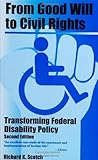
Richard K. Scotch. From Good Will to Civil Rights: Transforming Federal Disability Policy. Philadelphia: Temple University Press, 2001. 218 pp. $17.95 (paper), ISBN 978-1-56639-897-8.
Reviewed by Gerald V. O'Brien (Department of Social Work, Southern Illinois University Edwardsville)
Published on H-Disability (August, 2002)
For those with an interest in the analysis of disability policy, Section 504 of the Rehabilitation Act of 1973 has come to exemplify a fascinating example of policy development and implementation. At the time of its passage, this portion of the Act was a small, seemingly inconsequential statement that garnered little attention by legislators and other interested parties. Its influence, however, would be far-reaching, and it served as the basis for the better known Americans with Disabilities Act (ADA) of 1990.
Scotch's book is an analysis of Section 504. He provides a brief historical introduction to disability policy in the United States, and devotes the remainder of the book to the origin, passage, implementation, and impact of Section 504. The book was originally published in 1984. In the Epilogue, this second edition includes a brief overview of disability policy-making since the original edition came out, including a cursory introduction to the ADA.
Section 504 was the first federal policy extending the nondiscrimination language of the Civil Rights Act of 1964 to persons with disabilities. More limited than the ADA, Section 504 only applied to the federal government and private and governmental entities that contracted with the federal government, such as educational institutions. The majority of the Rehabilitation Act dealt with various funding provisions for rehabilitation programs. These high price-tag items led to two presidential vetoes of the bill. They also served to distract attention from the injunction against discrimination.
Several authorities have noted that the first edition of Scotch's book is provides the most in-depth analysis of Section 504. Especially significant in the work is the focus on the development of the Section by legislative aides, and the long and labyrinthine implementation process. While more recent disability policies such as the ADA included a substantive degree of participation and advocacy by disability rights groups--the recent maxim of such advocates, "nothing about us without us," typifies this involvement. This initial civil rights policy, the author notes, developed with little input by beneficiaries. According to Scotch, Section 504 was included in the legislation by legislative aides who had an interest in civil rights, and it became lost amidst the other provisions. He also notes that one of the motivating factors for the Section was that persons who were served by the Vocational Rehabilitation (VR) system often had difficulty entering the job market once they had completed their training. This often occurred because of structural and attitudinal barriers. Without some form of protection from discrimination and structural improvements, therefore, much of the money paid into the VR system was wasted.
Changes in the political climate and a lack of legislative discussion hampered the implementation of Section 504. In the policy process, government offices with authority for implementing policy looked to legislative records such as committee hearings and the Congressional Record for guidance on developing rules for applying the policy. Since Section 504 initiated virtually no discussion among legislators, however, the Office of Civil Rights, which implemented the policy, was left with the difficult task of implementing a vaguely written policy with virtually no legislative guidance. Scotch devotes several chapters of his book to this process.
A particular strength of this work, aside from the analysis itself, is the author's reliance on the testimony of people involved in developing the policy. Scotch interviewed legislative aides about the origin of Section 504, and the inauspicious manner in which the Section was developed is a fascinating chronicle of policy development. According to Scotch, disability interest groups were not only largely uninvolved in the development of the Section, but their contribution at all stages was tangential. Of course, this is due to the fact that during the early 1970s an organized disability rights coalition was only starting to develop.
Interestingly, Scotch writes that the lack of involvement by disability rights advocates, especially at the early stages of development, may have helped in the passage of the Section. Had a vocal advocacy group emerged, he notes, attention would have been drawn to this element of the Act, which could only have harmed its chances of remaining in tact. Where direct action by consumer groups did come about in relation to Section 504 was in the protests staged by advocates at Health, Education, and Welfare (HEW) offices, which included a takeover of several offices by persons with disabilities. This militancy arose after the Department had failed to implement the Section for several years. Scotch notes that some that were involved in implementation of the policy question whether the protests actually had much impact (p. 114). Direct action may have served a greater purpose, however, in empowering disability groups to become more involved in the political arena.
This book has few drawbacks, although I will mention a couple. First, the title of the work may leave some with the impression that the book provides a more sweeping historical overview of disability policy, rather than focusing on an essential transition time within this history. Especially since the second edition was published in 2001, some may purchase the book looking for information on recent policies such as the ADA. The title also implies that the work focuses primarily on the emergence of a disability advocacy coalition. This is especially true since one of the two figures on the front of the book--along with a wheelchair--is a clenched fist. While coalition-building is a tangential issue within the book, there are many recent books, such as Shapiro's No Pity, that consider the transition of persons with disabilities from disempowered beneficiaries of charity to vocal consumers in much greater depth. A final concern relates to the rewriting of the book. Originally published in 1984, it appears that only the Epilogue was rewritten for the 2001 edition. While this is not necessarily a problem, considering the nature of the book, it is not made clear in the introductory chapter that this section is wholly from the original version. Thus some of the narrative--when Scotch speaks, for example, of what has happened "in recent years" (p. 6) or "until very recently" (p. 10)--is difficult to place in its proper context. A brief explanation at the beginning of the chapter would have been helpful.
Scotch's book is a well-organized account of a social policy--remarkably simplistic in its wording but exceeding complex in its interpretation and extremely important in its impact--that benefits greatly from first-person testimony. It is not only recommended for those with a specific interest in disability policy, but for anyone with an interest in policy analysis. The issues that relate to Section 504 are so unique that the example provides a wonderful real-world teaching tool for college-level policy courses.
Copyright (c) 2002 by H-Net, all rights reserved. H-Net permits the redistribution and reprinting of this work for nonprofit, educational purposes, with full and accurate attribution to the author, web location, date of publication, originating list, and H-Net: Humanities & Social Sciences Online. For other uses contact the Reviews editorial staff: hbooks@mail.h-net.msu.edu.
If there is additional discussion of this review, you may access it through the network, at: https://networks.h-net.org/h-disability.
Citation:
Gerald V. O'Brien. Review of Scotch, Richard K., From Good Will to Civil Rights: Transforming Federal Disability Policy.
H-Disability, H-Net Reviews.
August, 2002.
URL: http://www.h-net.org/reviews/showrev.php?id=6568
Copyright © 2002 by H-Net, all rights reserved. H-Net permits the redistribution and reprinting of this work for nonprofit, educational purposes, with full and accurate attribution to the author, web location, date of publication, originating list, and H-Net: Humanities & Social Sciences Online. For any other proposed use, contact the Reviews editorial staff at hbooks@mail.h-net.org.

