



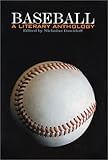
Nicholas Dawidoff, ed. Baseball: A Literary Anthology. New York: The Library of America, 2002. xii + 721 pp. $35.00 (cloth), ISBN 978-1-931082-09-9.
Reviewed by Alex Gordon (Department of English and Comparative Literature, Goldsmiths College, University of London)
Published on H-USA (July, 2002)
The Pen is Mightier than the Baseball?
The Pen is Mightier than the Baseball?
Is sport a metaphor for life? Despite charges of trivialisation and glibness, it is possible to see the correlation. The commitment to face the challenge year after year, to face unknown obstacles and overcome them, to remain faithful in spite of disappointment, and the satisfaction of achievement following hard toil, the passion, heartache, suspense, and joy: certainly sport provides us with useful narratives with which to metaphorise existential profundities. It provided the basis for British writer Nick Hornby's biography Fever Pitch (1995), a paean to the place of soccer as the physical constant in a world of psychological uncertainty. David Winner's Brilliant Orange: The Neurotic Genius of Dutch Football (2000) inverted the question, seeking to explain how Dutch soccer is indebted to Holland's unbroken landscape, the geometry of Mondrian's paintings, and the majesty of Rembrandt's brush stroke. Nicholas Dawidoff takes this idea one step further, arguing that an understanding of a national culture can be gained not only from watching and participating in its sports, but crucially through writing and reading about them. Be it journalism or fiction, baseball, the epitome of American sports for Dawidoff, is as much about words on a page as it is a game on the field. To this end he has edited an anthology of literary works from 1888 to the present day, traversing reportage, essays, short fiction, journalism, drama, memoir, and poetry. All entries into Dawidoff's montage seek to locate the game in what New Yorker baseball reporter Roger Angell called "The Interior Stadium," the tenth inning of the imagination in which glory and ignominy struggle for prominence.
Here, with a strict sense of chronology, and with their own brief but useful biographical summary, is a glittering array of American literary grandeur. Early on in this collection, Dawidoff dutifully includes the classic song by Jack Norworth, to which baseball is forever wed. Although "Take Me Out to the Ball Game" is now associated with Frank Sinatra and Gene Kelly in Busby Berkeley's musical of the same name, every baseball stadium across the United States today echoes with this tune whenever a crowd gathers to watch a game. Its sentimental cadence can be felt through all of the excerpts gathered here, from Damon Runyon's carnival evocations in 1911, to the epic statement found in the lengthy prologue to Don DeLillo's Underworld(1997). Dawidoff offers a glimpse of Ring Lardner, the man who wrote the original baseball novel, an epistolary affair that first appeared in magazine instalments, and seems to point the way for writers that followed. Thomas Wolfe and Carl Sandburg appear in the dugout alongside moderns like Bernard Malamud and John Updike. Tallulah Bankhead's memoir stands on first base while Robert Frost's poetry faces up to Richard Ford's incisive curve balls. Jimmy Breslin and George Plimpton sit in the press box, while Stephen Jay Gould sits in the bleachers constructing evolutionary statistics.
All offer us a cascade of vivid characters, both heroes and villains, winners and losers, the well worn dramatis personae of ancient Greek myth metamorphosed into an updated Olympian sport. For these modern scribes, baseball is the American everyman's annual Odyssey, the World Series crown its golden fleece. Yet beyond the vitality of the text lies the emotional and intellectual commitment of the reader to the author's cause. His purpose is archly obscured behind all of the bravado and scorelines, for essentially this is not writing for the sake of mere entertainment, but for social expression. Baseball literature, as we might name it, is designed to simultaneously underpin the extravagant vision of the American Dream, and to expose its fundamental contradictions. Ironically though, the singular act which ripped the presumed innocence out of the game, the fixing of the 1919 season, was not taken from the pages of fiction but from the newspapers. After that revelation, Norworth's song surely acquired a more cynical tone. Indeed, Dawidoff, dictating proceedings from the manager's bench, sends out his basemen (and women), backed up by an introduction which deflates the mythology of the game and places it in its historical context, a useful exercise in a collection which all too often seems to favour the romantic over the realistic in its evocation of this most American of games.
In spite of the breadth of this admirable anthology, the collection is not entirely comprehensive, as if that were ever the point. Dawidoff has, however, made some eccentric choices, and some glaring omissions. In the case of the former, both Philip Roth and horror writer Stephen King have written whole novels which forge their narratives from baseball. In Roth's case, his 1973 novel The Great American Novel focused on the rise of the Ruppert Mundy's and their roster of curious players including a one-legged catcher and a one-armed fielder. Dawidoff has chosen to include a section from Portnoy's Complaint (1969), Roth's earlier novel in which baseball plays an incidental role. Although he cites The Great American Novel in his bibliographical precis, the title of the book alone suggests the fundamental importance that Roth attaches to baseball as the metaphor of American letters. It is therefore surely an oddity to have chosen a section from another of Roth's fictions. Similarly, The Girl Who Loved Tom Gordon (1999) represents Stephen King's attempt at merging the supernatural thriller with the baseball narrative. The novel traces the movements of Trisha McFarland, separated from her parents while trekking in the woods of Northern New England. King manipulates the game to act as a psychic comforter for the frightened girl, which allows her to continue her journey through the Freudian undergrowth to be reunited with her parents. For King, baseball restores equilibrium to a constantly destabilised American society. Given the author's attempt at profound social commentary in this novel, it is a wonder that Dawidoff has opted for a charming, but certainly more anodyne essay by King, on the fortunes of his son's Little League team.
These selections are a case of editor's prerogative, for which he must be granted an unchallenged entitlement. However Dawidoff has failed to include some of the more important examples of literary baseball. Why, for instance, is Robert Coover's metafictional The Universal Baseball Association (1968), which locates the "life imitating art" question in a baseball card game, not here? Where are any of W. P. Kinsella's magic realist short stories, especially "Shoeless Joe Come to Iowa" (1980), which was lengthened into a novel and adapted into a memorable film? Why no mention of Zane Grey's The Short Stop, or even The Home Run King, Babe Ruth's one and only foray into fiction?
While such fault-lines obviously threaten the foundations of Dawidoff's edifice, his is a worthy attempt to canonise a genre which has often been marginalised by the critical authorities. As the study of Americana has extended itself in recent years to include serious examinations of the graphic novel and the 1970s skateboarding phenomenon, it becomes increasingly clear how central baseball literature is to the cultural life of the nation. For most of the established literary names included in Dawidoff's panoply, their work on baseball is usually considered mere dilettantism, a temporary foray into an arcane pastime before they return to the true business of literature. However, this collection stands in denial of such short-sighted puritanism, and acts as a heart-warming reminder that a full vision of America must include a rounded understanding of its greatest sport. An opportunity to follow the evolution of baseball literature from its origins to the present day is long overdue. No longer the stray short story and forgotten newspaper report, baseball literature has been gathered together in a single text and, as if to emphasise the centrality of its position in the nation's cultural heritage, has been published by the magisterial Library of America. Ignore this work at our peril, seems to be the didactic challenge.
As this enterprise confirms, the game is the passion not only of the sports jock but of the literary connoisseur, and has provided a rich source of material for some of the greatest names in American literary heritage, determined to construct ever more meaningful investigations of the American condition from the apparent triviality of sport. Dawidoff himself consoles any lingering inability to reconcile sport with existential profundity, with the thought that "life is difficult to understand, and people tend to talk about things that are difficult to understand in terms of things that are easier to understand." This volume was not intended, necessarily, to express the beauty of the game, but to acknowledge its influence on the nation's writers. Both foreign novice and domestic expert can feel satisfied with the accumulation and quality of writers enticed by the sport, enough certainly to convince anyone of the validity of the claim that sport is not "only" life, it is art as well.
If there is additional discussion of this review, you may access it through the network, at: https://networks.h-net.org/h-usa.
Citation:
Alex Gordon. Review of Dawidoff, Nicholas, ed., Baseball: A Literary Anthology.
H-USA, H-Net Reviews.
July, 2002.
URL: http://www.h-net.org/reviews/showrev.php?id=6536
Copyright © 2002 by H-Net, all rights reserved. H-Net permits the redistribution and reprinting of this work for nonprofit, educational purposes, with full and accurate attribution to the author, web location, date of publication, originating list, and H-Net: Humanities & Social Sciences Online. For any other proposed use, contact the Reviews editorial staff at hbooks@mail.h-net.org.

