



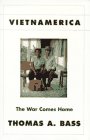
Thomas A. Bass. Vietnamerica: The War Comes Home. New York: Soho Press, 1996. 278 pp. $25.00 (cloth), ISBN 978-1-56947-050-3.
Reviewed by David Eyman (Skidmore College)
Published on H-War (October, 1996)
In any war there are victims of many stripes: those who were killed or wounded as combatants or non-combatants. Those displaced by the war and forced to find new homes and, sometimes, new occupations. Those who survived the conflict but suffer, years after the events survived, from post-traumatic stress syndrome. Thomas Bass has written a book about victims of another sort: the Amerasian offspring of American military personnel and Vietnamese women.
The existence of Amerasians is not entirely a phenomenon of the Vietnam War. The author suggests that Amerasians appeared after Commodore Perry steamed into Tokyo Bay in 1853 and again after Admiral Dewey captured Manila. He notes, "The Philippine census of 1920 counted eighteen thousand Amerasians in Manila alone" (p. 121). The Amerasians in Vietnam, however, came to haunt an American public already torn by conflicting feelings over the results of America's participation in the Vietnam War, especially when pictures of Amerasian children with distinctly Western features began appearing in various media in the United States.
The problems of Amerasians in Vietnam in the years immediately following the United States' departure from that country were many. They were often rejected by Vietnamese, many of whom considered them foreigners because of their parentage. They were likewise rejected by the United States, which officially considered them Vietnamese because of the country of their birth. Caught in the middle, many Amerasians lived drab, frightening lives at the lower levels of Vietnamese society.
In 1980 a number of countries, working with the United Nations, created the Orderly Departure Program, largely to deal with the Vietnamese boat people who were attempting to flee Vietnam under Communist rule. Some Amerasians managed to leave under this program, but most of the approximately 20,000 Amerasians who were to come to the United States would arrive after 1988 when the Amerasian Homecoming Act was put into effect. Teenagers or older by then, the Amerasians had to pass through the bureaucracy in Vietnam, frequently bringing with them other Vietnamese who were posing as relatives, then often through the squalor of the Philippine refugee camps, and thence to an American society that proved less than welcoming in many instances. Centers to assist with language instruction, job training, housing and the like were set up across the United States. Bass looks closely at the center set up in Utica, a city in upstate New York which had seen better days, while a thousand Amerasians and their families, real or imagined, are resettled there to work at finding new lives. The situation Bass sees is far from perfect.
In this volume the author has provided the reader with a disturbing, sobering look at a few Amerasians as they attempt to leave Vietnam to find lives in the United States. An author, but not a historian, Bass writes of first-hand experiences, of Saigon and Amerasians in a park in front of Saigon's Presidential Palace or at the Amerasian Transit Center, of the Philippine Refugee Processing Center, and of Utica in upstate New York with its Mohawk Valley Resource Center for Refugees and the short-lived Welcome Home House. From his experiences emerges a picture of despair only occasionally relieved by incidents of happiness or success in finding long-lost fathers. Is this an accurate picture? Perhaps. The reader steeped in history longs for sources, for footnotes, for a bibliography. These standard trappings of the scholarly work do not appear in this book. There is no reason to doubt that the experiences of Bass are presented accurately. But what of the experiences of the Amerasians, presented as second-hand accounts? Bass himself wonders about this after discovering the untruth of what he had been told by one of the Amerasians, writing,
I am being introduced to the circularity of Vietnamese discourse, in which truth is neither singular nor evident. In fact, many of the stories in this book may be untrue. The pain behind them, on the other hand, is real (p. 145).
The presentation of that pain, of the Amerasians' plight regardless of how accurate or precise the details, comprises the real value of this book. That plight may be considered another of America's problems from the Vietnam War. This is a valuable addition to the growing body of literature about the American involvement in Vietnam. It is well worth reading.
Copyright (c) 1996 by H-Net, all rights reserved. This work may be copied for non-profit educational use if proper credit is given to the author and the list. For other permission, please contact H-Net@h-net.msu.edu.
If there is additional discussion of this review, you may access it through the network, at: https://networks.h-net.org/h-war.
Citation:
David Eyman. Review of Bass, Thomas A., Vietnamerica: The War Comes Home.
H-War, H-Net Reviews.
October, 1996.
URL: http://www.h-net.org/reviews/showrev.php?id=652
Copyright © 1996 by H-Net, all rights reserved. H-Net permits the redistribution and reprinting of this work for nonprofit, educational purposes, with full and accurate attribution to the author, web location, date of publication, originating list, and H-Net: Humanities & Social Sciences Online. For any other proposed use, contact the Reviews editorial staff at hbooks@mail.h-net.org.

