



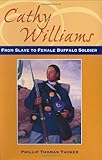
Phillip Thomas Tucker. Cathy Williams: From Slave to Female Buffalo Soldier. Mechanicsburg: Stackpole Books, 2002. vii + 258 pp. $26.95 (cloth), ISBN 978-0-8117-0340-6.
Reviewed by Sarah Janda (Department of History and Government, Cameron University)
Published on H-Minerva (May, 2002)
Mythologizing Cathy Williams
Mythologizing Cathy Williams
The story of Cathy Williams begins with the assertion that she was a remarkable woman who defied all odds to become a Buffalo Soldier and an independent woman. Tucker attempts to describe the culture from which her African ancestors likely came. He then discusses the nature of slavery and slave experience in order to provide a context for understanding Williams' experience. Essentially, Williams' story is that she was a slave in Missouri until the Union army liberated her during the Civil War. Forced to go with the regiment that set her free, she worked as a laundress and cook for the duration of the war. After the war ended in 1865 she decided to disguise herself as a man and join the army as a means to provide a living for herself and to avoid being a burden to her family. Her disguise worked and she served for two years in Company A of the 38th U.S. Infantry until she got tired of the grueling task of soldering. She then feigned an illness, her sex was discovered, and she was discharged a year early. Despite the author's contention that Williams was something of a female Horatio Alger, this book engages in more myth-making than scholarship. Tucker purports to answer significant questions concerning Williams' life, her decision to disguise herself as a man and join the army, and to connect her story with larger issues pertaining to military, African American, and women's history. Despite these ambitious goals, the book falls short across the board.
The use of sources and sheer conjecture are the most troubling aspects of this work. Most of the sources are secondary monographs which only loosely relate to the topic, and aside from an 1876 newspaper interview with Cathy Williams and her service records there appear to be no other primary sources which relate directly to her life. The full interview with Williams is contained in an appendix (one and a half pages in length) at the back of the book and is quoted from often in the text. Frequently, the author explains something and adds "In her [Cathy Williams] own words..." and then offers a direct quote from the same newspaper interview which only restates the initial observation. While it is commendable that in the absence of primary sources the author attempted to give a sense of what Williams' experiences may have been like, Tucker often slips into unwarranted conjecture. Granted, a fine line exists between a plausible likelihood and outright fiction, but it is a line repeatedly crossed in this work. For instance, the only reason Cathy Williams gave for wanting out of the army early was that she was tired of military service. However, that did not stop Tucker from suggesting that "a variety of factors had combined to sour her opinion of military life" (p. 179). He then goes on the relate a number of reasons for which he offers absolutely no proof, such as disillusionment with the racism, isolation, poor quality of life, thankless duty, lack of opportunity for advancement, health problems, etc. To be fair, Tucker largely tries to cover himself in most places throughout the book by using words such as "likely", "perhaps", "may have", "possibly" rather than stating outright that Williams did something or felt a certain way. Still, he paints an unsubstantiated picture by speculating that she "likely" felt bad about the army's treatment of Native Americans, that she "may have" joined the army out of gratitude for her freedom, and that she was "probably" involved in an uprising in her regiment regarding the unfair treatment of a camp follower. There is simply no evidence to support any of these and dozens more "possibilities" put forth in this book.
No less troubling is the thesis which remains clear but unsubstantiated throughout: Cathy Williams was a remarkable woman who succeed and triumphed against all the odds. In actuality, hundreds of women disguised themselves as men and successfully served in the military, many seeing actual combat, but Tucker fails to demonstrate what was so noteworthy about this one woman who pretended to be sick in order to avoid service she herself willingly entered. Despite his contention that Williams should serve as an inspiration for all Americans and that she was a trailblazer for women who later served in the military, the sources do not bear this out. Given the tactics employed by Williams to secure her discharge, her story lends more credibility to critics of women in the armed forces than as an inspiration to women in the military today.
In conclusion, given the paucity of sources, the story of Cathy Williams seems more suitable to an article or a book targeted at young adults. Whatever the case, it does not merit a scholarly monograph, a fact which the author and the editors of Stackpole Press should have recognized.
If there is additional discussion of this review, you may access it through the network, at: https://networks.h-net.org/h-minerva.
Citation:
Sarah Janda. Review of Tucker, Phillip Thomas, Cathy Williams: From Slave to Female Buffalo Soldier.
H-Minerva, H-Net Reviews.
May, 2002.
URL: http://www.h-net.org/reviews/showrev.php?id=6327
Copyright © 2002 by H-Net, all rights reserved. H-Net permits the redistribution and reprinting of this work for nonprofit, educational purposes, with full and accurate attribution to the author, web location, date of publication, originating list, and H-Net: Humanities & Social Sciences Online. For any other proposed use, contact the Reviews editorial staff at hbooks@mail.h-net.org.

