



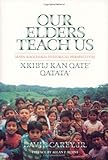
David Carey, Jr. Our Elders Teach Us: Maya-Kaqchikel Historical Perspectives: Xkib'ij Kan Qate' Qatata'. Contemporary American Indian Studies. Tuscaloosa: University of Alabama Press, 2002. xv + 385 pp. $29.95 (paper), ISBN 978-0-8173-1119-3.
Reviewed by Marc Becker (Division of Social Studies, Truman State University)
Published on H-LatAm (April, 2002)
The Maya-Kaqchikel and Guatemalan History
The Maya-Kaqchikel and Guatemalan History
This book, a revision of Carey's dissertation in Latin American Studies at Tulane University, attempts to combine the methodologies of anthropology and history in order to present Guatemala's history from the perspective of the Maya-Kaqchikel people. Based on 414 interviews, Carey seeks to provide "a forum for contemporary Maya to share what is important to them" and for them "to be participants, not simply subjects, in Guatemala's written history" (p. 23). The book, however, falls somewhat short of a "people's history" of Guatemala told from a subaltern perspective.
Carey is to be commended for learning Kaqchikel and conducting most of his interviews in this language (something that would be good for more researchers to do). Carey pretends "to be a conduit of history-simply observing, listening, not reacting" (p. 16). At the beginning of the book, Carey claims that "there is no monolithic, united Kaqchikel oral tradition or oral history" (p. 31). But by the end, he presents broad generalizations with little supporting evidence that has the Kaqchikel speaking in uniform, monotone voices with throw-away comments (for example, "Kaqchikel understand that politics is about trade-offs," (p. 244). Most historians have long since discarded the idea of an objective retelling of historical events, and despite Carey's stated intentions the book does present interpretations. A problem with purporting to present a historical narrative in this fashion is that it is difficult to tell when we are hearing Carey's voice, when we are hearing that of the Maya-Kaqchikel, and how much of the Maya-Kaqchikel voice that we do hear has been filtered through Carey's ideological lens.
By the end of this lengthy book (which could have been more tightly edited and more clearly organized), we do come to understand Carey's views on Guatemalan history. Justo Rufino Barrios and Jorge Ubico were the best leaders that Guatemala ever had. Although abusive, these leaders brought order to Guatemala. Carey attacks Carol Smith who criticizes Barrios for his attacks on Maya land holding (p. 268). Instead, Carey presents "the military as the only Ladino institution that mitigated the effects of racism" (p. 263). Such a defense of an institution which is guilty of genocidal actions against the Maya Indians may lead many readers to bristle. "We need a dictator like Ubico today," Carey quotes one informant as saying. Juan Jose Arevalo was a worse president because freedom and democracy lead to laziness which leads to disorder (p. 227). Jacobo Arbenz is the worst president that Guatemala has ever had because he tried to take land away from Ladinos and give it to the Maya Indians. Carey retraces the old and tired Cold War argument that Arbenz was a communist and that therefore it was a Good Thing that Carlos Castillo Armas overthrew him. Messy little details like the CIA's intervention on behalf of the United Fruit Company are almost completely excluded. For reasons that are unclear and unconvincing, Carey excludes post-1954 historical developments in this book. The odd omission leaves a huge conceptual hole in this volume.
Much of the book is based on interviews which seem to do little more than reflect dominant paradigms. This discourse desperately needs deeper analysis and events need to be placed in a broader context. For example, Carey has the Argentine Ernesto Guevara arriving in Guatemala in 1953 as a Cuban exile (p. 100), even though Guevara only joined forces with the Cuban exiles after he escaped from Guatemala to Mexico in the aftermath of the 1954 coup. More fundamentally, Carey misses Guatemala's influence on Guevara's ideology and the Cuban revolution. Guevara was distressed that Arbenz did not trust the peasants and workers in Guatemala to defend the revolution, and this influenced the direction that the Cuban revolution subsequently would take. The lack of a global context is even more evident is a subsequent discussion of the use of chemicals in agriculture without understanding how this has led farmers into dependency on multinational corporations which has resulted in the undermining of local autonomy. Tying the stories of the Maya-Kaqchikel to issues of global significance would have made for a much more interesting and significant book.
Kaqchikel scholars will want to read this book because there are some interesting details buried in this lengthy book. Carey's writing is accessible, but the book's organization along thematic lines akin to Carey's reading of Kaqchikel cosmology leads to a framework that may be very confusing for many undergraduate students to follow. Unfortunately, the book does not make broad enough theoretical contributions to studies of ethnic relations to interest most Latin American scholars, who would probably instead want to read Diane Nelson, Greg Grandin, and Kay Warren's recent works on the Maya in Guatemala.
If there is additional discussion of this review, you may access it through the network, at: https://networks.h-net.org/h-latam.
Citation:
Marc Becker. Review of Carey, David, Jr., Our Elders Teach Us: Maya-Kaqchikel Historical Perspectives: Xkib'ij Kan Qate' Qatata'.
H-LatAm, H-Net Reviews.
April, 2002.
URL: http://www.h-net.org/reviews/showrev.php?id=6219
Copyright © 2002 by H-Net, all rights reserved. H-Net permits the redistribution and reprinting of this work for nonprofit, educational purposes, with full and accurate attribution to the author, web location, date of publication, originating list, and H-Net: Humanities & Social Sciences Online. For any other proposed use, contact the Reviews editorial staff at hbooks@mail.h-net.org.

