



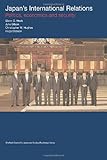
Glenn Hook, Julie Gilson, Christopher W. Hughes, Hugo Dobson. Japan's International Relations: Politics, Economics, and Security. London and New York: Routledge, 2001. xxxvi + 532 pp. $49.95 (paper), ISBN 978-0-415-24098-7; $220.00 (library), ISBN 978-0-415-24097-0.
Reviewed by George Ehrhardt (Department of Political Science, Indiana University)
Published on H-US-Japan (April, 2002)
When I left for Japan to study foreign policy two years ago, one of my professors asked "Why? What is there to study in Japan?" This book goes a long way to answering that question. In their goal of presenting a comprehensive overview of Japan's international relations, the authors have succeeded admirably. This is a wide-ranging book, covering Japan's relationships with the United States, East Asia, Western Europe, and a set of international institutions. Each relationship is further broken down into three issue areas--political, security, and economic.
Chapters 4 (politics), 5 (economics), and 6 (security) cover the Nichibei (US-Japan) relationship.[1] Politically, the Occupation gave the United States an opportunity to reshape Japan and the experience has given the US unparalleled influence over Japanese politics and society. The norm of cooperation with the US (what the authors call "bi-lateralism") is the dominant theme in Japanese foreign policy. The authors are careful to emphasize that Japan has not been entirely passive, however, and they discuss its opposition to the Vietnam War and Prime Minister Kakuei Tanaka's independent moves in the early 1970s (following on those of Hatoyama and Ishibashi in the 1950s).
They phrase their discussion of the security relationship in terms of a conflict between domestic norms (anti-militarization) and US pressure (bi-lateralism). The history of US-Japan political consultation since the end of WWII (where this book starts) is a constant stream of US requests for Japan to re-militarize and buy US weapon systems, which Japan has systematically resisted. Much of their discussion is of how this conflict played out in the Japanese policy apparatus, which is an interesting story.[2] Unfortunately, the book was unable to cover the growing movement toward acceptance of a military role that Prime Minister Koizumi and the 9.11 terrorist attacks have caused in the past year. Koizumi has frankly and publicly called the US-Japan relationship an alliance and the JSDF an "army" (guntai)--both terms were formerly avoided by the government.[3] A March 2002 poll found that more than 70% of Diet members and 60% of the population favored constitutional revision to allow Japan's participation in collective security.
In Chapter 5, they discuss the rise of Japan as an dominant economy and the trade conflicts it caused. US pressure on Japan to correct the trade imbalance first boiled over with the 1971 Textile Wrangle, where American negotiators learned how hard it would be to twist Japanese arms over trade when the Japanese negotiators were unable to convince domestic economic policy-makers to accept a deal, and continued with the fights over cars in the 1980s and semiconductors in the 1990s. Fitting their theme of Japanese independence, the authors play up the Japanese refusal to accept numerical targets for trade in the 1990s.
While the authors limited their discussion to Japan's relationship with the United States, it would have been nice to see chapters on Japan's relationships with other American countries--especially Brazil and Peru. The large population of Japanese immigrants in these countries (such as the parents of former Peruvian president Alberto Fujimori) makes their situation worth watching. As the population of Japan declines and the need for foreign labor increases, these countries may play an increasing role in Japanese foreign relations.
The section on Japan's relationship with East Asia (Chapters 9, 10, and 11) is at times provocative. The authors start with the argument that Japan's former inability to heal the wounds of WWII and create strong and amicable bonds with China and South Korea was indirectly caused by the United States. Since Japan was prevented by SCAP and later American pressure from independently participating in the de-colonization process, it was unable to deal with its history in the way the European powers were.
In the authors' view, Japan has worked hard and largely succeeded in overcoming this handicap. Japan normalized relations with Mainland China five years before the United States, and continues to be a leader in engaging Beijing. During the Kim Dae-Jung Administration in Seoul, Japanese-South Korean relations have improved as well, after remaining at arms-length distance for the first 50 years.[4] Nevertheless, the authors overstate their case when they say that Japan "....has returned to a central, and possibly dominant, position within the East Asia region as a political, economic, and security player and organizer" (p.15). They are unable to show any concrete signs that China or South Korea are ready to accept a Japanese role in regional security issues other than pointing out that Japanese are being invited to region-wide meetings such as the ARF or ASEAN+3.
In chapter 10, The description of how economic relations between Japan and Asia evolved after the war is a good one, and the detailed coverage of Japan's role in the Asian Financial Crisis very useful. Chapter 10 starts with a discussion of the role of Japanese ODA in economic relations, showing how the Japanese government structured its development assistance to aid the penetration of local economies by Japanese firms. They show how Japan-Southeast Asia trade is still asymmetrical, with Japan selling manufactured goods but only buying raw materials in return. For the NICs, they note, the engine of growth is still the United States, not Japan.
The one exception to this is China. While this issue is not discussed in the book, over the past few years imports of manufactured goods from the Mainland have soared, driving down domestic prices in Japan and forcing entire industries into bankruptcy.[5] Japan is currently undergoing a similar process to what the United States experienced in the 1970s and 1980s, as manufacturing jobs move abroad in search of cheaper labor. How Japan deals with this transition from a manufacturing economy to a knowledge economy will have important ramifications for many years to come.
According to the authors, the Asian Financial Crisis was largely the fault of Japan. As the Japanese recession dragged on in the 1990s, imports from Southeast Asia fell, causing them balance of payments troubles. To compound the problem, FDI from Japan also fell. This double financial punch was too much for these still-fragile economies (presumably China was fine because it was successfully exporting to Japan as well as the United States). The story gets interesting when the authors discuss Japan's efforts to resolve the crisis. the Japanese government initially tried to create an Asian Monetary Fund (AMF) to distribute funds to help countries overcome the crisis, but was stymied by the United States, who feared a dilution of its control over international finance. This AMF story is often cited in other places in the book as evidence of Japanese independence from the US. Following that failure, Prime Minister Miyazawa enacted a plan in 1998 (while the US was busy with Latin American financial issues) to provide cash to the region to reinvigorate trade. The authors are careful to mention, however, that the Japanese government did not consider making the fundamental reforms necessary to address either cause of the Crisis itself.
The chapters on Japan's interaction with Europe are particularly valuable. Recent signs of Japanese-European cooperation to limit "unilateralist" American policies (such as the abandonment of the Kyoto Protocol) suggest that the relationship is worthy of close inspection. The book describes the gradual growth of contact between Japan and Europe, particularly in the economic sphere. This includes the development of institutionalized communication between the Japan and Europe at fora such as the Asia-Europe Meeting (ASEM). These meetings are valuable because they provide the two sides a chance to develop joint interests in the absence of the United States. While Japan-European contacts have largely escaped American notice, the authors point out that the third side of the Japan-US-EC triangle is starting to become a reality.
In chapter 15, the authors argue that Japanese economic penetration into Europe in the 1980s and 1990s has given Japan political influence on the continent. In particular, the authors note, the Euro issue has been highly salient for Japanese firms and they have pressured the UK government to clarify its stance on the Euro issue so as not to lose Japanese FDI. This penetration has not been smooth, however, and much of the discussion is on the roles of MITI and Japanese industry associations in setting voluntary limits on exports to Europe to avoid trade conflicts.
In the security field, the authors argue that Japanese-European relations have enabled Japan to push its anti-militaristic norms on the world stage--unlike in relations with the United States. In Kosovo, for example, Japan made clear that its contributions would be channeled through multilateral organizations such as the UN and that it would focus on peaceful post-crisis civilian needs rather than on supporting NATO airstrikes. Japan also was active in mediation with the Russian government. Japan and Europe have been able to work together to push for shared agendas in non-proliferation, regional stability and the peaceful resolution of conflict.
I was surprised, however, by the lack of attention paid to Russo-Japanese relations. Of all the European nations, Russia--Japan's closest neighbor--has always had the biggest presence in Japanese minds(usually as an enemy). Japanese language foreign policy textbooks tend to carefully explain the controversy over the Northern Territory issue (4 islands off Hokkaido occupied by Russia over which Japan claims sovereignty), and spend time on the efforts by Prime Ministers Hatoyama and Tanaka to resolve the question.[6]
The final empirical section of the book is on Japan's interactions with the United Nations and other international institutions. This too is valuable because unlike the US, Japan has tried hard to work out its foreign policy goals in the context of international organizations.
The United Nations has a special place in Japanese policy, and appropriately, the authors devote a whole chapter to it. While the authors provide a good description of Japan's efforts to win a permanent seat on the Security Council, the most interesting aspect of the UN is its role as a safe place for Japanese foreign policy to "go public." Even during the Cold War, Japan tried to make the United Nations a place for countries to work out their differences peacefully. In the 1970s, as America began to turn away from the United Nations, Japan disagreed, remaining a member and continuing to heavily fund UN activities. In spite of declining anti-militarism in Japan, or perhaps because of it, the security role of the United Nations is growing in Japanese minds. The UN has provided a context in which JSDF personnel have been sent abroad, beginning in 1993 in Cambodia. This gave Japan an opportunity to show that the JSDF could play a constructive role in promoting regional stability. While public opposition remains, the government has grown more willing to send JSDF units abroad--within the context of UN-sponsored action--including a recent decision to send a contingent to East Timor. During the war in Afghanistan, Japanese public opinion remained insistent that Japanese support for American retaliation should only occur if in support of a UN Security Council Resolution.
The chapters on Japan's growing role in international institutions (particularly economic ones) should be eye-opening to any who discount Japanese foreign policy as merely an extension of American influence. They document numerous cases in which Japan has pursued policies in the WTO and IMF which ran counter to American preferences. These chapters are an important part of the authors' case that Japan is an important actor on the global scene. Indeed, Japan's initiatives in promoting the East Asian Economic Conference (EAEC), the Asian Monetary Fund (AMF), and its role in serving as an Asian voice in the G7/8 have not been fully appreciated in America. For example, the authors describe how Japan was instrumental in pulling the G7 countries back into engaging China after the Tiananmen Square killings. Their argument that Japan's "quiet" (i.e. low-key, low-risk) diplomacy has not been adequately recognized is a strong one.
This book shines in its role as a reference work. For scholars, the extensive citations make it useful as a literature review for the many debates on Japan's place in the world. Unfortunately its suitability as an undergraduate textbook, however, is marred by language such as "Japanese policy-making agents and other political actors insturmentalize Japan's international relations by means of a range of power resources in terms of a specific temporal dimension, channel for insturmentalization and level of activity" (p.71). For those able to forge through the dense writing, its breadth of coverage and extensive documentation make it an excellent choice to keep nearby when doing research or preparing for class. To increase the usefulness of this volume as a reference work, the authors have included almost 150 pages of appendixes, including timelines, tables, and diplomatic documents [7].
Notes
[1]. Another overview of this relationship can be found in Walter Lafeber, The Clash: U.S.-Japanese relations throughout History (W.W. Norton and Co., 1997).
[2]. Youichi Funabashi, Alliance Adrift (Council for Foreign Relations Press, 1999); Hidetoshi Sotooka, Masaru Honda and Toshiaki Miura, 50 years of the U.S. Japan Alliance: Security and Secrets [nichibeidoumeihanseki: anpo to himitsu] (Asahi Shinbun Press, 2001).
[3]. He called the JSDF an "army" during speeches in his campaign for the LDP Presidency in March of 2001.
[4]. See Victor Cha, Alignment Despite Antagonism (Stanford University Press, 1999).
[5]. In Japan it is common for small towns/cities to be dominated by a single industrial sector (made up of many small firms). I have seen towns whose whole economy is being destroyed by competition from China, where factories are closing and unemployment skyrocketing.
[6]. For a comprehensive look at Japanese diplomacy suitable for the English-language undergraduate market, see Makoto Iokibe, The History of Postwar Japanese Foreign Policy [Sengou Nihon no Gaikoushi] (Yuuhikaku, currently in translation). Also see (in Japanese) Akio Watanabe, Japan's Foreign Policy [Nihon no Gaikou] (Tokyo University Press, 1989).
[7]. One final note: The cover photo for this book is a strange choice. It features full-figured Japanese Prime Minister Yoshiro Mori alongside the other G8 leaders at the 2000 summit in Okinawa, offering a rare visual image of Japan standing among the other industrialized nations without being physically dwarfed. Since asserting the growing size of Japan's role in world politics is one of the authors' main goals, this image may have seemed appropriate. Inside Japan, however, Mori is best known for his inept handling of foreign policy issues--so bad that his own backers were forced to remove him from office after the Ehime Maru incident in early 2001. Japan was also mocked by the other G7 for the astronomical cost of the Okinawa Summit--some of which was siphoned off by the Foreign Ministry itself in a systematic Ministry-wide embezzlement scheme. Is this really the image of Japan the authors wish to present?
If there is additional discussion of this review, you may access it through the network, at: https://networks.h-net.org/h-us-japan.
Citation:
George Ehrhardt. Review of Hook, Glenn; Gilson, Julie; Hughes, Christopher W.; Dobson, Hugo, Japan's International Relations: Politics, Economics, and Security.
H-US-Japan, H-Net Reviews.
April, 2002.
URL: http://www.h-net.org/reviews/showrev.php?id=6175
Copyright © 2002 by H-Net, all rights reserved. H-Net permits the redistribution and reprinting of this work for nonprofit, educational purposes, with full and accurate attribution to the author, web location, date of publication, originating list, and H-Net: Humanities & Social Sciences Online. For any other proposed use, contact the Reviews editorial staff at hbooks@mail.h-net.org.

