



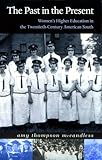
Amy Thompson McCandless. The Past in the Present: Women's Higher Education in the Twentieth-Century American South. Tuscaloosa and London: University of Alabama Press, 1999. x + 389 pp. $49.95 (cloth), ISBN 978-0-8173-0994-7.
Reviewed by Jennifer D. McDaid (Archives Research Services Department, Library of Virginia)
Published on H-SAWH (January, 2002)
Well-Read and Well-Mannered
Well-Read and Well-Mannered
"My oldest girl took to education like a duck takes to water," James Perdue explained to an interviewer for the Virginia Writers' Project in 1939. After finishing high school, Miss Perdue attended Radford State Teachers College and found work in a Franklin County, Virginia, school. Her sister was "likely to go to teachin' too," James Perdue explained, since "it's as good as anyone'd want his daughter to do." While he approved of women working as teachers, Perdue frowned on the new fashions he saw in nearby Roanoke, including high-heeled sandals, red lipstick, and pants. "Of course they're callin' them new names--slacks, I think it is--an' they come in fancy colors," he sighed, "but they ain't nothin' but pants." Like most Southerners, Perdue thought women would benefit from an education, but he firmly believed that only certain professions (and certain behaviors) were appropriate. Women might be well-read, but they should also be well-mannered.[1]
In The Past in the Present, Amy Thompson McCandless has written the first comprehensive history of women's higher education in the twentieth-century South. Using a rich array of school catalogs, oral histories, and other contemporary sources mined from college archives across the region, she deftly describes the experiences of black and white women, and examines how the educational experiences of Southern women in public and private institutions differed from the experiences of their sisters nationwide. Southern students, according to McCandless, have been more Protestant, more rural, more conservative, and less affluent than students in other regions. Economic, social, political, and cultural forces at work in the South combined to shape a distinctive academic atmosphere for women. Certain types of institutions--such as all-black colleges, public women's colleges, and separate agricultural colleges--were more prevalent in the South than in the rest of the country. Campus life at Southern colleges was markedly different, in McCandless's view, because Southern life was different.
McCandless begins by describing the status of Southern women's education at the turn of the century, when an agrarian economy and traditional views of gender, class, and race set Southern education apart. Southern women had limited scholastic opportunities in comparison to those enjoyed by female students in other parts of the country (and, of course, in comparison to those available to Southern men). By 1900, seventy-one percent of the nation's colleges--but only six Southern state universities--were coeducational. Resistance to coeducation and coordinate education was fierce in the South. McCandless traces Mary-Cooke Branch Munford's lengthy--and ultimately unsuccessful--fight to create a coordinate college for women at the University of Virginia early in the century. Opponents saw no difference between women on a nearby campus (sharing the University's library and teaching staff) and women on the campus, and they firmly believed that female students would distract men from their studies, lower academic standards, and sully college traditions. As a result, Virginia's General Assembly defeated a bill proposing a coordinate college in Charlottesville every biennium from 1910 to 1920. (For a time, Virginia was the only Southern state without a publicly supported liberal arts college for women.)
Advocates of equal education in the South did enjoy some victories. The College of William and Mary in Virginia became coeducational in 1918 (but charged women higher tuition fees), and the University of Virginia opened its graduate and professional programs to female students in 1920. The stubborn Southern opposition to coeducation still lingers, McCandless argues, as evidenced in the controversial attempts to admit women to the Citadel in South Carolina and Virginia Military Institute. Both finally submitted to court-mandated coeducation, the Citadel in 1996 and VMI in 1997.
McCandless describes the distinctive "'twoness' of Southern character, place, and time" that shaped the course of women's higher education in the twentieth century (p. 17). Southern women were "simultaneously American and Southern, Southern and female, female and black/white, and black/white and upper/middle/lower class" (p. 281). Those with the means to pay tuition could pursue higher education, as long as they adhered to the ideal of the genteel Southern lady. Rules at black and white colleges emphasized manners and deportment, requiring students to attend chapel, dress properly, and shun any appearance of impropriety. Parents, administrators, and teachers of female students viewed decorum and obedience as more important than independence and scholarly achievement.
While Southern institutions strictly monitored behavior, they only slowly revised the classical curriculum and raised graduation standards. Textbooks failed to include references to women and their accomplishments, and professors North and South often taught political science courses with little regard for the Nineteenth Amendment. "Women have had the suffrage for ten years," the president of Connecticut College wrote in 1930, "but I do not believe that the colleges as a whole have quite grasped that fact" (p. 77). Preserving traditional views of sex and race, McCandless points out, was "vital to preserving the twentieth-century hegemony of the white, upper-class man" (p. 156). As late as 1964, women at Auburn University in Alabama received a list of "What to Wear When"--dresses or skirts for class, with gloves for football games and heels for Sunday dinner. Women could not wear blue jeans or chew gum in public; during campus demonstrations, female students were expected to retreat to their dormitories and close the blinds. Not all students dutifully followed this "prescribed path to ladyhood," and some openly challenged the social restrictions imposed by administrators (p. 148). In 1934, the freshman class at Hollins College in Virginia successfully petitioned the dean of students for permission to wear bobby socks (instead of stockings) to class; other students fought for the right to smoke, drink, and date.
Although the traditional views preserved in Southern colleges cast women in a supporting role in society, they also helped to forge a sense of sisterhood and security. These unique circumstances prepared women to work together in clubs and organizations, where they worked effectively to change society and challenge the status quo. Ultimately, paternalism fostered social consciousness and community activism among women.
While the educational opportunities available to women were limited on the basis of gender, they were further limited on the basis of race and class. Administrators and legislators who opposed coeducation also objected to integration, as did the majority of white students at institutions in the Deep South. Black women overcame daunting economic, political, and social obstacles to acquire a higher education. Throughout her book, McCandless interweaves their story with that of their white counterparts, constructing a thoughtful, comprehensive narrative.
The Past in the Present makes a significant contribution to the complex history of women in the twentieth-century South. McCandless's informative survey places women in a broad context, but also provides intimate portraits of their experiences, largely through striking oral histories that give voice to their struggles and accomplishments. Bolstered by primary source research, interviews, and a survey of college Web sites, Amy Thompson McCandless has written a much-needed study of women's educational opportunities and the challenges that accompanied them.
Note
[1]. James Perdue interview (1939), "WPA Life Histories, Virginia Writers' Project," Library of Virginia.
If there is additional discussion of this review, you may access it through the network, at: https://networks.h-net.org/h-sawh.
Citation:
Jennifer D. McDaid. Review of McCandless, Amy Thompson, The Past in the Present: Women's Higher Education in the Twentieth-Century American South.
H-SAWH, H-Net Reviews.
January, 2002.
URL: http://www.h-net.org/reviews/showrev.php?id=5836
Copyright © 2002 by H-Net, all rights reserved. H-Net permits the redistribution and reprinting of this work for nonprofit, educational purposes, with full and accurate attribution to the author, web location, date of publication, originating list, and H-Net: Humanities & Social Sciences Online. For any other proposed use, contact the Reviews editorial staff at hbooks@mail.h-net.org.

