



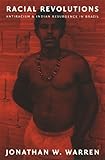
Jonathan W. Warren. Racial Revolutions: Antiracism and Indian Resurgence in Brazil. Durham and London: Duke University Press, 2001. 392 pp. $64.95 (cloth), ISBN 978-0-8223-2741-7.
Reviewed by Seth Garfield (Department of History, University of Texas at Austin)
Published on H-LatAm (January, 2002)
In the last several decades, the Brazilian Indian population has witnessed a dramatic upsurge. Whereas between 1900 and 1957 the indigenous population plummeted from 1 million to less than 200,000, official estimates in 1995 enumerated 325,000 Indians. This indigenous resurgence has been particularly remarkable in eastern Brazil where the indigenous population, after centuries of Luso-Brazilian colonization, was long considered extinct, and the non-white population categorized as pardos, mestios, or caboclos. Jonathan Warren joins up with a growing team of Brazilian scholars, led by Joao Pacheco de Oliveira, who have sought to unravel the historical and cultural processes leading to the return of the native in eastern and northeastern Brazil. In his book, Warren revisits the process of racial formation and contemporary race-based political/cultural movements within Brazil.
In explaining the indigenous upsurge--which flies in the face of modernization theory, evolutionary anthropology, and the longstanding dream of Brazilian elites of biocultural "whitening"--Warren challenges the notion that such explosive growth can be attributed solely to demographic processes of birth, death, and, migration. Moreover, he rebuts the instrumentalist thesis held by many observers, which posits that these "posttraditional" Indians (to use Warren's term) are merely charlatans or "racial hucksters" who have conveniently remembered or fabricated their Indianness as a means of securing access to the land rights and state-backed assistance guaranteed by Brazilian law. In fact, in one of the book's most riveting sections, he lists the material costs of being Indian in Brazil: lower wages, limited employability, and restricted access to education.
While Warren recognizes that there are potential material gains and political bolsters associated with Indianness that may have provided added allure to socioeconomically marginal populations, he correctly insists that a more satisfying explanation must take into account how racial identity shifts have been shaped as well by non-material forces in Brazil and worldwide. Only broad cultural, political, and attitudinal changes could fully explain the resoluteness of his informants who have faced violence, intimidation, and ridicule in asserting an indigenous identity that departs from and confronts popular, stereotyped notions of Indianness in Brazil.
After documenting centuries of violence, exploitation, and forced assimilation perpetrated by state, church, and colonists toward eastern Indians, Warren convincingly identifies several sweeping changes that have contributed to what he dubs the process of "Indianning" in Brazil. At the state level, he hails the demise of an integrationist policy and the constitutional recognition of multiculturalism (in the aftermath of international denunciations of genocide and the subsequent return to democratic rule), as well as the postauthoritarian state's increased vigilance in defending indigenous rights. At the nongovernmental level, Warren credits the actions of NGOs and, primarily, the liberationist wing of the Catholic Church in Brazil, whose indigenous advocacy group, Indigenous Missionary Council (CIMI), has been at the forefront in defending and organizing indigenous communities since the 1970s in their struggle for land, resources, and cultural respect. (Although, in lauding the emergence of CIMI, Warren curiously does not discuss the impact of the anti-missionary resolutions of the Barbados Convention in 1971 on the formation of CIMI, nor does he problematize, as other Brazilian scholars have, the underlying politics of a church-based organization.) Moreover, he traces shifting conceptions of ethnicity among anthropologists, whose litmus test no longer rides on markings of cultural persistence, but on the mere maintenance of a boundary of social difference. Since anthropologists have served under Brazil's National Indian Foundation (FUNAI) as the arbiters of indigenous authenticity, such ethnic redefinitions have allowed for a more encompassing classification of Indians.
Warren finds that as a result of such transformations, scores of one-time "mestizos" are less afraid or ashamed to affirm an Indian identity. The absence or incompleteness of traditional tribal practices, once (and still) used to affirm a non-Indian, mestio, or caboclo identity, is now openly denounced by these interlocutors as the product of colonialism and racism; in fact this lack is reconceptualized as an integral part of what it means to be an eastern Indian in twentieth-century Brazil. In what is undoubtedly one of the book's greatest strengths, Warren's indigenous informants offer heartrending accounts of victimization as well as steadfast determination to combat racism and to take pride in their Indian identity. Based on these findings, he chides scholars of race in Brazil for focusing exclusively on blacks and ignoring Indians and the "deracialization" of power that their movements portend. For one, he critiques scholars of Afro-Brazil who assume that the 43 percent of the Brazilian population categorized as "pardo" are, in fact, black, raising the tantalizing possibility that many may come to identify themselves as Indian. But more immediately, Warren welcomes the "Indian-only" and "Indian-first" sensibilities and political agendas among his informants, which he has identified (in contrast to the more muted Afro-Brazilian subjectivities) as healthy challenges to "white supremacy" in Brazil.
Warren's study of indigenous racial formation, informed by critical race theory, helps to fill the enormous gap on indigenous peoples in Brazil and to explore indigenous identity within both comparative national and hemispheric perspective. Nevertheless, Warren's model, which foregrounds race as the determinative factor in the shaping of Brazilian power dynamics, political projects, and cultural norms (as well as the primary means of transforming them), does not fully account for the state policies, structural transformations, juridical underpinnings, and cultural ambiguities and contradictions that have historically defined and transformed the nature of Indianness. For example, in highlighting the anti-Indian record of the "exorcist" state from colonial times until its demise in the 1980s, Warren skirts the equally long (albeit less effective) history of protective legislation towards indigenous peoples since the seventeenth century, which has been detailed by Manuela Carneiro da Cunha. This protective legislation, or at least the struggle over its implementation, certainly adds a dimension to indigenous peoples' historical experience (nearly absent among Afro-Brazilian populations), and nuances the historic dynamics of white supremacy in Brazil. In this vein, Warren's inattentiveness to the history of tutela, or the system of state-mandated wardship of indigenous peoples, which existed for much of the twentieth century, is rather curious. The ambiguities surrounding tutela, which on the one hand granted indigenous people "special" government protection but, on the other, did so because of their purported incapacity in civil society, might have been further explored given its importance in shaping Indian-"white" relations and Indian subjectivities. While Warren does recognize the gains achieved by Indians under the Brazilian Constitution of 1988, he might have placed such advances within a broader legal history of indigenous rights.
Likewise, although Warren is correct in emphasizing the whitening, acculturationist agenda of government policy, he overlooks the ambiguities that historically rendered this project contradictory and fragmentary since the inception of the Indian Protection Service in 1910. Government officials were always confronted by a certain "imperialist nostalgia" in their efforts to "acculturate" Indians. The most extreme example, of course, was the creation of the Xingu Park in 1961 to protect Brazil's "primitive" populations. Yet a closer reading of state pronouncements and actions towards other indigenous groups shows a gnawing preoccupation with salvaging the "good" essence of Indianness (virtue, valor, dignity, quaint rituals, etc.), of consecrating some (often invented) aspect of Indianness (witness, for example, the "Day of the Indian," created by the Vargas regime in 1943), and celebrating the indigenous contribution to national character (which Warren appears to roundly dismiss). Among "posttraditional" eastern Indians, the government Indian bureau--whose legitimacy derived from its management of Indian and interethnic affairs--would be particularly pressed to avouch and to showcase the authenticity of its subjects. Thus, for example, archival research by Brazilian anthropologist Jose Mauricio Andion Arruti has uncovered the central role of Indian Protection Service officials in the 1930s and 1940 in encouraging, if not outright demanding, the performance of the "traditional" tore dance among northeastern Indians as a marker of indigenous authenticity. Warren, on the other hand, apparently sees the tore as an entirely self-generated contemporary expression of indigenous identity in challenging a white supremacist state (pp. 224-25). All this suggests an alternative reading in which the state historically played a more critical role in the formation, rather than merely the destruction, of indigenous identity. Indeed, Warren's own evidence implies the need for a broader and more nuanced perspective: while he marvels at a study showing that northeastern Brazil's indigenous population had jumped from an estimated 11 groups with 13,000 individuals in 1975 to 17 indigenous groups with a population of 17,000 in the mid-1980s, the relatively high numbers of the earlier estimate (documented under the heel of "exorcist" military rule and prior to the sweeping changes he identifies as the cause of resurgence) are suggestive of a longer and more complex history of Indian-state relations.
There is under the period of study a very important "structural revolution" in Brazil too, but it is rather lacking in Warren's analysis. As historic wards of the federal government in a nation highly segmented by regional and sectoral inequalities, Indian communities have not only been affected by shifting cultural currents (the emergence of "postexorcist" or "postsavage" mentalities) in twentieth-century Brazil; they have also been shaped by the process of state penetration into the countryside and its regulation of rural social relations (including the regularization of land titles and the promotion of indigenous community development projects)--a process which increased dramatically under military rule. And while the relatively stronger presence of the state in indigenous areas has far from yielded miraculous results, it has also contributed to increased ability to demarcate land and probably to improved health conditions among indigenous populations--which may be a larger factor in the resurgence of Indian communities in Brazil than the study suggests.
Warren's use of a racial prism to understand indigenous political mobilization and the larger course of Brazilian history offers much thought for further research and comparative study, yet it also leaves analytical gaps and interpretive pitfalls. On the microlevel, he asserts that the rural Indians are "all but excluded from the public and private sectors of the economy," (p. 123) which leaves the reader straining to comprehend their exact relationship to the market, their relative access to consumer goods, and their day-to-day routines. It is true that Warren is more concerned with the racial identity of his subjects, yet even here he appears to overstate their resistance to white ("branco") hegemony in his effort to prove that they follow and aspire to "the law of the Indian" rather than "the law of the white" in their self-definition as Indians. While he coins the term "posttraditional" for his informants, they in fact refer to themselves (pp. 23-24) as "mais civilizados," or "more civilized" (ostensibly than their Amazonian counterparts). Such pejorative notions indicate that the "law of the Indian" is far less impermeable to the "law of the white" and fundamentally challenges his primary conclusion that there is not "the slightest hint that they [his informants] have, at some level, internalized the derogatory imaginings of Indianness" (p. 278). Indeed, such divisions among indigenous peoples (among many others) have proved a tremendous barrier to effective pan-Indian organization in the Americas. Likewise, Warren's uncritical rendering of the anti-Indian goings-on of FUNAI obscures the fact (or at least the contradiction) that the Indian agency is in fact comprised of a very large percentage of indigenous employees.
Finally, although Warren celebrates the anti-"branco" affirmations of indigenous peoples as proof of "racial literacy" against "white supremacy," the evidence may not be as clear-cut: among many indigenous groups, the term "branco" is used as a catchall phrase to delimit non-Indians, rather than whites per se. Warren's rejoinder that discourses and other practices are rarely, if ever "race neutral," regardless of whether individuals appreciate this fact (p. 241), seems rather reductionist. Thus, while shedding light on Brazil's terrible social inequalities, Warren's dichotomous model glosses over important objective and subjective distinctions among indigenous groups in Brazil, as well as important overlaps between the "laws" and the "spaces" of Indian and white.
One of Warren's most intriguing points is that the "racial revolutions" he has studied may snowball as more mestio, peasant communities identify as Indians to gain the constitutional right to territory, thereby rectifying Brazil's skewed distribution of land. This scenario is appealing, but the implications of Indian resurgence (as envisioned by Warren) for larger, class-based movement for land reform in Brazil, such as the Movimento Sem Terra, are questionable. Will such "racial revolutions" restructure power dynamics in Brazil or will they limit the potential for multiracial class-based movements as elites exploit anti-Indian sentiment to divide subalterns? Will "posttraditional" indigenous communities, guarding their rights as Indians, abstain from or even oppose broader class-based social movements? Do the culturally essentialist notions of Indianness that Warren and some of his indigenous informants celebrate "forge a discursive world that usurped the symbolic capital of the noble savage while simultaneously avoid[ing] the discursive snare of inauthenticity"? (p. 198). Or do such essentialist notions serve as well to perpetuate and reinforce the racialist paradigms and culturally determinist ideas that pervade Brazilian society and that have historically been (and may continue to be) arrayed to blunt indigenous initiatives? These are only some of the important questions raised by Warren's innovative study, which promises to stir further discussion on racial identity and inequality in Brazil and comparative indigenous mobilization in the Americas.
If there is additional discussion of this review, you may access it through the network, at: https://networks.h-net.org/h-latam.
Citation:
Seth Garfield. Review of Warren, Jonathan W., Racial Revolutions: Antiracism and Indian Resurgence in Brazil.
H-LatAm, H-Net Reviews.
January, 2002.
URL: http://www.h-net.org/reviews/showrev.php?id=5830
Copyright © 2002 by H-Net, all rights reserved. H-Net permits the redistribution and reprinting of this work for nonprofit, educational purposes, with full and accurate attribution to the author, web location, date of publication, originating list, and H-Net: Humanities & Social Sciences Online. For any other proposed use, contact the Reviews editorial staff at hbooks@mail.h-net.org.

