



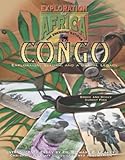
Bruce Durost-Fish, Becky Durost-Fish. Congo: Exploration, Reform, and a Brutal Legacy. Exploration of Africa. Philadelphia: Chelsea House Publishers, 2001. 144 pp. Ages 11 up. $29.95 (cloth), ISBN 978-0-7910-6198-5.
Reviewed by Richard A. Corby (School of Social and Behavioral Sciences, University of Arkansas at Monticello)
Published on H-AfrTeach (December, 2001)
Europeans in Central Africa
Europeans in Central Africa
Ten short chapters make up this book written for students in middle and high schools. The chapters feature such Westerners as Henry Morton Stanley, Leopold II of the Belgians, George Washington Williams, William Henry Sheppard, and Edmund Morel. One chapter does present the kingdom near the mouth of the Congo River called Kongo, which flourished 500 years ago, with some attention paid to indigenous life and institutions. Even here, though, the Portuguese intrusion and developing slave trade dominate the latter part of this account. The last chapter moves at breathtaking speed through rule by the Belgian government to 1960, and then independent Congo under Patrice Lumumba, Mobotu Sese Seko, and Laurent Kabila. Richard E. Leakey states in his foreword that it is important for writers about the continent to attempt an Afrocentric view as much as possible. Leakey continues, "The time has come to regard African history in terms of what has happened in Africa itself, rather than simply in terms of what non-African individuals did when they first traveled to the continent" (p. 13). If only the authors, Bruce and Becky Durost-Fish, had followed this sage advice!
This book is a reversion to past practices in that virtually every chapter features Westerners and their activities in central Africa. Westerners act upon Africans. The latter are mostly passive. In one of the few chapters in which Africans are featured, the authors focus on the Bambuti, whom the authors also call "Pygmies," one of the most atypical people on the continent. Pictures display such captions as, "Pygmy Men Holding Poison Arrows and Spears, 1934" (p. 58) and Pygmies with Poison Arrows, 1927" (p. 61). Africans are often portrayed as children, easily fooled by Europeans into doing the latter's bidding, as, for example on page 46 where Emil Torday, the Belgian traveler, in 1908 easily hoodwinked Bakongo leaders into providing men to serve as porters.
Most of the forty-seven pictures in the book come from the Royal Geographical Society Picture Library, most of them published here for the first time. The great majority date from the first two decades of the twentieth century. Some are fascinating, such as a young boy from 1908 standing by a railroad track (p. 82) and the view of a Congo River steamer in 1910 (p. 34). The overall effect, however, of pictures from these decades results in readers of this volume concluding that the people of Congo today live in simple, rural, exotic isolation from the rest of the world. Far too many photographs show "Native Chief, Lualaba River Area, c. 1885" (p. 18), "Pygmy Warriors, 1926" (p. 63), "'War Dance,' Eastern Congo, 1906" (p. 110), "Medicine Man, Central Congo, c. 1915" (p. 111), or "Traditional Hut, c. 1915" (p. 116). Nothing shows people living today in towns and cities, or depicts buildings, or schools, nothing remotely showing people living in the modern world. Many pictures don't fit the text on the same page. For example, on page 120 the text discusses a 1957 attempt at reform in local government but the photograph which covers most of the page shows a "Watusi Herdsman, 1926" and thus has nothing at all to do with anything in the entire chapter. Similar anomalies abound in this book. One could easily reach the conclusion that these photographs are the main reason for this volume. The text often seems to be more of an afterthought than a serious attempt to tell the story of the people of this region of central Africa. Young people's worst stereotypes about Africa will be confirmed upon seeing the pictures in this volume.
There are a few worthwhile features scattered throughout the volume. King Leopold's cruel and rapacious rule is depicted accurately, for instance. I cannot, however, recommend Congo: Exploration, Reform, and a Brutal Legacy for use in the classroom.
If there is additional discussion of this review, you may access it through the network, at: https://networks.h-net.org/h-afrteach.
Citation:
Richard A. Corby. Review of Durost-Fish, Bruce; Durost-Fish, Becky, Congo: Exploration, Reform, and a Brutal Legacy.
H-AfrTeach, H-Net Reviews.
December, 2001.
URL: http://www.h-net.org/reviews/showrev.php?id=5767
Copyright © 2001 by H-Net, all rights reserved. H-Net permits the redistribution and reprinting of this work for nonprofit, educational purposes, with full and accurate attribution to the author, web location, date of publication, originating list, and H-Net: Humanities & Social Sciences Online. For any other proposed use, contact the Reviews editorial staff at hbooks@mail.h-net.org.

