



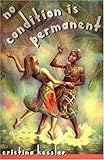
Christina Kessler. No Condition is Permanent. New York: Philomel Books, 2000. 183 pp. $17.99 (cloth), ISBN 978-0-399-23486-6.
Reviewed by Stanlie M. James (Afro-American Studies Department, University of Wisconsin, Madison)
Published on H-AfrTeach (December, 2001)
No Condition is Permanent is the story of Jodie, a 14-year-old white American girl who unexpectedly finds herself living with her mother half way around the world in Sierre Leone. Jodie's mother, a college professor is granted a sabbatical and provided with funding to conduct field research in Bukama a small fishing village.
Despite her mother's delight at returning to her old Peace Corp village to study the activities of the village women, Jodie is not pleased by the prospect of leaving her new California home and friends to go live in strange and unfamiliar Africa. Soon after she arrives in Bukama, Jodie develops a friendship with Khadie a girl her own age. While Khadie teaches Jodie about some of the customs and language of her people, and about how to work like the girls and women of the village, Jodie reciprocates by teaching Khadie how to read and write in English. Although the special relationship they develop seems to transcend most of the boundaries of race, nationality and culture, eventually their friendship is severely tested by the boundaries imposed by Sande--the women's secret society in Sierre Leone.
Her mother tries to impress upon Jodie the importance of respecting the culture of others even though she may not understand it and fearfully insists that she stay away from Sande. Meanwhile Khadie also tries to warn Jodie not to interfere in her preparations for initiation into Sande. Following her own instincts Jodie disobeys her mother and ignores the wishes of her friend in an ill-fated attempt to "save" Khadie from something that Jodie does not understand and finds frightening. Her brash intrusion into the off limits space of Sande places Jodie and her mother into a dangerous situation from which they must literally escape with only their lives and the clothing they wear.
This book should appeal to the junior and senior high reader on several different levels. For example it depicts a loving yet contentious relationship between a teen-aged daughter and her divorced mother. While the two do spend time together they also separately pursue their own interests and develop their own peer relationships. Thus the reader learns about Jodie's efforts to develop independently as she moves towards maturity. Krio (a language spoken in Sierre Leone) words and phrases are used throughout so that by the end the reader has a very rudimentary knowledge of the language. The reader is also introduced to the routines of village life through the eyes of the newcomer/outsider Jodie. Mediated through her friendship with Khadie, Jodie learns about how the village women and girls cultivate rice, care for children and prepare food. She also learns about cultural differences in modesty as exhibited by traditional attire, housing arrangements and extended families, toileting habits, and the need for vigilance against the dangers of poisonous snakes.
While No Condition is Permanent introduces the reader to many aspects of village life in Sierre Leone, it is also a mystery. The reader is provided with brief glimpses of Sande but the author exhibits her respect for this culture by refusing to breech the secrecy of the society. Rather, through Jodie, the reader learns that some traditions and customs are not easily accessible to the curious outsider nor is it appropriate for outsiders to critique customs they do not understand. Ultimately the reader should come away from this book with a sense that while customs can and do change within their own context and at their own pace, that it is most likely inappropriate, disrespectful and may even be dangerous to try to force change in places where one is an outsider/stranger.
Christine Kessler has made a sincere attempt to treat the customs and traditions of another culture with respect. Although she uses an oblique approach to the sensitive subject of genital cutting, without condoning it or demonizing the people, she manages to situate the custom within the broader context of the role of Sande as a way of preparation for womanhood (a rite of passage). Thus the reader is introduced to the rationale behind such a custom, to some understanding about how such a custom is integrated into the fabric of the society and to some sense that the ultimate responsibility for change really lies with the people most intimately connected to the culture.
I would highly recommend this book for junior and senior high readers with the stipulation that knowledgeable parents and teachers be available to the reader for thorough follow up discussions.
If there is additional discussion of this review, you may access it through the network, at: https://networks.h-net.org/h-afrteach.
Citation:
Stanlie M. James. Review of Kessler, Christina, No Condition is Permanent.
H-AfrTeach, H-Net Reviews.
December, 2001.
URL: http://www.h-net.org/reviews/showrev.php?id=5753
Copyright © 2001 by H-Net, all rights reserved. H-Net permits the redistribution and reprinting of this work for nonprofit, educational purposes, with full and accurate attribution to the author, web location, date of publication, originating list, and H-Net: Humanities & Social Sciences Online. For any other proposed use, contact the Reviews editorial staff at hbooks@mail.h-net.org.

