



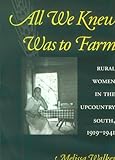
Melissa Walker. All We Knew Was to Farm: Rural Women in the Upcountry South, 1919-1941. Revisiting Rural America Series. Baltimore and London: Johns Hopkins University Press, 2000. xvii + 341 pp. $44.50 (cloth), ISBN 978-0-8018-6318-9.
Reviewed by Elizabeth Schafer (Independent Scholar)
Published on H-SAWH (November, 2001)
Living Off the Land
Living Off the Land
Voices of ordinary women who experienced extraordinary changes resonate in Melissa Walker's incisive study of twentieth-century transformations of southern agricultural communities. Her narrative is like the breezeway of a dogtrot cabin through which readers can glimpse the daily activities and concerns of rural women residing in the upcountry South during the inter-war period. Such personal interactions with specific women who were enduring depressed agricultural economies, facing the introduction of such external institutions as the federal government and industry, and choosing how to adjust to emerging social demands guides readers of All We Knew Was to Farm. We become aware of issues crucial to farm women, who were reevaluating their roles within their families, communities, and region. Walker examines how rural upcountry women dealt with expectations for them to shed traditional identities when their isolated region confronted rapid industrialization. She capably proves her thesis that an amalgam of factors prompted these women to learn alternative employment and lifestyle strategies when they were removed from the land that had sustained them and cash replaced mutual aid as a bargaining tool. Although each woman's experiences varied, common themes are relevant to all upcountry rural women's metamorphosis.
The book's title is inspired by a statement that a rural woman named Della Sarten made to a Smithsonian Institution interviewer in 1987 as part of the Oral History of Southern Agriculture project. Although seemingly a simple observation, this remark is the seed for Walker's complex examination of how rural women perceived their agriculturally related roles and adapted to changes that disrupted their lives. Topical chapters describe how women in various parts of the upcountry South were affected when industrialization and modernization altered their relationship to the land, their families, and their communities. While each chapter is effective alone (many were first published as journal articles), together they emphasize the widespread changes caused by the influx of urban factors, whether government agents or industries, into the rural South. These outsiders sought to ease economic distress by developing natural resources, which resulted in ejecting people from their land. Walker's chapters blend comprehensive studies of broad topics, such as home extension work, with examinations of how specific localities were affected.
Walker, an assistant professor of history at Converse College in Spartanburg, South Carolina, respects her subjects, whether people, places, or livelihoods, and carefully explains topics unfamiliar to readers who do not have access to rural lifestyles and are historically removed from pre-commercialized farming culture. She corrects myths about agrarian life, especially those portraying farm women as contented homemakers uninvolved in agricultural activities and decision making. Walker proves that rural women earned income essential to their families' immediate prosperity and to their savings for future improvements. Women were respected for contributing their farming ideas.
In her acknowledgements and introduction, Walker tells readers that she is writing about her own family's past. She describes herself as "a farm girl from the hills of East Tennessee" who as a child enjoyed hearing women's tales about farm life. She admits, "In many ways this book is a tribute to my roots in a rural upcountry community" (pp. xiii, xvii). Commenting about the women she studied, Walker says she is "fascinated with their stories of survival--of hard times outlasted and obstacles overcome. These were the stories of women who found their identities in their work, in their central role in preserving their families, and in the mutual support networks of their communities" (pp. 2-3). Walker knows the upcountry region and its residents well. She understands their mindset, sense of family and neighborliness, aspirations, worries, and motivations, and she uses this knowledge to portray her subjects without sentimentality or bias.
Walker describes the interwar period for women as a "liminal moment in their struggles to shape their own lives." It was a time in which "multiple transforming agents" such as race, family, government and industry presented "different strategies for different women" to mitigate their economic woes but sometimes "limited their options in ways that left them to choose the best from a bad set of options" (p. 3). Walker warns readers that women faced varied situations that cannot be summarized simply. Change did not occur evenly in the upcountry South, and it was sometimes impeded by resistance, as when residents refused to leave land designated for federal projects. Industrialization did not completely replace agriculture, and traditional agrarian values and lifestyles continued in varying degrees throughout the region.
Walker carefully explains that the South represents varied cultures and cannot be categorizedby blanket terms, such as "Appalachian," that perpetuate stereotypes and do not reflect diverse characteristics. She labels the region in Tennessee, South Carolina, and West Virginia that she studies as upcountry South to focus more accurately on specific populations with shared history, attitudes, and lifestyles influenced by the region's location on the remote periphery of urban centers and its mountainous terrain, ample natural resources, and less arable soils than other farming regions. The upcountry South was one of the first southern areas in which numerous outside investors sought to develop industries and employ low-wage workers.
Walker stresses that "neither prosperity nor poverty fully determined rural women's choices; race and class alone do not explain the wide variety of women's responses to change" (pp. 6-7). Each woman reacted differently to her particular changing circumstances and decided how she would pursue opportunities after the familiar life of subsistence farming was no longer a viable option. Often the situations women pondered were unsettling and unlike any previous dilemmas they had encountered.
The strongest chapters of All We Knew Was to Farm describe how women from varying circumstances--land owners and tenants; whites and African Americans; elite, "middling," and impoverished individuals--lived before, during, and after their isolated communities were changed by federal projects, aluminum manufacturing, or coal mining (p. 26). At the end of World War I, farm prices had decreased drastically, initiating a twenty-year period of agricultural depression. Economic instability plagued the people and times Walker documents in her book, but most women were still able to feed their families with food from gardens and clothe them with homemade garments. The Depression of the 1930s affected traditional farming practices, and industrialization transformed agricultural expectations. New Deal programs promoted financial aid to commercial agriculture, which began to replace family farms. Walker describes how the nation's agriculture switched from being primarily a home-based subsistence activity to feed families and local populations to mostly a large-scale agribusiness venture to feed national and global populations.
While upcountry men attempted to secure cash through farm commodities markets during this transition, women continued to grow food and raise livestock for family consumption, rely on mutual aid networks for support, and earn income by selling goods and services. Helping neighbors and friends was basic to the upcountry culture, and feeding hobos and vagrants was considered a responsible act of charity. Some women earned money by renting rooms in their farmhouses to boarders. Many women bartered goods, swapping fabric and preserves for dairy products and coffee. The women Walker writes about were initially subsistence farmers who either had the monetary resources to become commercial farmers when industrialization occurred or who left the land for non-agricultural urban pursuits. Some existed in both worlds, working in off-farm jobs to earn money to invest in farming.
Upcountry women were resourceful, utilizing all available supplies, such as removing everything from a hog "except its squeal"(p. 38). A kettle was used to cook food, make soap, and boil laundry. Women did not expect conveniences and were ecstatic to have an indoor sink installed to drain water. Electricity was a luxury that became more common as regional dams were built. Making do or surviving without were common practices. As a result of their domestic savvy, women were crucial and influential members of their families and societies. Walker skillfully shows the gender dynamics of how upcountry women and men divided agricultural work and emphasizes that each couple decided who would perform which tasks based not on social regulations but on personal preferences.
Women were active participants in farming, often referring to agricultural activities with the pronoun "we" to show the complementary roles of husband and wife. Although men usually did not perform housework, women worked in fields, especially when men were engaged in industrial or public work, such as the Civilian Conservation Corps. Some women protected their daughters from chores they thought were too physical for young women, such as plowing. Occasionally, husbands abandoned wives or were murdered, and many of those women received money from neighbors to pay mortgages or medical expenses. In turn, the women felt obligated to work off their debt because they were too proud to accept charity. Rural women sometimes wrote to Eleanor Roosevelt, explaining their plight and asking for federal relief jobs for themselves or family members.
Walker reveals that rural homes often consisted of several generations of a family residing together, with adult children caring for parents and/or grandparents tending to grandchildren. Widows sometimes offered rooms to boarders who, although strangers working on dam construction or other industrial work, became a supportive community within a house. Discussing family demographics, Walker states that reproduction statistics and attitudes toward birth control demonstrate that many women had large families to assure a sufficient labor force but that the physical stress accompanying pregnancies and hard work prematurely aged upcountry women. Upcountry populations suffered public health problems, including tuberculosis. Walker emphasizes that women preferred consulting midwives for medical care because physicians were usually located in urban places, cost too much, and had little sympathy or understanding of rural concerns and customs. Midwives were mostly rural women who considered their ministrations as part of mutual aid, and farm women could more easily compensate them for their services than they could physicians.
Walker describes how farm periodicals instructed women to improve their homes and make crafts that could also be sold to earn income. Stressing that farm women could combine home and career, these magazines urged women to collect cash by selling eggs and butter as a relief measure to enhance profits. That way women could free men from farm chores so they could work at off-the-land jobs for wages to invest in commercial agriculture. Magazine features praised successful agricultural businesswomen. Readers protested when one editor remarked that rural women had limited earning potential, and angry letters revealed that women considered themselves valuable agricultural partners with their spouses.
As material prosperity increased, a middle class emerged, and some rural women developed lifestyles and values relevant to this new status, including becoming homemakers as the United States Department of Agriculture (USDA) encouraged through home extension programs. African-American women welcomed expanded opportunities for professional careers as demonstration agents but often were overwhelmed with greater workloads than their white colleagues. Walker describes how farm women received home extension agents with suspicion. The education offered by the agents was limited because they misunderstood how involved women were in agriculture. Agents discouraged women from generating income from their agricultural activities, and agents also divided labor into male and female roles that did not accurately represent the reality on many farms. Agents emphasized nutrition and sanitation of homes, which were important issues but not economic priorities for rural women. Although bureaucracy prevented most agents from adjusting their lessons to be more appropriate and useful, some agents were able to help with local relief efforts and ease relocation stress.
Few women became involved in extension projects, and those who did considered them primarily social activities or hobbies. Many did attend handicraft schools, however. African-American women were not as successful selling produce and crafts at road markets because many whites wanted to discourage African Americans from independent ventures in order to assure a plentiful supply of laborers for domestic chores.
Perhaps some of the most fascinating sections of Walker's book describe how people reacted to being removed from their land. While some landowners eagerly sold their land to the government, many upcountry people resented governmental intrusion of any kind. Upcountry residents reluctant to leave their land outwitted federal workers who, relying on urban social codes, misinformation, and prejudices, often underestimated the intelligence of local farmers. The federal agents were then angered when the locals refused to leave or demanded more money to do so.
During the inter-war period, industries, military bases, and government programs, including the Tennessee Valley Authority (TVA) and the Great Smoky Mountains National Park, gained prominence over agriculture. Upcountry farm land was sold, and men became wage earners in full-time, non-agricultural, urban positions, including tourism as more Americans began to vacation in the mountains. Most employers discouraged women from participating in jobs that paid well and relegated women to jobs stereotypically associated with females, such as maids and cooks. Husbands who did not want their wives to work for other men insisted the women stay home. At some businesses, employers discouraged married women from applying for positions that men and single women qualified for, and Walker provides examples of how some upcountry women outspokenly decried such restrictions, hinting of an early feminist mindset.
As a result of being removed from the land, many upcountry women lost their economic power, although Walker emphasizes that class was the most significant factor in determining how women were affected by modernization. Landowners' wives usually faced more choices than tenant women. As agriculture industrialized and farm women's work changed, perceptions of class also became more restrictive. Previously, upcountry people were categorized by rural values such as industriousness, morality, and social responsibility, and social status could change as people's perceptions of each other changed. Because of industrialization, occupations and wealth more rigidly categorized upcountry people, who became more conscious of a social hierarchy. People who already had resources tended to prosper. Conditions worsened for people already mired in poverty who did not own land. Most African Americans encountered racism. Churches could not be depended on for relief because communities lacked resources for ministers, let alone charitable goods, and class conflict divided some congregations. Attendance declined because many people lacked clothing considered suitable to those who equated the quality of attire with social status.
While some upcountry women developed home businesses, others moved to urban areas to work. Some women invested in and managed commercial farms. By selling their land to the TVA, women had funds to become partners in businesses. They actively made choices to benefit themselves, their children, and their spouses. Women often pressured husbands to move into urban areas, which had better educational resources than country schools. Although many former farm women seemed to have better-quality lives after relocating, urban living had its limitations. Abandoning or leaving the land, which had often been the family home for several generations, depressed many women, who experienced a paradox of simultaneous improvements and constraints. Women's control over shaping their destiny through their choices changed. When Doris Cope moved to Knoxville, for example, she insisted on taking her cow, which symbolized her fear of losing rural values and self-reliance even as she sought a better life for her children. Although the cow's presence upset Cope's urban neighbors, who were uneasy about rural newcomers, it comforted her as she slowly adjusted to her new world. Rural-urban conflicts simmered. Many urban residents did not understand the ways of rural women and mistook their shyness and work ethic for snobbery. In these cities, residents often equated materialism and wealth with social success. Because of their dress style, accents, and mannerisms, upcountry people were often unfairly labeled with derisive terms such as "hillbilly" and deemed unworthy.
Women found that the skills useful on the farm usually did not apply in the city. Women removed from the land also lost their immediate extended families, as well as support systems and trading networks. Many upcountry people who were relocated when the U.S. Army built Camp Croft in Spartanburg, South Carolina, were disappointed with the inferior land, houses, and livestock that replaced their property and upset at monetary and business losses they suffered. When they complained, their patriotism was questioned.
Walker examines how women responded to the introduction of heavy industry. Primarily, women underwent a transition from a rural to an urban existence. Although some women attempted to stay on their land or retain their rural ways, most could not keep their family roles and felt alienated because of social hierarchies in towns. The Aluminum Company of America (ALCOA) and its company town (with the same name as its acronym) presented new dilemmas for upcountry women. A 1937 labor strike reveals the divisive aspects of non-farm employment. Women whose husbands remained on the land while working for ALCOA did not encourage labor demands because they did not want to risk losing money needed to support farming. Women who lived in Alcoa endorsed the strike because the company town provided support similar to their rural networks. According to Walker, these women became more marginalized because they no longer provided essential resources to their family economies. In coal mining communities, women formed networks for comfort because of their fears of cave-ins and explosions that might kill miners. Developing camaraderie, these women helped each other and endorsed unions and strikes to improve their lives. Walker includes an intriguing observation about how many rural women confronted with urban labor difficulties (and perhaps accompanying marital strife) responded with silence and how some women's history scholars are considering the correlation of silence and repressed anger.
Investigating economic changes in Sevier County, Tennessee, home of the tourist town of Gatlinburg and the Smoky Mountain National Park, Walker determined that few upcountry people greatly profited from tourism. Women who had the resources to sell handicrafts or operate popular restaurants and inns thrived, but most upcountry people forced to relocate moved elsewhere in Tennessee.
World War II defense work resulted in the dispersal of many upcountry people and the arrival of outsiders to work at the Oak Ridge National Laboratory. Wartime rationing and shortages limited how people could spend money, and industry gained more influence than agriculture. Rural women became even more dependent on their husbands, and gender relations changed. Women had fewer economic and decision-making roles in their homes and communities.
Walker also studied white women's roles in commercial dairy and peach farming and determined that although they mostly enjoyed a better quality of life, they had reduced influence upon policies concerning family farms and communities. Many men discounted women's agricultural knowledge and abilities. Walker notes how the Farm Bureau gained lobbying power nationwide for the interests of commercial farmers, who were primarily white males.
Walker thoroughly explored a cornucopia of sources to depict her changing landscape and people. A scholar of oral history, she used previously recorded narratives in addition to interviews she conducted herself. Walker consulted the expected federal records at the National Archives, as well as obscure but rich local history sources. Regional archives, newspapers, and periodicals provided a plethora of primary observations to supplement the gaps and inconsistencies in interviews. Walker skillfully weaves fictional and popular culture details throughout her narrative.
The sixth title in the Revisiting Rural America series, Walker's book complements the series' other texts, especially Mary C. Neth's Preserving the Family Farm: Women, Community, and the Foundations of Agribusiness in the Midwest, 1900-1940.[1] The subject of women as agriculturists and women's identification with land emerged as a scholarly field in the late twentieth century, and Walker is familiar with most of the significant publications that treat this topic. For insights about women's attitudes towards land and economic autonomy through agriculture, scholars might also wish to consult H. Elaine Lindgren, Land in Her Own Name: Women as Homesteaders in North Dakota.[2] Books of interest published simultaneously as Walker's book include one that she reviewed for H-Net, Rebecca Sharpless, Fertile Ground, Narrow Choices: Women on Texas Cotton Farms, 1900-1940, and Bonnie O. Tanner, The Entrepreneurial Characteristics of Farm Women.[3]
All We Knew Was to Farm has richly cultivated the ground for future studies of women and their various relationships with land. Walker's insights will prove useful to scholars researching agricultural and rural history, as well as rural sociology. Additionally, the book provides a deeper understanding of women's, cultural, southern, technological, economic, and oral history. Walker has thoughtfully considered her topic from numerous angles and addressed most applicable concerns for this book.
Related questions that researchers might wish to explore include determining if any anti-technology assaults on commercial farms or industries occurred in the upcountry south and, if so, by whom, when, and where. Have there been any sentimental actions to identify family farms that survived in the region in the way that century farms have been celebrated in the Midwest? If so, are those farms successful commercially and what crops and methods have resulted in their longevity? Have historical agricultural and industrial sites in the upcountry South been identified and publicly marked, and what do such memorials (or lack of them) reveal about the region's past and present residents and their attitudes? How many of the interviewed upcountry women had children who pursued a college education, and for what professions did they study? How many of the subjects' descendants chose agriculturally related careers? Did anybody combine agricultural and industrial interests to seek better agricultural engineering techniques? Several of Walker's chapters, especially those touching on rural public health, the concerns of geriatric residents, and external agents who participated in the process of mass removal of rural populations, suggest the possibility of lengthier investigations. Walker's methodology could be applied to rural women throughout the world who have been forced off the land by circumstance or design.
Notes
[1]. Mary C. Neth, Preserving the Family Farm: Women, Community, and the Foundations of Agribusiness in the Midwest, 1900-1940 (Baltimore: Johns Hopkins University Press, 1995).
[2]. H. Elaine Lindgren, Land in Her Own Name: Women as Homesteaders in North Dakota (Fargo: North Dakota Institute for Regional Studies, 1991).
[3]. Rebecca Sharpless, Fertile Ground, Narrow Choices: Women on Texas Cotton Farms, 1900-1940 (Chapel Hill: University of North Carolina Press, 1999); Bonnie O. Tanner, The Entrepreneurial Characteristics of Farm Women (New York: Garland Publishing, 1999).
If there is additional discussion of this review, you may access it through the network, at: https://networks.h-net.org/h-sawh.
Citation:
Elizabeth Schafer. Review of Walker, Melissa, All We Knew Was to Farm: Rural Women in the Upcountry South, 1919-1941.
H-SAWH, H-Net Reviews.
November, 2001.
URL: http://www.h-net.org/reviews/showrev.php?id=5689
Copyright © 2001 by H-Net, all rights reserved. H-Net permits the redistribution and reprinting of this work for nonprofit, educational purposes, with full and accurate attribution to the author, web location, date of publication, originating list, and H-Net: Humanities & Social Sciences Online. For any other proposed use, contact the Reviews editorial staff at hbooks@mail.h-net.org.

