



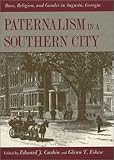
Edward J. Cashin, Glenn T. Eskew, eds. Paternalism in a Southern City: Race, Religion, and Gender in Augusta, Georgia. Athens: University of Georgia Press, 2001. xiii + 204 pp. $50.00 (cloth), ISBN 978-0-8203-2257-5.
Reviewed by Mary Waalkes (Department of Behavioral and Social Sciences, Lee University)
Published on H-South (November, 2001)
Paternalism in Augusta
Paternalism in Augusta
Paternalism in a Southern City: Race, Religion, and Gender in Augusta, Georgia is a collection of essays edited by Edward J. Cashin and Glenn T. Eskew. These essays address varied factors involving paternalism in Augusta, Georgia, from the town's founding through the turn of the twentieth century. According to the collection under review, paternalism is present in relationships between whites and blacks, men and women, the elite and workers. How the authors define paternalism in these essays is as interesting as the way the authors see it operating in Augusta.
The essays came out of Augusta State University's 1996 symposium on Augusta's history. Paternalism is the common thread that runs through the papers, and is the defining element of the book, tying together race, gender, and class. However, the definition of paternalism varies with the author. Edward J. Cashin, who contributes the volume's initial essay, sees paternalism as a rural ethic, essentially benign, and one that fits awkwardly amid Augusta's mercantile interests. The other essayists in this book view paternalism somewhat differently, not necessarily as a benign pattern of life, but as a rationale for supporting the status quo, and as a pattern of behavior that was sustained in an urban setting.
Cashin's essay, "Paternalism in Augusta: The Impact of the Plantation Ethic upon an Urban Society," looks at three major influences on Augusta: the Charleston ethic; the influence of evangelical religion; and the Virginia plantation ideal. The application of these influences takes on a deterministic tone with the Charleston ethic described as a close relative to northern money-grubbing and the Virginia planter ideal standing for all that was right with the Old South. Cashin applies these three models to Augusta's history, moving quickly, anecdotally, and superficially through time. The Virginia ethic becomes the model for high-minded living, with slavery existing as the primary flaw in the honor code. The evangelical thread shows up from time to time in the essay, but is less important than the tensions between the Charleston and Virginia ideals. The latter two essentially stand for the southern ideal versus the Yankee ideal, or the agrarian versus the industrial or commercial impulse. The evidence is unconvincing, and the argument is embarrassingly facile.
"The reason that the memory of Robert E. Lee has such a hold upon the hearts of so many southerners is that he came closer than most to the ideal" (p. 7). Statements such as this give the essay both a dated and polemical feel. At the end of the essay, Cashin takes a final wistful look at the slave-holding South and suggests that waving the Confederate flag today "...may indicate deep stirrings in the southern psyche and presage the revival of the Virginia tradition" (p. 38).
Michele Gillespie in her essay "From Household to Market: Black and White Women at Work in Augusta, 1790-1825" addresses the space women found for themselves at work and in the marketplace. Women were subjected to paternalistic control by men, but were nonetheless able to move into areas where they could maintain a limited degree of autonomy. Gillespie's essay does a fine job of detailing the efforts of black and white women to improve their own personal and family fortunes in a time when occupational choices were limited for women. Some slave women engaged in informal barter and so devised for themselves habits of consumption outside the control of their masters. Free black women could hire their labor as seamstresses or laundresses without working in the confining structure of white homes. Poor white women, from about 1790 to 1818, could take in orphans and thus support themselves and benefit the town. White women with more access to capital might improve the family economy by setting up female academies. Gillespie shows that in many ways women in Augusta might shape a space for themselves, although the degree of autonomy gained was limited and did not significantly challenge white male paternalism.
In her essay on white male identity, Leeann White suggests that men who were millworkers defended their manhood in opposition to acknowledging mill owner paternalism. "Paternalism and Protest in Augusta's Cotton Mills: What's Gender Got to Do with It?" shows how men in the mills lost their autonomy and were relegated to the lesser status usually reserved for women, children, and slaves. Some of the worker protests that arose in the mills reflected the struggle men experienced in holding onto an identity that was not determined by a paternalistic relationship to the mill owners. White's argument is that while historians have examined worker resentment toward paternalistic owners, they have not considered how the idea of manhood may have had more to do with protests than worker identity. Defending manhood meant maintaining distance from people considered dependent and therefore "feminized" such as women, children, and slaves. White makes an interesting case that union membership acted as a means for men in the mills to recapture their manhood. Male workers could stand between their wives and children who worked in the mills and the mill owners, and by doing so, could assert their manhood.
Glenn T. Eskew's contribution, "Paternalism among Augusta's Methodists: Black, White, and Colored," portrays paternalism as a complex issue wherein black congregations benefited from ties to white churches. Elite black members of Trinity Colored Methodist Episcopal Church accepted white assistance when it was to their advantage, and often received denominational support from St. John's church, whose members were white. Trinity's ties to white paternalists could be a problem, as when white ministers served short-term assignments at Trinity, giving sermons that emphasized accepting the racial status quo. Augusta's other black Methodist churches were aligned with northern black denominations, the African Methodist Episcopal Church and the African Methodist Episcopal Zion Church. These churches, while not officially tied to white Methodist congregations in Augusta as Trinity was, still received support from white Methodists who made church lots available for a nominal fee. Eskew suggests that working class black churches, while enjoying the benefits of paternalism in this sense, were freer of white control than was Trinity. He also gives a good account of the congenial relations between black and white churchmen. A question that comes to mind is whether some of this was due to the common denominational bond between Trinity and St. John. Perhaps Trinity's members were more willing to accept white paternalism than the other less denominationally linked black churches because of denominational loyalty.
Jim Crow practices in Augusta toward the end of the nineteenth century boxed in wealthier African Americans whom whites refused the prerogatives due other elite members of society. Kent Anderson Leslie's essay, "No Middle Ground: Elite African Americans in Augusta and the Coming of Jim Crow," compares the experiences of the black elite in Augusta, showing various strategies used by them to gain or protect their positions in the city. Amanda America Dickson, Bishop Lucius Henry Holsey, the Ladeveze-Harper families, and Lucy Craft Laney were members of Augusta's African American elite. Leslie illustrates that Laney was the most successful of them in maneuvering through the racial roadblocks of that era, primarily because she expected little of whites. Her realistic pragmatism and her staunch support for education saw Haines Normal and Industrial School through a difficult period in Georgia's history. In this essay, dependence on white paternalism, as racial lines hardened in Augusta, became more of a hindrance than not in negotiating for personal or community advancement. Leslie's essay is a good introduction to the following essay that more closely examines how one individual both used paternalism and rejected it when essential rights were threatened.
William Jefferson White, founder of Harmony Baptist Church, navigated the difficulties of racism in Augusta by accepting paternalism where it benefited African Americans, and by standing firmly and vocally against racism when needed. Bobby J. Donaldson's essay, "Standing on a Volcano: The Leadership of William Jefferson White," is an excellent microcosm of changing racial relations following Reconstruction, and the means by which black leaders protested the loss of citizenship rights. Donaldson establishes White as a leader who accepted paternalistic support from whites when that support helped the black community. White maintained good relations with some white supporters even during the Atlanta riot of 1906, when he himself was suspected by whites of being a radical. However, as this suggests, White also strongly advocated black rights and he pushed the boundaries of acceptable criticism of whites to the point where he endured a brief exile from Augusta rather than face likely violence. Donaldson's essay is a fine tribute to White, who built up black education in Augusta, and who spoke boldly and publicly against disenfranchisement as the city moved toward limiting the rights of its African American citizens. Even more, Donaldson greatly enhances our understanding of individual strategies used by African American leaders during the Jim Crow era. White maintained his devout belief in God, but adapted his voice, and the way he dealt with whites according to the exigencies he faced. This essay is a miniature portrait of Reconstruction and Jim Crow era racial maneuvering for rights, and is a valuable resource to students of either era.
"Rolling Religion down the Hill: Millworkers and Churches in Augusta" by Julia Walsh presents millworkers as both recipients of missionary care from wealthier white church members, and as forceful makers of their own brand of religion. Millworkers received paternalistic assistance from mill owners and wealthy churchgoers above the mill town, but they also fashioned their response to organized religion much as many people do today. Millworkers chose from a menu of services offered by their churches, including Sunday school for the children, revivals, benevolence outreach, and prayer meetings. Often church services held limited appeal to millworkers, who found informal religion more attractive. Walsh shows that the concern of upper and middle class Augustans for millworkers was a complex mix of economic self-interest, denominational pride, and paternalistic responsibility for needy workers. Walsh spends some time examining worker radicalism, with special attention to Berean Baptist church and the populist newspaper, the Wool-Hat. Baptist leadership outside the local church opposed Berean's advocacy of the Knights of Labor. Paternalism in this case acted against a long-term partnership between Berean and politicized workers. While articles in the Wool-Hat indicated some workers wanted their churches to reflect their economic and political views, Walsh makes a strong case that most workers were more ambivalent regarding religion and politics.
The common thread in these essays is paternalism. Taken individually, however, the essays vary as to how central paternalism is to the argument. Read as a whole, the essays transcend local issues, and encourage the reader to examine the various meanings of paternalism, the legacy of it, and the strategies of individuals who struggled in a historical landscape defined by paternalism.
If there is additional discussion of this review, you may access it through the network, at: https://networks.h-net.org/h-south.
Citation:
Mary Waalkes. Review of Cashin, Edward J.; Eskew, Glenn T., eds., Paternalism in a Southern City: Race, Religion, and Gender in Augusta, Georgia.
H-South, H-Net Reviews.
November, 2001.
URL: http://www.h-net.org/reviews/showrev.php?id=5624
Copyright © 2001 by H-Net, all rights reserved. H-Net permits the redistribution and reprinting of this work for nonprofit, educational purposes, with full and accurate attribution to the author, web location, date of publication, originating list, and H-Net: Humanities & Social Sciences Online. For any other proposed use, contact the Reviews editorial staff at hbooks@mail.h-net.org.

