



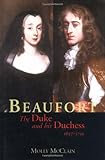
Molly McClain. Beaufort: The Duke and His Duchess, 1657-1715. New Haven: Yale University Press, 2001. 320 pp. $35.00 (cloth), ISBN 978-0-300-08411-5.
Reviewed by Tom Cogswell (Department of History, University of California-Riverside)
Published on H-Albion (October, 2001)
Doubles at Badminton
Doubles at Badminton
Historians are famously oblivious to their surroundings, but of late, even the most absent-minded seem to notice a certain loss of public interest in their work. In earlier decades, when the latest efforts of Trevelyan, Plumb, and Hill hit the bookstores, their audience was measured in tens, if not hundreds, of thousands. Alas, many of their successors in the early twentieth century barely seem able to attract the attention of their professional colleagues and graduate students, and these scant numbers are rapidly dwindling. The scholarly practice of writing for themselves has become so ingrained that some have recently wondered about the profession's ability to reverse this disturbing trend. The gravity of the situation, however, plainly has been overstated. Scholars can still find a wide audience, as Molly McClain illustrates with Beaufort: The Duke and the Duchess.
In no small part, the reason for McClain's success can only please the most traditional scholar: she does history the old fashioned way--she thoroughly researches it. Although those working in the field have long known about the importance of moving beyond the "canonical" sources held at the British Library and the Public Record Office, it is often too tempting merely to stroll over to St. Pancras or ride the tube out to Kew. For her part, McClain has traveled into the wilds of rural Gloucestershire. At Badminton House, she found the unexpected riches of the Somerset family archives for the late seventeenth-century, and, above all else, she spotted eighty-eight letters between Henry Somerset, the first duke of Beaufort, and Mary, the duchess. Here, McClain deserves full marks for having identified a tantalizing topic. The Badminton archive in all likelihood could well be used to illuminate the local power structure and the various furores in the West Country, or to chart the passage of a prominent peer through the troubled waters of late Stuart court. Alternatively it could cast a floodlight on the creation and administration of a massive aristocratic estate, or on the role of noble women at Whitehall and in the household. McClain, however, has resisted the impulse to focus too narrowly on any one of these; instead she has used them in varying degrees to explore a much more novel topic, the relationship of an early modern couple.
In addition to rich sources and an unusual subject, McClain also brings an elegant and engaging prose style to the project. To be sure, this book will prompt some grumbling from those who believe Clio demands from her devotees a cautious and at times even a tedious presentation. Take for example McClain's depiction of the newly widowed Lady Mary Beauchamp: "She wanted to escape from the suffocating rules and regulations which governed the lives of virtuous widows and to enjoy sexual pleasure, immodest behavior and even extravagance. At twenty-seven years of age, she could demand nothing less" (p. 24). In response, modern disciples of Carlyle's nemesis, Professor Dryasdust, might sputter about sources and insist on leaving drama out of history. But in short order, even the most sceptical scholars will quickly learn to jog along with McClain as she analyzes the couple. They could scarcely do otherwise, so compelling is the Beaufort's story. Indeed, rarely have general readers found careful scholarship so enchanting.
The duke appears as a classic example of a common aristocratic type, someone who believed that the path to prominence lay through Whitehall. Thus after the Civil War, the duke sought to repair his family's tattered fortunes by offering his services first to Cromwell and then, even more enthusiastically, to Charles II and James II. In due course, he rose to become Lord President of the Council of Wales, Lord Lieutenant in a half dozen counties, and a great regional magnate. His success was not universally applauded, and during the Exclusion Crisis, his detractors saw the moment for revenge. Beaufort came from a family famous for its devotion to the old religion; in fact, he himself only conformed to the Church of England in his twenties. The belated conversion had more to do with politics than theology, for on his deathbed, he reportedly returned to Rome. Consequently in the late 1670s, when the Whigs encouraged attacks on the Catholic entourage of the duke of York, it was easy enough to expand them to include the alleged crypto-Catholic Lord President. Like the Stuart brothers themselves, Beaufort rode out this crisis, and his loyalty earned him a dukedom. Unfortunately, a sense of loyalty also bound him to the dynasty, and even when the duke was increasingly alienated from James II, he could not bring himself to renounce the king either during or after the Glorious Revolution. Hence, after 1689, the once preeminent bureaucrat slipped into obscurity as a non-juror.
His tale, while well told, is not as inherently fascinating as that of his duchess. Thanks to the paucity of sources, seventeenth-century aristocratic wives often appear as two dimensional characters. The duchess's extensive correspondence, however, allows McClain to bring her quite vividly to life. Daughter of Lord Capel and widow of Lord Somerset, she found herself in her early twenties all alone, save for two small children and a domineering mother-in-law. Desperate to restrain her "many passionate thoughts" (p. 10), she found her salvation in the young Lord Herbert, whom she soon married. The extent of her devotion to her second husband became evident as she diverted some of the Seymour revenues, which she controlled for her young son by the first marriage, to replenish her new husband's bare coffers. In the subsequent decades, as he spent extensive amounts of time in the metropolis, she remained at Badminton, presiding over the household and estate as well as managing local patronage matters and elections. With periods of activity came increasingly prolonged bouts of depression, when "melancholy" nearly paralyzed her. Fortunately, she eventually found relief in the form of a profound religious experience and ultimately in collecting exotic plants. In her later years, she had ample need for these consolations. Her husband died in 1700, and for the next fifteen years, recurrent quarrels with her children by the first marriage and with her grandson, the second duke, drove her to distraction and ultimately out of Badminton, the palatial country house which she had helped fashion. Nonetheless she succeeded in amassing one of the great botanical collections of the era.
McClain's handling of their parallel lives is skillful indeed. Yet this triumph notwithstanding, her readers may well end the book wishing to know much more about various aspects of her two subjects. For example, the background of Beaufort's quarrel with the Monmouthshire gentry arguably emerges much clearer in her 1995 article than the book.[1] It is, however, equally clear that she could not have easily indulged her readers without disturbing the careful balance in her analysis of this couple. The book's worst flaw can be laid at the feet of the publisher; the book boasts eighteen black and white illustrations, and while we should be grateful for these, the fact remains that several of them, most notably the splendid Lyly portraits, would have been much more impressive in color. This oversight, it is to be hoped, will be corrected in the paperback edition of Beaufort. And let there be no doubt; this work should come out in paper, the sooner the better.
Admittedly Beaufort will not alter the historiography of the period. Rather McClain's goal here is at once simpler and grander. She wants us to understand a early modern partnership, and she succeeds brilliantly, as scores of general readers, undergraduates, and their instructors will happily agree.
Note
[1]. Molly McClain, "The Wentwood Forest riot: property, rights and political culture in Restoration England," in Political Culture and Cultural Politics in Early Modern England, ed. Susan Amussen and Mark Kishlansky (Manchester, 1995), pp. 112-32.
If there is additional discussion of this review, you may access it through the network, at: https://networks.h-net.org/h-albion.
Citation:
Tom Cogswell. Review of McClain, Molly, Beaufort: The Duke and His Duchess, 1657-1715.
H-Albion, H-Net Reviews.
October, 2001.
URL: http://www.h-net.org/reviews/showrev.php?id=5566
Copyright © 2001 by H-Net, all rights reserved. H-Net permits the redistribution and reprinting of this work for nonprofit, educational purposes, with full and accurate attribution to the author, web location, date of publication, originating list, and H-Net: Humanities & Social Sciences Online. For any other proposed use, contact the Reviews editorial staff at hbooks@mail.h-net.org.

