



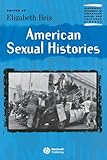
Elizabeth Reis, ed. American Sexual Histories. Blackwell Readers in American Social and Cultural History Series. Oxford: Blackwell Publishers, 2000. xv + 416 pp. $64.95 (cloth), ISBN 978-0-631-22081-7.
Reviewed by Fusako Ogata (Department of History, University of Minnesota)
Published on H-Women (September, 2001)
New World of Sexual Histories in America
New World of Sexual Histories in America
American Sexual Histories, edited by Elizabeth Reis, is a collection of fourteen essays that had originally been published between 1985 and 1999. All the essays except two are those published in the 1990s. Organized chronologically, the book covers the wide span of various aspects of histories of sexuality from the colonial period to the 1960s. The topics include bestiality, interracial sexual relations (between Anglo and Indian, "oriental" and white, and between white women and black men), courtship of young women and men in eighteenth-century New Hampshire, "free love" in the Oneida Community, ministerial misdeeds, hysteria, homosexual identities, abortion, birth control, the lesbian and the prostitute, and sex change.
Each chapter starts with an easy-to-read, very clear introduction written by Reis which should serve as a helpful guide for students who may have little knowledge of the individual themes. Then the essay follows, paired with primary source documents, most of which are those used and analyzed by authors in their essays. A few questions and further reading also accompany the documents. These primary sources are indeed frequently more interesting and fun to read than the essay itself.
American Sexual Histories is a part of The Blackwell Readers in American Social and Cultural History Series whose purpose is "to introduce students to cutting-edge historical scholarship that draws upon a variety of disciplines, and to encourage students to 'do' history themselves by examining some of the primary texts upon which that scholarship is based" (p. x). Overall the book does a fair job of achieving its stated goal.
The quality of the fourteen essays is uneven. Many are interesting, informative, well-written, and superbly analyzed. Some are tedious without being analytical enough with regards to the social meaning of the specific topic. While the book does succeed in bringing "new, exciting scholarship" (p. x), it does not seem to be a "compact" textbook for undergraduate students as the series editor Jacqueline Jones claims. Rather it would suit scholars and specialists better. At least for Japanese students enrolled in American women's and social history, this rich volume of wide-ranging topics in American sexual history would be too thick and detailed, given the students' more limited knowledge of both American history and English.
Out of the three essays that discuss sexual relations between the different races, two are particularly interesting. Henry Yu's study on "Mixing Bodies and Cultures: the Meaning of America's Fascination with Sex between 'Orientals' and 'Whites'" is fascinating. His work corrects the still prevalent but simplistic idea that interracial means blacks and whites by showing that the taboo about "miscegenation" went beyond that. Yu presents us with the marriage of a Chinese man and a white woman in 1897 California that was sensationalized in the popular media. He focuses on the particular obsession among American social scientists in Chicago, between the 1920s and 1960s, regarding sexual relations between whites and Asian Americans. Yu's essay is a smooth read and easy to follow. He reveals the flaws of American white social scientists and reformers who "insisted that culture was a mental phenomenon, a matter of consciousness divorced from physical attributes" (p. 296).
As evidence for his conclusion in this essay he uses Rose Hum Lee. Lee was the first Chinese-American to head a sociology department at an American university. Lee was born and raised in Montana, but "never felt fully accepted" and "could see no way out of America's racial dilemma short of racial homogenization" (p. 294). She maintained pessimistically that intermarriage is the "ultimate answer to the problem of racial prejudice and strife" (p. 295). I have personally observed how physical and biological differences among races plays a significant role in differentiating and often discriminating against "others" in the United States, both in history and at present. One cannot deny that "the prime marker of cultural difference has almost always been the body" (p. 296). Current "racial problems" such as violence in Cincinnati and still-prevalent "racial profiling" would be the examples of this phenomenon. Therefore, I find Yu's argument persuasive though I would like to see evidence beyond that of Rose Hum Lee.
Martha Hodes provides another intriguing story of interracial sex in "White Women, Black Men, and Adultery in the Antebellum South." She debunks the stereotype that the sex between black men and white women in the South was both a taboo and a forced one, by using the records of an 1852 divorce case of a white husband and his wife who openly maintained an illicit relationship with a black slave man. I particularly like the ways in which Hodes interprets and analyzes certain situations even when the evidence seems limited. One of the striking findings is "a marked absence of white outrage and violent retribution toward the participating black man, whether slave or free" (p. 146) who has had a continuous adulterous relationship with a white married woman. Hodes argues that the link between interracial sex involving white women, black men, and murderous white violence was not in place prior to the Civil War.
She also shows that the reason the white husband decided to seek a divorce, after long putting up with his wife's adultery, was because he did not want the economic responsibility of the children from his wife's adultery, and not his anger concerning the wife's sexual relationship with a black slave. We learn that the husband's divorce was denied, proving again the complexities inherent in the institution of racial slavery in the hierarchical antebellum South.
Leslie Reagan's "About to Meet Her Maker: Women, Doctors, Dying Declarations, and the State's Investigation of Abortion, Chicago, 1876-1940" is extremely insightful. She explains how control of abortion was practiced in the pre-Roe era with the terrible measure of "dying-declarations." Reagan's research uncovered "the harassment of sick or dying women" because of their illegal abortion "in the name of criminal investigation continued until the decriminalization of abortion" (p. 241). This creates an interesting parallel to the anti-abortion rights climate in current American society where abortion is such a over-politicized issue. The ongoing heated debate on abortion issues in this country is quite perplexing and yet attention-grabbing for Japanese who treat abortion in a completely different manner.
Andrea Tone beautifully demonstrates "the technical illegality of birth control and the burgeoning birth control industry in the 1930s" (p. 250) in "Contraceptive Consumers." Her approach to the birth control issue from the perspective of consumers and industry is full of discoveries and excitement. Tone points out that "historians have typically framed birth-control history as a tale of doctors, lawmakers, and women's rights activists." She recasts the history of birth control by including "the agency of a new set of actors, birth-control manufacturers" (p. 265). Her story also reveals that women themselves were active agents in the popularization of birth control devices (under euphemistic names) even if they were often ineffective and even dangerous.
George Chauncey, Jr.'s, well-known work on the U.S. Navy's investigation of alleged homosexuality among sailors in the World War I Era makes a distinction between actual sexual activity and sexual "identity." He marvelously argues that many of the men engaging in homosexual activity regarded themselves as "normal" as long as they assumed traditional "male" roles in their homosexual behavior. Thus, their identity as straight men was not threatened. The way people label "homosexuality" changes over time. Similarly, ministers got around the suspicion of homosexuality by utilizing another self-serving perception of distinction between behavior and identity. Chauncey's essay enables us to realize again that sex and sexuality are indeed historical. It is interesting to note the stark contrast between the way lesbians were defined as sexual deviants in the post-WWII era as shown in Donna Penn's essay on "Lesbian, Prostitute and Female Sexuality." Does this unequal treatment toward homosexual men and lesbian women stem from the Victorian notion of womanhood as pure and asexual?
"'Girling of It' in Eighteenth-century New Hampshire" by Laurel Thatcher Ulrich and Lois K. Stabler is a tale based on the examination of a diary, much like Ulrich's famous book of a midwife. It vividly exposes the liberal courtship of young women and men, including what an eighteenth-century man, Abner Sanger, in New Hampshire called "girling of it" (or "staying with"), which meant something between all-night talk and sexual intercourse between unmarried people. Drawn on Sanger's diary, the authors again challenge the fallacy of the old "stereotype" that Puritans were "puritanical."
"Sex Change and the Popular Press" by Joanne Meyerowitz explores the history of transsexuality in the nineteenth-century, both before and after the famed Christine Jorgensen's sex change from male to female in 1952. It emphasizes the crucial role of mass media in "disseminating the concept of surgically altered sex" (p. 393). The essay helps us realize the complexity of the history of transsexuality as well as the self-perception of transsexuals themselves.
American Sexual Histories makes one reconsider what is "natural" or "normal" in certain historical periods. And it sends the message that sex has a history like everything else.
If there is additional discussion of this review, you may access it through the network, at: https://networks.h-net.org/h-women.
Citation:
Fusako Ogata. Review of Reis, Elizabeth, ed., American Sexual Histories.
H-Women, H-Net Reviews.
September, 2001.
URL: http://www.h-net.org/reviews/showrev.php?id=5531
Copyright © 2001 by H-Net, all rights reserved. H-Net permits the redistribution and reprinting of this work for nonprofit, educational purposes, with full and accurate attribution to the author, web location, date of publication, originating list, and H-Net: Humanities & Social Sciences Online. For any other proposed use, contact the Reviews editorial staff at hbooks@mail.h-net.org.

