



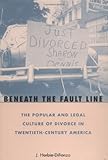
J. Herbie DiFonzo. Beneath the Fault Line: The Popular and Legal Culture of Divorce in Twentieth-Century America. Charlottesville: University Press of Virginia, 1997. xiv + 177 pp. $35.00 (cloth), ISBN 978-0-8139-1707-8.
Reviewed by Felice Batlan (Department of History, New York University )
Published on H-Law (September, 2001)
Divorce and the Meta-Narrative of History
Divorce and the Meta-Narrative of History
Recently the realm of divorce law has attracted the attention of legal historians and theorists who have realized that it provides, not a backwater, but a fertile arena in which to explore the intersections of statutory law, appellate law, trial law, social change, popular culture, gender, and the complicated behavior of individual litigants cast in the role of adversaries but formerly lovers, intimates, and family members. Perhaps in no other area of law have formal requirements and rules so differed from the lived realities of peoples' lives. Furthermore, within these interstices appear the age-old questions: does law shape culture, does culture shape law, or are the two are one and the same? Recently, two valuable books--by Hendrik Hartog and Norma Basch[1]--present remarkably rich and complicated narratives of the changing course of American divorce law in the nineteenth century and the multitude of ideologies that shaped it. J. Herbie DiFonzo's Beneath the Fault Line, which appeared before the studies by Hartog and Basch, also provides a welcome history of divorce, focusing on the twentieth century.
DiFonzo, an associate professor of law at Hofstra University, begins his well-researched book somewhat teleologically by posing the question how and why law and popular attitudes towards divorce changed over the course of the twentieth century; by the 1970s no-fault divorce and living-apart statutes became common across the United States, replacing fault-based divorce regimes. Counterintuitively, his central thesis is that the liberalization of divorce laws was often a conservative move by legislatures intent upon slowing divorce rates. In practice, however, these laws had no such effect. In exploring this thesis, DiFonzo examines not only cases, statutes, and scholarly works, but also a vast number of articles appearing in popular magazines between World War I and the 1950s, in an effort to trace changing cultural and popular understandings of divorce.
In Chapter 1, "The Feminization of Divorce after World War I," DiFonzo posits that the emergence of the New Woman, which included a widespread perception of greater economic opportunities for women in the labor force as well as a transition from an ideology of domesticity to that of individualism, ushered in a new popular (if not legal) acceptance of divorce. DiFonzo makes a number of important points in this chapter that reflect his nuanced understanding of the interactions between law on the books and the ways that litigants, asserting their own agency, shape legal practice. DiFonzo writes, "[D]ivorcers co-opted the trial bench, by and large, ignoring the fault threshold to divorce encoded in statute and case precedent and substituting a formulaic ritual which masked the underlying reality of mutual consent.... Thus, the vanguard of dissolution-minded spouses indeed made law outside the normal registers of legislative and appellate mandate" (p 16). Thus, DiFonzo sets up a dialectic, which runs throughout his book, between formal law and lived law.
Although his argument is adroit, more troubling is DiFonzo's periodization--especially where and how he decides to begin his narrative. DiFonzo leaves his reader with the impression that in the 1920s divorce became both feminized and popularized, representing discontinuity with the past. Such a claim is problematic. As Norma Basch has demonstrated by analyzing nineteenth-century trial court records, long before the second decade of the twentieth century divorce was a women's remedy, often for abandonment. Likewise, one of Hendrik Hartog's most profound contributions is his demonstration that throughout the nineteenth century husbands and wives, often ignoring the legal process altogether, abandoned one another (typically the husband abandoning the wife), moved, re-married, and fashioned new identities for themselves. In light of their work, both the question of how the post-World War I period represents either continuity or discontinuity, and the ways that popular culture may have reflected or distorted the era's character, seem more complicated and less transparent than DiFonzo allows.
Furthermore, DiFonzo's argument regarding changing gender roles also seems incomplete. To be fair, he is attempting to present a synthetic history of women's gradual "emancipation" in the first half of the twentieth century; in the process, he does a good job synthesizing a wealth of material. His book lacks an understanding of gender as a relationship of contextualized power, however. Thus, for example, we must question what divorce by "mutual consent" actually meant and the differing impacts that divorce laws may have had on a wide variety of women across races and economic classes. Related to this issue are the ways in which divorce laws also served to regulate gender boundaries and the family, while serving a state-building project intimately related to a particular vision of Americanization and the stability of the family.
For instance, Eileen Suarez Findlay's recent work on Puerto Rico provides important insight about American divorce at the turn of the twentieth century and its relationship to gender, imperialism, and the state.[2] Indeed, part of the program of the colonialization by the United States of Puerto Rico included the adoption of greatly liberalized divorce laws (1902) in an attempt to make marriage itself more enticing. Findlay writes that access to divorce unleashed a flood of initial support for U.S. rule, and Puerto Rican women descended upon the courts seeking divorces.[3] Findlay's account again demonstrates some of the problems with DiFonzo's periodization and also raises the fascinating question of the role of U.S. divorce law in fashioning support for U.S. imperialism, which must be understood as at least one component of U.S popular culture.
Even though DiFonzo's understanding of the conjuncture of divorce and gender is not entirely satisfying, he deftly demonstrates how the law of divorce tracked other legal trends, while he adds a number of illuminating twists. In doing so, he reads divorce law back into the larger narrative of jurisprudence through which legal historians and theorists understand the changing shape of American law during the course of the twentieth century. Divorce law in the late nineteenth and early twentieth centuries, which only recognized fault (primarily in the form of desertion, cruelty, and adultery) as grounds for divorce, was an example par excellence of legal formalism in which form presided over substance and fact. The technical grounds of fault provided a ritualistic legal foil allowing trial courts to ignore the facts as long as fault was properly articulated and the litigants mumbled the correct words.
Indeed when both parties agreed sub silentio on the divorce, no party had any incentive to file an appeal, giving the trial courts essentially free rein to engage in this legal charade. DiFonzo recites the by-now well-known New York State divorce antics of hotel-room set-ups meant to produce photographic evidence of adultery. DiFonzo concludes that the trial bench supported easy access to divorce and often, in practice, expanded the grounds of cruelty to encompass incompatibility. Yet unlike legal formalism in the arenas of contact, tort, and property, legal formalism vis-a-vis divorce seems a much more benign, even positive phenomenon, essentially creating a zone of privacy for divorcing couples and allowing for individual agency, again demonstrating the importance of context over labels.
By the 1930s, some states began to contemplate reforming fault-based divorce regimes to allow for non-fault-based causes, such as incompatibility and living-apart statutes. In 1933, New Mexico was the first state to amend its divorce laws to add incompatibility as a ground for divorce. Even so, as DiFonzo demonstrates, New Mexico's appellate courts were left to demarcate the boundaries of this new legal category of "incompatibility" and to determine whether fault and recrimination could still be recognized in incompatibility cases. Over the course of decades, New Mexico's Supreme Court produced a series of often-inconsistent opinions, demonstrating the continuing sway of fault-based divorce jurisprudence in the minds of appellate judges. Living-apart statutes ran an equally tortuous route, as divorcing couples found it easier to play the fault game then to spend years living apart before divorcing. DiFonzo argues that legislatures enacted such statutes not to facilitate divorce but rather to stem the tide of divorces. Divorcing couples refused to take the bait. Those who did, however, at times confronted hostile appellate courts that read into these statutes numerous restrictive requirements. DiFonzo thus sets forth a pattern in which legislatures, trial courts, and divorcing couples, each for disparate reasons, attempted to move away from a regime of fault, while appellate courts often frustrated such attempts.
In the period following World War II, divorce increasingly came within the purview of family courts, where law and a culture of therapy merged. Under the guise of psychological expertise, family court judges (such as Paul Alexander of the Toledo, Ohio family court) attempted to stem the tide of divorce. No longer would the fault of one party, or even mutual consent, necessarily result in a divorce decree. Rather, divorce-seekers were redefined as mentally ill and in need of expert guidance and treatment. Thus, the judge, along with other experts, now became the arbiter of the health of the marriage rather than the couple themselves, as various courts experimented with enforced reconciliation. Similarly, the move away from viewing divorce cases as adversarial proceedings helped to reshape attorneys' roles from representing an individual client to expressing concern for the health of the entire family. DiFonzo stresses that therapeutic family courts reflected a fad within the law towards sociological jurisprudence and interdisciplinary collaboration--a reaction against the legal formalism of the long nineteenth century. Although the story of the move to expertise and science has been told many times, DiFonzo once again makes the convincing argument that the formalism of the fault system of divorce provided greater leeway for self-autonomy then that derived under a combined legal/social work regime, in which a court sought to substitute its assessment and its decision for those of the couple seeking divorce.
Surprisingly, unlike other historians who have written about family courts, DiFonzo does not discuss the ways that court-enforced reconciliation hampered the efforts of wives to escape marriages. As he acknowledges throughout his study, it was women who, historically as well as today, most often seek divorces. Thus, state efforts to prevent divorces must also be understood as having gendered implications and as being, at least in part, efforts to control women and to enforce a particular norm of what constitutes the appropriate family. Indeed, we need to provide a theoretically-grounded explanation, taking account of the conservatism of the Cold War era, for the emphasis after World War II on maintaining the intact family through divorce reform. Historians such as Elaine Tyler May and (more recently) Laura McEnaney are beginning to explore the Cold War's effect on changing perceptions and ideologies of the role of the family, and the complicated, although crucial relationship between foreign and "domestic" politics.[4] One of the next fruitful steps in legal history should be to begin integrating and conceptualizing divorce law into these theoretical paradigms.
And yet, as DiFonzo writes, by the 1960s family courts, along with juvenile courts, were beginning to fall into disfavor. The divorce bar resented the loss of fees and of its monopoly over knowledge and power, which it now had to share with a bevy of social workers and psychologists.[5] The psychiatric profession began to doubt the effectiveness of mandatory counseling and, perhaps most important, states began to notice the high cost of staffing such courts.
DiFonzo documents California's efforts at divorce reform as illustrative. In 1966, Governor Edmund G. Brown appointed a commission to study family law. The commission produced a report, influenced by recent proposals and reforms in England, that strongly endorsed a non-adversarial, therapeutic family court with jurisdiction over marital dissolution. Such courts would rely upon a cadre of professional staff charged with determining whether a marriage was beyond repair. In addition, they would provide marital counseling, and exert not inconsiderable pressure on the parties to reconcile. Although the legislature rejected the creation of a statewide system of family courts, Governor Ronald Reagan signed into law the Family Law Act of 1969, which eliminated fault from the state's law of divorce. In 1972, the California Supreme Court ruled that a couple's consent to end their marriage could not substitute for the court's own determination of irreconcilable differences. Trial courts, however, repeating patterns established earlier in the century, refused to deny divorces.
In his last full chapter, DiFonzo writes the following enigmatic words about the legal reforms resulting in no-fault divorce: "These radical changes in the formal legal system had stripped the process of its cultural authenticity by artificially accelerating the tendencies toward a socially atomistic and destructive form of individualism.... No fault, this new paradigm in family law, constitutes nothing more elegant than naked divorce" (170). Thus, it appears that DiFonzo believes that he has written a narrative of change over time. Yet a reader might discern a different narrative trajectory implicit in the text--one not of change but of continuity. As DiFonzo demonstrates, throughout the century, in one way or another, married couples divorced and the formal legal rules consistently seemed to have meant little, as couples and their lawyers learned to play by whatever rules were in place. DiFonzo writes, however, that no-fault divorce, or divorce on demand, was the symptom of individualism run amok in a "society with a fervid disinterest in preserving relationships" (p. 172). This charge seems easily made but extremely difficult to unpack. For instance, the gay and lesbian rights movement has spent years fighting to have the law recognize same-sex marriages. People divorce but they also continue to remarry. Indeed, exactly what society, people, and relationships are we talking about? How do we even begin to measure such a claim?
DiFonzo has produced an immensely readable book filled with ideas. Yet too often he drops the various threads of his argument. For instance, at times, especially for the post-World War I period, he pays particular attention to popular culture, mostly in his reading of popular magazine articles. Yet when he turns to legal reforms in the post-World War II period, his analysis of popular culture fades. Likewise, what might be labeled "women's emancipation" plays a large role in DiFonzo's pre-World War II narrative but fades in the period following World War II. Furthermore, the lack of any discussion of the women's liberation movement or texts such as Betty Freidan's The Feminine Mystique are particularly startling omissions.
Nevertheless, DiFonzo makes a substantial contribution to the literature on twentieth-century American divorce, primarily through his complex understanding of the state and the ways in which its various components--the legislature, reform commissions, appellate courts, and trial courts--worked at cross-purposes, while individuals caught in the system's matrix continually adopted to the rules of the game.
Notes
[1]. See Hendrik Hartog, Man and Wife in America: A History (Cambridge: Harvard University Press, 2000); Norma Basch, Framing American Divorce: >From the Revolutionary Generation to the Victorians (Berkeley: University of California Press, 1999).
[2]. See Eileen J. Suarez Findlay, Imposing Decency: The Politics of Sexuality and Race in Puerto Rico, 1870-1920 (Durham, N.C.: Duke University Press, 1999).
[3]. Findlay, Imposing Decency, 112.
[4]. See Elaine Tyler May, Homeward Bound: American Families in the Cold War Era (New York: Basic Books, 1988); Laura McEnaney, Civil Defense Begins at Home: Militarization Meets Everyday Life in the Fifties (Princeton, N.J.: Princeton University Press, 2000).
[5]. Although DiFonzo does not make the point, many of these social workers were women.
If there is additional discussion of this review, you may access it through the network, at: https://networks.h-net.org/h-law.
Citation:
Felice Batlan. Review of DiFonzo, J. Herbie, Beneath the Fault Line: The Popular and Legal Culture of Divorce in Twentieth-Century America.
H-Law, H-Net Reviews.
September, 2001.
URL: http://www.h-net.org/reviews/showrev.php?id=5485
Copyright © 2001 by H-Net, all rights reserved. H-Net permits the redistribution and reprinting of this work for nonprofit, educational purposes, with full and accurate attribution to the author, web location, date of publication, originating list, and H-Net: Humanities & Social Sciences Online. For any other proposed use, contact the Reviews editorial staff at hbooks@mail.h-net.org.

