



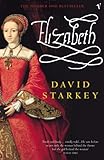
David Starkey. Elizabeth. London: Vintage, 2001. xii + 372 pp. + 16 pp. of plates. $16.09 (paper), ISBN 978-0-09-928657-8.
Reviewed by Norman Jones (Department of History, Utah State University)
Published on H-Albion (September, 2001)
The Difficult Youth of Elizabeth I
The Difficult Youth of Elizabeth I
This is the book of BBC 4's Elizabeth that ran in the UK in the spring of 2000. The release of this biography was timed to match the showing, and Elizabeth: Apprenticeship quickly entered the best seller list in Britain. The popularity of the program and the biography was due in part to the subject matter, and in part to David Starkey's reputation and skills as a media personality. Perhaps best known to BBC listeners as a radical libertarian panelist on Radio 4's The Moral Maze, he created the program David Starkey's Henry VIII in 1998. American audiences have known him as a commentator for NBC's coverage of the funeral of Princess Diana. But before all his media activities, David Starkey, a student of Sir Geoffrey Elton, earned a PhD in Tudor history from Cambridge, writing a dissertation which is accurately described on Starkey's web site [http://goodqueenbess.com/pages/home.html] as "an underground classic." An expert on the household of Henry VIII, he interpreted Henry's court to the public in a superb Greenwich exhibition and edited the household inventories of Henry VIII. He is now engaged in a new television program on the six wives of Henry VIII and a new biography of that king. Sometimes referred to in the press as the "media don," Starkey's contributions to the public interest in the Tudors were recognized this year by the Historical Association, which awarded him the Medlicott Medal for Services to History.
Most historians faced with the "book of the film," let alone the film itself, are immediately skeptical. We distrust film's lack of nuanced interpretation and the security of footnotes. And most of the time we are absolutely correct in doing so, but in this case we have to pause and ask whether Starkey, who won his scholarly spurs and taught Tudor history at the London School of Economics, has united the worlds of popular media and scholarly rectitude. Clearly this book is written for an audience that does not care whether he looked at PRO SP 10 in person. It is an audience that wants to know about the perils of Elizabeth, and which is entertained by a strong historical narrative, so it cannot be expected to tolerate formal historical argument. The pull of the scholarly standard and the push of popular narrative are visible in this text, but Starkey has done a good job of uniting the two. He is up-to-date in his secondary scholarship, even while he uses popular language that sometimes makes the scholar uncomfortable. As he say in the preface, "if the result reads like a historical thriller, I shall be well pleased!" (p. xi).
This biography recounts the life of Elizabeth from her birth to the first day of her reign as queen, the first twenty-five years of her life. Its thesis is that her youthful experiences shaped her into the ruler she would become, and that these experiences are underestimated by other biographers of the Queen. It is he says, a tale full of "extravagant characters and madcap schemes" (p. xi) in which women plot with the best and throw over the restraints of respectability and marriage. This is not a promising start, aiming to lure readers from the popular market. As the biography settles into its chronological recounting of Elizabeth's youth, it turns into a more respectable, straightforward narrative, becoming less of a historical thriller, and more of a re-telling of well-known historical events.
Looking at the bones beneath the narrative, we find a rather odd combination of sources. Starkey has apparently been deeply influenced by Louis Wiesener's La Jeunesse d'Elizabeth d'Angleterre (1878), a two-volume account which covers exactly the same ground. It is, as he says, the most thorough treatment of the subject. He shows a reluctance to cite modern biographies, dismissing them as written by historians who have fallen in love with Gloriana. This seems rather harsh, since several biographies allot considerable space to the youthful experiences that formed Elizabeth. J.E. Neale's Queen Elizabeth I (1934) comes to mind as one which, written with a similar light touch, has remained a scholarly standard. Appropriately, however, he is not interested in arguing with others scholars.
His short chapters alternate between those built on modern secondary sources and those based on primary sources. Clearly, some chapters are summaries of others' works. For instance, the chapters on Elizabeth's Marian incarceration at Woodstock are based almost entirely on C.R. Manning's 1855 collection of state papers relating to the affair. This allows for a straight narrative, but does not invite nuances or admit historiographical insight. On the other hand, some chapters, like that on the Parliament of 1559, are based mostly on secondary works. It would be churlish of me to complain that he was not using an excellent source for that chapter, my Faith by Statute (1982), but its heavy use underscores the way he selected his sources. Where a standard work exists, it is extensively incorporated. Where printed runs of documents are available, he generally prefers to use them.
Were this a book aimed at undergraduates, I would quarrel with some of his interpretations and descriptions. His account of Thomas Seymour's forward behavior toward Elizabeth follows the sources, but ends with a twist that rushes into a place angelic historians fear to tread. Catherine Parr and her husband, hints Starkey, if tried by social workers and pediatricians, would be found guilty of child abuse. He then speculates that Catherine Parr participated because her mind was unbalanced by her pregnancy. A modern audience might resonate to claims of child abuse, but it goes far beyond what can be proved. Especially since he seems to discount the struggles for political power and control that lurk just beneath the charges against Seymour. As Sir John Neale observed, the whole episode was shocking only to Victorian minds, not Tudors, and it only became interesting when it was linked to Seymour's desire to marry either Elizabeth or Jane Grey. If Starkey had expanded the narrative a little more, to include more of the politics beyond Elizabeth's person, the Seymour affair might have looked less like sexual abuse and more like abuse of power.
This is important because Starkey believes that this episode scarred Elizabeth's sexual development. An exciting argument about the origins of virgin queenship, it seems as likely that the behavior of political leaders in the affair taught her lessons she never forgot. She certainly emerged from the experience a shrewder politician, but it is difficult to know if she lost her sexual naivete at the same time.
Although he sometimes goes too far, other parts of Starkey's book are very refreshing. This is certainly a good account of Elizabeth in Mary's reign, and it vividly paints the strains and risks that convinced Elizabeth to adopt a Nicodemite theology. I especially like the ways he uses his knowledge of court organization and etiquette to illuminate political positions.
The ultimate question is whether this book could be safely used in a course; does it recount the history in a professionally satisfactory manner? One could assign it to undergraduates. It is a lively and interesting narrative that opens up a number of issues, such as sexuality, the functioning of royal households, court etiquette and religion in ways that would create teaching opportunities. One would not, however, want to use it as a single source. Paired with something else, such as Diarmaid MacCulloch, The Boy King: Edward VI and the Protestant Reformation (2001), it might serve well. Best of all would be to match it with Jenny Wormald's biography of Mary Queen of Scots (rev. ed., 2000) so students can learn to differentiate between "mere" biography and fully contextualized biography.
When all is said and done, I applaud Dr. Starkey's determination to make Tudor history interesting to the public. As the medium between the worlds of scholarship and popular history, he did a respectable job with this book.
If there is additional discussion of this review, you may access it through the network, at: https://networks.h-net.org/h-albion.
Citation:
Norman Jones. Review of Starkey, David, Elizabeth.
H-Albion, H-Net Reviews.
September, 2001.
URL: http://www.h-net.org/reviews/showrev.php?id=5473
Copyright © 2001 by H-Net, all rights reserved. H-Net permits the redistribution and reprinting of this work for nonprofit, educational purposes, with full and accurate attribution to the author, web location, date of publication, originating list, and H-Net: Humanities & Social Sciences Online. For any other proposed use, contact the Reviews editorial staff at hbooks@mail.h-net.org.

