



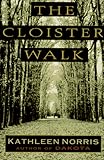
Kathleen Norris. The Cloister Walk. New York: Riverhead Books, 1996. xv + 384 pp. $23.95 (cloth), ISBN 978-1-57322-028-6.
Reviewed by Dale Jacobs (University of Nebraska-Lincoln)
Published on H-PCAACA (August, 1996)
Piety in Our Time: A Poet's View
In Kathleen Norris's new book, The Cloister Walk, she returns to material that she first touched on in Dakota: A Spiritual Geography, expanding and revisioning her encounters with both monasticism and spirituality. Despite the fact that she had been "raised a thorough Protestant, with little knowledge of religious orders, and no sense of monasticism as a living tradition," ten years ago Norris became an oblate of the Benedictine order. Through her association with Benedictines in both South Dakota and Minnesota, Norris attempts to understand spirituality, monasticism, liturgy, and the ways in which they are connected to her life and her writing.
The Cloister Walk chronicles a period that spans two nine-month terms of study at the Institute for Ecumenical and Cultural Research at St. John's Abbey and University in Collegeville, Minnesota. As she tells the scholars gathered at the first seminar of the Ecumenical Institute, her "research" is to be "primarily experiential, and will be centered on attending the daily Liturgy of Hours at the monastery." The Cloister Walk, then, is an explicitly non-academic work; rather, it is a miscellany of ruminations on the place of religion and poetry in American life in general and in Norris's life in particular.
Norris mixes diary entries drawn from her time in the monastic community with essays that cover a wide range of topics that both debunk simple pictures of monastic life and broaden our understanding of what it is to live a life of community and spirituality. In this collection, we are able to witness a mind brilliantly at play, wrestling with difficult ideas such as the connection between liturgical time and poetic time, the place of saints in modern society, how to learn from monastics about living in community, the relationship between monastic celibacy and marriage, Benedictine hospitality and its connections to modern life, and the place of metaphor in spiritual and collective languages. Drawing on her experience as a poet, Norris draws us into her spiritual questioning and reflection while simultaneously directing us to see their larger implications. Her writing, then, acts as a kind of lecto divina, or "holy reading," in which she can read the world and her place in it while causing us to think about the same issues.
As Norris explains, the word "oblate" means "to offer" and, as she says, she initially knows not what she has to offer. She has, in writing The Cloister Walk, shown us that she has to offer an impressive breadth of inquiry that invites us to look again to issues of spirituality and poetry that are not often a part of our daily lives in contemporary American society. Like all good essayists, Norris offers us the process of a fertile mind at work, meditating and reflecting so that we might do so as well. The Cloister Walk is a thoroughly enjoyable and thought-provoking book spoken in a voice that is strong and clear and joyful. It is, in the final analysis, experiential research of the best kind.
If there is additional discussion of this review, you may access it through the network, at: https://networks.h-net.org/h-pcaaca.
Citation:
Dale Jacobs. Review of Norris, Kathleen, The Cloister Walk.
H-PCAACA, H-Net Reviews.
August, 1996.
URL: http://www.h-net.org/reviews/showrev.php?id=542
Copyright © 1996 by H-Net and the Popular Culture and the American Culture Associations, all rights reserved. H-Net permits the redistribution and reprinting of this work for nonprofit, educational purposes, with full and accurate attribution to the author, web location, date of publication, originating list, and H-Net: Humanities & Social Sciences Online. For any other proposed use, contact P.C. Rollins at Rollins@osuunx.ucc.okstate.edu or the Reviews editorial staff at hbooks@mail.h-net.org.

