



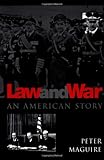
Peter Maguire. Law and War: An American Story. New York: Columbia University Press, 2000. xii + 290 pp. $30.00 (cloth), ISBN 978-0-231-12050-0.
Reviewed by Jonathan Lurie (Rutgers University, Newark)
Published on H-Law (July, 2001)
The Trials of War
The Trials of War
Law and War is a fascinating, occasionally flawed and frustrating, but ultimately successful work that is well worth reading. Moreover, as we await and anticipate the impending war crimes trial of Slobodan Milosevic, Peter Maguire's work is especially timely. Although much of the book focuses on the Nuremberg trials, Maguire, who has taught on this subject at Columbia University and Bard College and was historical advisor to the documentary "Nuremberg: A Courtroom Drama," quite properly places this topic in a broader context. The resulting account of "law and war" focuses on four preludes to Nuremberg: our Civil War; the virtual destruction, if not elimination, of Native American society; the Philippine insurrection; and World War I. Maguire contends, I believe correctly, that unless one understands how American policy towards law and war was shaped and reshaped by these four developments, it is impossible to grasp the ultimate significance of the Nuremberg trials AND their implications concerning future American policy, for better or for worse. Those who feel confident about U.S. policy as we head into the latest round of international war crimes trials, aptly described by Yale Law Professor Ruth Wedgwood as "a growth industry," ought to read Maguire's book and carefully ponder his conclusions.[1] Maguire argues that the lessons of Nuremberg "remain unclear" in part because "what that name represents is really a series of contradictory trials that lead to no single, simple conclusion" (p. 5). They represent a telling example of "the storm where war, law and politics swirl and oscillate in a constant state of flux." As with much of our history, the Nuremberg Trials reflected a real "tension between America's much-vaunted ethical and legal principles and its practical policy interests" (pp. 5-6). Moreover, American history demonstrates an inability and/or disinclination to make war with a common set of expectations and procedures. Thus we fought the Civil War, the Indian Wars, and the Philippine insurrection with very different tactics and perceptions of our opponents. Denouncing some opponents as "savages" or "barbarians," we made war according to different sets of rules, depending on who our adversaries were. Treaties ending hostilities with England were one thing, but solemn promises made to Indians were quite another. Opponents in Cuba were not equated with Phillipino natives clothing their insurrection in the rhetoric of a quest for independence.
In the early 20th century, even as the United States repressed this "insurrection" with a brutality still noteworthy, it strongly endorsed new codes for international law, as long as they did not conflict with American interests. This duality was not unique to the United States, but was reflected by European nations who fought wars against one another with very different rules than those applied in their colonial wars. The ability to justify such differences concealed in such phrases as "manifest destiny," or the views associated with John Fiske, Josiah Strong, or Alfred Thayer Mahan, resulted in a new tendency to use law and war as a political tool "like any other." What could be justified legally did not have to be justified morally (p. 53). In addition to this duality, Maguire notes a third practice established well before World War II, one he labels "strategic legalism." As applied to war crimes, the term referred to "post trial, non judicial means to further reduce already lenient sentences. In other words, once the public had been served its 'justice,' the sentences were quietly reduced behind the scenes" (p. 9).
Maguire links conduct based upon these three tendencies to a number of Wall-Street-trained lawyers who held high diplomatic posts between 1896 and 1953. Such names as Elihu Root, Robert Lansing, Henry Stimson, John J. McCloy, and John Foster Dulles figure prominently in his narrative. As Secretaries of State, Root and Lansing had experienced no difficulty separating morality from policy. "Justice," claimed Lansing, "is secondary. Might is primary" (p. 78). At the conclusion of what had been, thus far, the bloodiest war in the 20th century, Lansing opposed a harsh punitive policy towards Germany, on the grounds that it "might also lead to a breakdown of authority that would hinder 'the resistance to Bolshevism'" (p. 78). Moreover, even though the "Young Turks" virtually exterminated more than a million Armenians, the United States had been conspicuous by its absence from the joint British-French-Russian denunciation of such atrocities. And whereas post-World War I diplomatic efforts employed rhetoric that condemned recourse to war, and renounced it as an instrument of national policy, the reality was totally different, as citizens in Ethiopia, Manchuria, and Czechoslovakia could well verify.
Maguire shows how problematic the path towards the Nuremberg trials was. It represented a trail riddled with inconsistencies. A number of American soldiers who liberated the Nazi death camps committed "war crimes," in that they permitted or assisted in the torture and killing of a number of German workers or staff at the hands of understandably vengeful inmates now liberated. They were not punished. The Russian brutalities in Poland and Eastern Europe could not be a subject for the international tribunal, even though there was no doubt concerning the viciousness of Soviet conduct. Nor was the American fire bombing of Tokyo, an incident that killed between 90,000 and 100,000 civilians, to be questioned, even though General Curtis LeMay noted that "we scorched and boiled and baked to death more people in Tokyo on the night of 9-10 March than went up in vapor at Hiroshima and Nagasaki combined" (p. 102). Above all, there remained the question of a victor's "justice" as opposed to a winner's "vengeance." Which of these two alternatives best described Nuremberg?
Justice Robert H. Jackson, on temporary leave from the U.S. Supreme Court to serve as Chief Prosecutor for the first Nuremberg Trials, stated that for the allies to "stay the hand of vengeance and voluntarily submit their captive enemies to the judgement of law is one of the most significant tributes that Power has ever paid to Reason" (p. 124). It could also be considered, Jackson conceded, as victors dealing with the vanquished. Almost half a century after Jackson spoke, a survivor of Nazi horrors, New York Times editor Max Frankel, insisted that at Nuremberg, "the winners were producing a false image of justice, a theatre of the absurd...." Such proceedings were in fact "a retroactive jurisprudence" that would surely be unconstitutional in an American court.[2] Indeed, the German defendants were quick to point to Allied conduct during the war that paralleled their own. Had Admiral Karl Doenitz, for example, committed war crimes in ordering his submarines neither to give advance warning of a ship's imminent destruction, nor rescue survivors? Not according to American Admiral Chester Nimitz and the British Admiralty. Both conceded that "they too had waged unrestricted submarine warfare" (p. 124). Indeed it was difficult for the British to condemn the validity of Doenitz's actions, as they had done exactly the same thing. After sinking the famous German battleship Bismarck in 1941, the British ships deliberately left most of the Bismarck's crew to drown in the Atlantic.
Although Maguire does not discuss the point, perhaps it may have been lingering doubts concerning the very legitimacy of their actions that led the International Military Tribunal (IMT) to be what he describes as "very conservative in applying the hotly debated conspiracy and aggression charges" (p. 129). The judges did indeed sentence twelve representatives of the Nazi leadership to death, but in terms of reeducation, reform and overall social engineering--all goals of the IMT architects--they were "less successful." Maguire notes the lingering German emphasis on the legal flaws inherent in the IMT trials, rather than on the need to reeducate an entire nation. He devotes considerable space to a fascinating analysis of contemporary German reaction to them. Although he does not explore this theme in any great detail, it would have been interesting to compare Japanese reaction to their equivalent war crimes trials with that of Germany. Maguire is far more critical of General MacArthur's conduct of the Yamashita and Homma war crimes trials.
Maguire cites a number of differences between the German and Japanese proceedings. In contrast to Nuremberg, MacArthur himself selected the judges, none of whom was a lawyer. Moreover, the Japanese tribunal was not bound by usual rules of evidence. Again, in marked contrast to Nuremberg, two of the resulting death sentences were reviewed by the United States Supreme Court. That the Court affirmed these verdicts is not surprising. But, as Maguire points out, the vigorous dissents from Justices Frank Murphy and Wiley B. Rutledge did "lasting damage to the reputation of the Yamashita case." Ultimately, Maguire concludes, the IMT at Nuremberg has received (as it deserved) much better treatment from history than the MacArthur trials did. Those trials represented "a throwback to traditional, punitive political justice" (p. 135). Although its level of success can be debated, Maguire believes that undoubtedly the IMT procedures and resulting decisions went beyond this.
The best part of Maguire's study is his persuasive narrative of and explanation for the ultimate fate of the vast majority of Nuremberg defendants--release from confinement and pardon. He shows how American policy vacillated from the righteous rhetoric of Robert H. Jackson to the ultimate embrace and rearming of West Germany, all because of Cold War fears that dominated American foreign policy from 1948 to 1958. Indeed, he implies, little is left of the IMT war crimes Nuremberg trials but nostalgia. By the late 1950s the Allies released their last convicted war criminals. A High Commissioner to Germany such as John J. McCloy--another Wall-Street-trained attorney in the tradition of Elihu Root and Robert Lansing--well reflected the new Cold War mentality. In 1942, at the time of the disgraceful internment of Japanese Americans, McCloy had dismissed the U.S. Constitution as "just a scrap of paper" (p. 224). He later recalled that "I never considered myself a politician, but rather a lawyer, so the question I asked myself in the various jobs I had was 'What should we do to solve the problem at hand'"? (pp. 380-381). If the problem was how to rearm and realign West Germany with the United States, the continued imprisonment of German war criminals had to cease. And it did.
Maguire's analysis of the Nuremberg trials is marred by some frustrating errors and omissions. He mentioned that on November 6, 1946, the IMT sentenced twelve convicted defendants to death, and further states that (as Hitler, Himmler, and Goebbels had also done) Goering cheated the hangman. Maguire than adds that on October 16, "the other ten convicts" were hanged (p. 130). Nowhere does he explain that one of the twelve, Martin Bormann, was tried in absentia. Bormann disappeared during the final collapse of Nazi Germany and has not been located to this day. Also, Maguire's treatment of "war crimes" during the Civil War would have been strengthened by integrating Phillip Shaw Paludan's haunting and disturbing book Victims: A True Story of the Civil War into his analysis.[3.] Moreover, the book could use some judicious editing and careful proof reading; e.g., "Thirty years War (1648-1648)" Finally, a number of the book's extensive endnotes should have been integrated into the text. Better yet, Columbia University Press should have placed the footnotes on each page.
None of these criticisms seriously detracts from the goal of Maguire's study: to explore and chronicle the vast gaps between the rhetoric and reality of American policy vis-a-vis war crimes throughout our history. This he has accomplished very well. Ultimately, he writes, "the time has come to reconsider the legacy of the Nuremberg trials as more of an anomaly than a paradigm" (p. 289). As we anticipate further war crime trials, Maguire's words ring true with a disturbing resonance: "Lurching from global crisis to global crisis, we live in an age when strategic, much less moral, doctrines have been replaced by psychobabble, public opinion polls, and that great arbiter of justice, CNN" (p. 289). Given the accuracy of his point, one wonders how significant and lasting future war crimes trials can be. Professor Jonathan Bush observes that, with the end of the cold war in the early 1990s, "what was most troubling" about the "international community" has been the fact that "it overvalued what trials can do and completely missed the point of what Nuremberg did and didn't do" (p. 289). Maguire's book is an effective antidote for this condition.
NOTES
[1]. Quoted in The New York Times, July 1, 2001, at 8.
[2]. The New York Times Magazine, May 7, 1995, at 48-49.
[3]. Phillip Shaw Paludan, Victims: A True Story of the Civil War (Knoxville: University of Tennessee Press, 1981).
Copyright 2001 by H-Net, all rights reserved. H-Net permits the redistribution and reprinting of this work for nonprofit, educational purposes, with full and accurate attribution to the author, web location, date of publication, originating list, and H-Net: Humanities & Social Sciences Online. For any other proposed use, contact the Reviews editorial staff at hbooks@mail.h-net.msu.edu.
If there is additional discussion of this review, you may access it through the network, at: https://networks.h-net.org/h-law.
Citation:
Jonathan Lurie. Review of Maguire, Peter, Law and War: An American Story.
H-Law, H-Net Reviews.
July, 2001.
URL: http://www.h-net.org/reviews/showrev.php?id=5294
Copyright © 2001 by H-Net, all rights reserved. H-Net permits the redistribution and reprinting of this work for nonprofit, educational purposes, with full and accurate attribution to the author, web location, date of publication, originating list, and H-Net: Humanities & Social Sciences Online. For any other proposed use, contact the Reviews editorial staff at hbooks@mail.h-net.org.

