



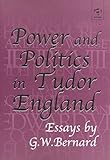
G. W. Bernard. Power and Politics in Tudor England. Aldershot and Burlington: Ashgate, 2000. 240 pp. $59.95 (cloth), ISBN 978-0-7546-0245-3.
Reviewed by Barrett Beer (Department of History, Kent State University)
Published on H-Albion (July, 2001)
Early Modern Power and Polemic
Early Modern Power and Polemic
Without apology to the new history in any of its forms and formulations, this fascinating collection of essays focuses on high politics and the exercise of power as its title clearly suggests. Closely inter-related themes include the Tudor monarchy, leadership at the highest level, the role of the nobility, political conflict, the monarchical character of the Church of England, and domestic architecture. Bernard's interests in Thomas Wolsey, Thomas Cromwell, Anne Boleyn, and relationships between the crown and council lie at the heart of a major part of the Tudor research agenda of the past fifty years. The essays not only explore power and politics but also have a distinct polemical tone with sharp attacks on the scholarship of G.R. Elton, Eric Ives, Retha Warnicke, Nicholas Tyacke, as well as the entire postmodernist movement. The book draws heavily on Bernard's previous publications and consists of an introduction and ten essays of which four are published for the first time.
"At the heart of the essays in this volume," Bernard writes, "lies an interest in the nature and expression of power, defined quite straightforwardly as the ability to take and to enforce decisions" (p. 1). In contrast to Elton, he argues that the English nobility remained powerful politically, socially, economically, and ideologically throughout the sixteenth century. Bernard vehemently rejects Ives's emphasis on factionalism and scorns a group of hedgers whom he labels as "it all depends" historians (p. 6). Although not mentioned in the title of any of the essays, Henry VIII quickly emerges as the dominant figure not only in the book but throughout the Tudor century. The other essential element in Bernard's equation of Tudor politics is the nobility. The Pilgrimage of Grace, here portrayed as a protest against Henry's religious policies, was halted at Doncaster through the efforts of George Talbot, Earl of Shrewsbury who raised over 3600 men within a week. During the reign of Edward VI, Edward Seymour, Duke of Somerset and John Dudley, Duke of Northumberland are designated as courtier- and administrator-magnates who were successfully thwarted in 1549 and 1553 respectively by a non-factional coalition of provincial nobility and gentry. Throughout the century loyal nobles acted on behalf of the Crown in the regions where they held land and formed a community of interest that sustained a partnership between the Crown and landed classes.
Descent from positions of power or influence are themes that appear in five different essays, if Amy Robsart's fall down a stairs is included. In a reconsideration of the fall of Wolsey, Bernard rejects arguments of Ives that a faction led by Thomas Howard, Duke of Norfolk was responsible for the cardinal's demise in 1529 and demonstrates that responsibility in fact lay with Henry VIII. The king was also primarily responsible for the fall of Anne Boleyn, but Bernard insists that he was no monster who acted irrationally. Bernard contends that there is "the likelihood that Anne and at least some of her friends were guilty of the charges brought against them" (p. 98) even if the motivation for her actions remains ambiguous. Descent for Thomas Cromwell is more broadly conceived as the author rejects not only Elton's interpretation of Cromwell's political demise in 1540 but also the larger part of Cromwell's standing as a major historical figure. After Wolsey, Queen Anne, and Cromwell, Thomas Seymour is definitely smaller fry, because he was a rash politician lacking any trace of judgment who threatened his brother, Protector Somerset, and other councillors. Amy Robsart, wife of Robert Dudley, Earl of Leicester, never exercised real political power, but her death in 1560 affected her husband's influence at court. Bernard reviews a wide range of evidence and concludes that while it would be difficult to convict Dudley in a court of law, a "good case can be made for saying that he intended to murder his wife and very likely did" (p. 172).
Bernard's essay on the Reformation is painted on a larger canvas as he examines the period from 1529 to 1642 and inflicts further damage to the already shaky thesis of Tyacke. Whereas historians often associate the changes of the Reformation with the clergy (either supported or opposed by the laity), Bernard postulates a monarchical reformation, a view that is a direct descendant of the old dictum that the English Reformation was an act of state. He finds little evidence of an Arminian plot in the 1620s and denies that William Laud was an Arminian who tried to create a like-minded clergy.
While Bernard's major conclusions are clearly presented, his detailed arguments are often complicated and a challenge to follow especially as one must digest ill-organized page-long paragraphs (pp. 58-60, 140, 143). He does not fully appreciate that he has engaged in a debate that reaches back at least to the early twentieth century when A. F. Pollard explored many of the same issues and consequently neglects to consider the broader historiographical context within which his work is located. To this reviewer many of Bernard's issues have a familiar, if dated ring since they were regular fare among graduate students at Northwestern forty years ago and treated at great length by Lacey Smith in Henry VIII: The Mask of Royalty (1971) and other works. While Bernard rejects the relativity of postmodern scholarship in favor of a laudable quest for objective truth, his own negative assessments of the work of able historians such as Elton, Warnicke, Tyacke--none of whom are remotely identified with postmodernism--suggest that a critical evaluation of sources can lead to widely varying conclusions rather than to the certainty that he values so highly. Indeed his own methodology reveals a few cracks when he accepts the authority of the Spanish chronicler of the reign of Henry VIII, draws on French poetry, and credits the authority of an anonymous historian to sustain his arguments. Whether it is policy-making during the reign of Henry VIII or the Reformation under Elizabeth, James I, or Charles I, Bernard's readings of the sources conveniently confirm his view that the monarchy was always dominant and that ministers, queens, and churchmen followed the king's lead.
If we assume that one of Bernard's objectives was to stir the waters of historical debate, it may be concluded that he has succeeded magnificently. His provocative essays refocus scholarly attention on important questions that are not less significant because they are old and draw attention to weaknesses embodied in the new history as well as scholarship that operates under a variety of other labels.
Copyright 2001 by H-Net, all rights reserved. H-Net permits the redistribution and reprinting of this work for nonprofit, educational purposes, with full and accurate attribution to the author, web location, date of publication, originating list, and H-Net: Humanities & Social Sciences Online. For any other proposed use, contact the Reviews editorial staff at hbooks@mail.h-net.msu.edu.
If there is additional discussion of this review, you may access it through the network, at: https://networks.h-net.org/h-albion.
Citation:
Barrett Beer. Review of Bernard, G. W., Power and Politics in Tudor England.
H-Albion, H-Net Reviews.
July, 2001.
URL: http://www.h-net.org/reviews/showrev.php?id=5283
Copyright © 2001 by H-Net, all rights reserved. H-Net permits the redistribution and reprinting of this work for nonprofit, educational purposes, with full and accurate attribution to the author, web location, date of publication, originating list, and H-Net: Humanities & Social Sciences Online. For any other proposed use, contact the Reviews editorial staff at hbooks@mail.h-net.org.

