



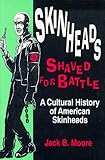
Jack B. Moore. Skinheads Shaved for Battle: A Cultural History of American Skinheads. Bowling Green, Ohio: Bowling Green State University Popular Press, 1993. 200 pp. $19.95 (paper), ISBN 978-0-87972-583-9; $39.95 (cloth), ISBN 978-0-87972-582-2.
Reviewed by Themis Chronopoulos (New School for Social Research)
Published on H-PCAACA (July, 1996)
Skinheads: Culture, Politics, History
Contrary to other American media and anti-racist organization accounts, this study argues that the Skinhead movement is a cultural rather than a political phenomenon. It attempts to trace the skinhead cult from its onset but focuses on fascist American skinheads in the 1980s, the first decade of their development as a separate and identifiable group.
Using reports by the Anti-Defamation League, the Southern Poverty Law Center, newspaper articles, and skinheads themselves, Jack Moore provides an articulate cultural portrait of fascist skinheads, their links to white supremacist groups, and their violent excursions--many of which resulted to the death of innocent people. One of Moore's most important contributions is his chapter on skinhead media representations, in particular those of syndicated talk shows (Oprah Winfrey, Geraldo Rivera, and the like) which, driven by their shameless quest for ratings, were of no meaningful substance and provided fascist skinheads with reinforcement of their perceived image.
The greatest weakness of the book is Moore's painstaking attempt to portray the entire skinhead movement as predominantly racist and fascist since its inception. It is doubtful that the majority of skinheads during any period of their existence outside the United States were either fascist or racist. In late 1960s Britain, the skinhead movement was a multiracial working-class phenomenon with Jamaican reggae and ska as well as American soul functioning as its most important cultural objectifications; Moore's assertion that this lasted for only a few months is incorrect, for in fact, it continued well into the 1970s; indeed, the skinheads were very influential in the revival of ska music during the 1980s. Moore's claim that punk was a fertile ground for the development of racism and a scene where violence was endemic is also inaccurate and based on symptomatic evidence; by the mid-1980s, the punk scene in the United States had effectively isolated and purged fascist skinheads. In fact, this is precisely when they began to emerge as a separate phenomenon preoccupied with the racist prejudices that the press and other organizations have illustrated. Further, Oi! music is not merely a white, racist skinhead musical stance; many of the most important bands in that movement have black members and followers. Finally, Skinheads Against Racial Prejudice (SHARP) is the most important skinhead organization, with chapters all over the world, despite the fact that many of its members remain blindly patriotic for their own country, and in some cases are homophobic, sexist, and view violence as a way to pursue their goals. Clearly the lines are not as sharply drawn as Moore describes them in this interesting study.
Overall, Moore's account is an excellent cultural testament on the rise (and fall) of racist and fascist American skinheads as well as the ideology and the actions that after 1985 characterized them as the most dangerous hate group in the United States. However, his views on the relationship between skinheads and the various musical scenes (reggae, ska, soul, punk, and Oi!) as well as the assertion that the majority of skinheads are mindless racist brutes should be examined in more careful detail. Perhaps future studies will add greater subtlety to this portrait. Until then, this is a fine and stimulating book about an important topic in popular culture studies.
This review is copyrighted (c) 1996 by H-Net and the Popular Culture and the American Culture Associations. It may be reproduced electronically for educational or scholarly use. The Associations reserve print rights and permissions. (Contact: P.C.Rollins at the following electronic address: Rollins@osuunx.ucc.okstate.edu)
If there is additional discussion of this review, you may access it through the network, at: https://networks.h-net.org/h-pcaaca.
Citation:
Themis Chronopoulos. Review of Moore, Jack B., Skinheads Shaved for Battle: A Cultural History of American Skinheads.
H-PCAACA, H-Net Reviews.
July, 1996.
URL: http://www.h-net.org/reviews/showrev.php?id=528
Copyright © 1996 by H-Net and the Popular Culture and the American Culture Associations, all rights reserved. H-Net permits the redistribution and reprinting of this work for nonprofit, educational purposes, with full and accurate attribution to the author, web location, date of publication, originating list, and H-Net: Humanities & Social Sciences Online. For any other proposed use, contact P.C. Rollins at Rollins@osuunx.ucc.okstate.edu or the Reviews editorial staff at hbooks@mail.h-net.org.

