



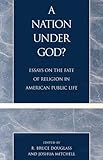
Joshua Mitchell. A Nation under God? Lanham, Md.: Rowman & Littlefield Publishers, 2000. xiv + 252 pp. $93.50 (cloth), ISBN 978-0-7425-0750-0; $25.95 (textbook), ISBN 978-0-7425-0751-7.
Reviewed by Bruce W. Stuart (California State University Fullerton)
Published on H-AmRel (July, 2001)
Religion and the Not-So-Naked Public Square
Religion and the Not-So-Naked Public Square
The book assesses the current state of religious discourse in the public arena. Focusing on the United States and addressing significant issues of communicating religious ideas in public debate, the eleven articles of the anthology are thoughtful, provocative, and timely. Introduced by a succinct thematic essay, the articles demonstrate the authors' concern that religious beliefs be given appropriate voice in contemporary democratic society and that the "public square" be open to ideas and policy agendas that have been shaped within specific religious traditions and motivated by distinctive spiritual experiences.
Citing the contributors' adherence to "one or another" of the nation's three "historic faiths," and suggesting that their collective discourse should be understood as an expression of "tolerant and ecumenical behavior" from a perspective within the "public church," the editors resist the secularization of contemporary America as well as those religious spokespersons who seek a privileged standing in public life (pp. ix-x). Cognizant that advocacy of religious beliefs in public life might well constitute a threat to democratic values, several essays articulate from several religious perspective a set of ethical guidelines for engaging in public advocacy. The authors strive for thoughtful religious reflection within the public discourse of a democratic polity.
A portion of the anthology addresses contemporary issues of public debate and policy advocacy. Two articles address contemporary challenges to traditional Christian views of marriage. John Witte, Jr., "An Apt and Cheerful Conversation on Marriage," characterizes the tension in Anglo-American family history between Christian views of marriage and an Enlightenment-based critique that has greatly influenced contemporary reform. Critical of the "patriarchy and paternalism" of the past, the author also cites "the massive social, psychological and spiritual costs of the modern sexual revolution" and notes the expanding impact of Enlightenment "contractual"values on contemporary marriage and divorce law (p. 91). The author warns that Enlightenment reform does not necessarily contribute to liberty and equality for women and children and counsels that families need support from a variety of spiritual and institutional sources (in addition to contracts, laws and courts).
Michael J. Perry, "Christians and Political Self-Restraint: The Controversy over Same-Sex Marriage," treats a contemporary public debate as an opportunity to reflect on Roman Catholic beliefs and the complexity and variety of ideas within that faith tradition. Perry argues that the diversity within the Catholic tradition ought to constrain the manner in which its spokespersons enter public debate and should shape both the form and the content of policy advocacy. Perry cites sharply differing views within the Church on homosexuality as a principle reason for caution in seeking political expression of religious views that oppose same-sex marriage and advocate legislative prohibitions against it. Issues of same-sex sexual conduct are contested within the Catholic Church. Many Catholics, Perry indicates, have a "religiously based belief," (a biblically based belief) that homosexual sexual conduct is always hostile to human well being (p. 178). By contrast: other speakers within the Church dispute the biblical basis of this belief. This intradenominational dissensus suggests to the author that biblically based advocacy of a prohibition of same-sex marriage is not appropriate to the contemporary public debate.
Perry argues that a reasoned analysis of contemporary human experience of same-sex sexual conduct and its consequences should supplement, even substitute for, biblically based positions. Within the Catholic theological-ethical tradition of Thomism such analysis is appropriate. Such reasoning in public religious discourse may well be persuasive to those who do not belong to that tradition but who can nonetheless appreciate thoughtful insight and practical wisdom that is a consequence the careful study of human behavior. In other words, in the context of a pluralistic society, a contemporary-oriented analysis is likely to be more persuasive to members of the public than biblically based testimonies that have arisen within a self-divided interpretive community.
Little attention in the anthology is given to other specific policy debates, with the exception of a brief, forceful critique of the American Catholic Bishops' "crusade" against abortion (126-129). Mary C. Segers, "Where Are We Now? 'The Catholic Moment' in American Politics," argues that the Bishops' twenty-year campaign against should have taught Church leaders several lessons about contemporary political advocacy, including the recognition that they cannot claim special privilege in the public arena, that their arguments are subject to the same tests of rationality as others in the debate, that they must be more aware of legislative dilemmas within a pluralistic society and that they ought to listen to the critical voices of Catholic feminists.
Beyond these excursions into the history, theological-biblical rhetoric and ethical reflection on public debates over marriage, homosexuality and abortion, the articles devote most attention to persuading the reader that religious people should enter public debate and that religious values and perspectives have a significant contribution to make to public life. One stated purpose of the volume "is to show how the quality of our public life (and indeed our entire way of life) could be enhanced by making room for a more overt reliance on resources derived from our religious traditions-and how it is diminished when we deny ourselves the possibility of calling on them" (p. xi). Reacting to those who discourage public-realm religious discourse, the authors' collective attitude is typified in Elliot Dorff's comment: "Instead of advocating all efforts to keep the public square as naked of religious views as possible, I now find myself instead arguing for religious American to come to the public debate as the religious people they are, contributing their distinctive religious perspectives to the discussion about, and creation of, national policy" (218). Each commentary blends analysis and advocacy in relation to specified religious experience, teaching or tradition.
The several articles presuppose the crucial significance of religious experience, revelation, and the existence of an order of reality that transcends the ordinary, the personal, the political, and the public, and each essay suggests ways in which these spiritual aspects of human life might be interjected into modern social and political discourse without either claiming special privilege for particular religious traditions, texts, and practices or without abandoning public discourse to merely secular concerns. Daniel Walsh, "The Inseparability of Reason and Revelation," and R. Bruce Douglass, "Transcendence and the Democratic Prospect," for example, treat as problematic a modern tendency to denigrate revelation and privatize its expression by denying it access to public discourse in pluralistic society, and both authors suggest that democratic ideals and the promise of extensive democratic decision-making have not yet been realized in unambiguous fashion (pp. 46-47). If this is the case, these authors argue, the distinctive revelatory tradition of Christianity (Walsh) and/or the experience of the "sacred" and "religious convictions" (Douglass) constitute rich resources of "empowering" contemporary citizens. Engagement with the traditions and encounter with religious experience gives opportunity for contemporary believer-citizens to grasp the depth dimension of their historical circumstances and to face the predicaments of contemporary democratic life more realistically.
Walsh asserts a contemporary need to reintegrate "spirit and intellect" (revelation and reason) in such manner that rationality be discerned as grounded in an order of reality "beyond choice" and also that revelation might "authenticate itself as the truth of reality." If I understand him correctly, Walsh thinks much contemporary confusion about the nature of reason is related to a failure to ground reason in an order of reality beyond itself. He also argues the necessity of discerning that human being participate in "transcendent being" and that awareness of this participation comes through historical experience, a human history into which revelation has "irrupted" to illumine the order of existence and illustrate its significance (8-11). Centering on the revelatory tradition centered in Christ, but recognizing a plurality of traditions, Walsh discerns the shaping power of revelation on contemporary liberal constitutional forms and "the liberal reverence for the inviolable dignity and worth of each individual" (p. 12).
Douglass, for his part, is much concerned that modern emphases on progress, growth, and economic issues have endangered democracy as distinctive way of life. Claiming that democracy takes "a people of a certain sort to make it work" and "entails a particular way of life" (thus disputing those who would focus solely on the procedural dimensions of democracy), he worries that in technologically advanced societies people find themselves "obsessively striving" for economic goals. It has become all-too-easy for people's lives to be dominated by concerns for material well-being and the pressure to "prove themselves" through self-achievement in production and consumption-in effect, to be driven by "middle-class" values and objectives (pp. 48-50). A spiritual response to this powerful challenge, Douglass asserts, is the critique "that one does not live by bread alone" coupled with the potential of religious traditions, experience and convictions to "empower" individuals and communities to resist the blandishments of modern economic values.
Such resistance will not be easily achieved and the spiritual resources necessary for viable alternatives to economic fixations are not likely to be sustained merely by focusing on our spiritual heritage or social patterns of the past. The anthology presses us toward hope in the near future. It is important to see that the modern disenchantment of the world and its relegation of spiritual-transcendent matters to the fringes of society have not lead inexorably or unequivocally to human emancipation and justice. The modern project, reduced of its religious content, has marked deficiencies, and it seems apparent to the authors that significant changes are in order. At the least, religious convictions and alternative insights to the contemporary state of modernity indicate that we cannot passively continue things are they are. We must recognize, Walsh asserts, that "we are stuck in an historical rut" and have "lost historical agency." In this pessimistic tone, he ponders the possibility of a spiritual reawakening that will not discourage democratic agency but enhance its wider realization in the pluralistic society of the near future (p. 60).
In touching this theme of spiritual reawakening, Douglass' essay shows its connection with other essays that describe the ways in which American public life has been enriched in the past by an exceptional history of relating religion to government, mediating material prosperity and spiritual advancement and nurturing the growth of religious communities engaged in public advocacy and national policy decisions. Joshua Mitchell, "The Trajectories of Religious Renewal in America: Tocquevillean Thoughts," argues that the modern European experiences of "disenchantment" and disestablishment of Christian authorities from social/political power contrasted dramatically from the American experiences of widespread citizen participation in local government and citizens' early recognition of the plurality of Americans' religious expression and institutions. Using Alexis Tocqueville, the nineteenth-century social commentator, and matching the arguments made by Walsh and Douglass, Mitchell affirms the close relationship of Christianity and democracy. In effect, Christianity supports the development of habits of thought within which individuals can direct their preferences to democratic ends. Noting the proclivity of people to make absolute their own preferences and thereby endangering democracy, the author calls attention to the Christian understanding of sin as potential for moderating excessive claims; thus he affirms the utility of religion in the character-formation that is a vital foundation for democratic freedom (pp. 33-34).
I was most intrigued by the complex discussion of the history of religious establishment and disestablishment that Eldon J. Eisenach developed in "Post-Protestant America? Some Hegelian Reflections on the History and Theory of Religious Establishment." In conjunction with this history, Eisenach outlines the way in which a national political theology has emerged. This voluntarily established perspective constitutes the "normative framework by which and through which [the American people] have understood and shared a common experience." (p. 143) This political theology is "both in and of the American people, providing a shared moral and spiritual orientation sufficient enough to authorize common political and social projects and provide adhesive ties to define us as one people distinct from other nations." (p. 143) This article in effect outlines the operative theology/philosophy of the public church perspective represented by the anthology.
This essay is best read in conjunction with Daniel J. Elazar, "Recovenanting the American Polity." Elazar's history is designed to persuade the reader of the contemporary relevance of covenantal thinking to reassert forms of monotheistic morality in a reconstituted civil realm in order to assure a vital citizenry, empowered and capable of achieving a just and orderly society, Eisenach's affirmation of political theology also emphasizes the close continuity of this national theology and the religious freedom that nurtures particular religious traditions and their doctrines. He notes that religious communities can construct their distinctive organizational forms, publicly acknowledge their beliefs and doctrines and "inspirit and authorize national moral, social, and political reform movements and projects" without subverting their religious identity (pp. 146-7).
Elazar's historical analysis acknowledges that earlier American covenantal communities had struggled with the tensions of exclusivity and openness amidst general conditions of plurality, but he is most concerned to stress covenantal thinking as a prudent foundation for morality, community and a healthy civil society. He perceives decline of the public influence of religion in the past century as linked to the powerful influence of a "neopaganism" that neglects social obligations and dismisses efforts to seek a more righteous world. He worries also about the widespread manifestation of "natural liberty" whereby individuals are forced to cope with the raw elements of nature in sole dependence on their own strength, unassisted by a supportive community. Covenantal thinking is vital, Elazar thinks, for the sustenance of civilization in these times of trial.
Eisenach's political theology presupposes a national covenant, and thus it resonates with Elazar's discussion. Both authors cite the biblical foundations of covenantal forms that have shaped American community life, and both note shifting forms of covenantal structures and several reinterpretations of covenantal conceptualization throughout American history. It seems to me that Eisenach's hope for a vital political theology that addresses the political challenges of the twenty-first century and Elazar's concern to constitute civil society on a covenantal basis signal a fundamental commonality of interest between the two. The two authors bespeak-with their colleagues who are represented in this anthology-a thoughtful, hopeful vision that religious ideas, spoken judiciously in the public arena and religious based advocacy contending for justice on public issues can speak clearly and truthfully in this modern, still-democratic society.
This anthology provides a rich resource of thoughtful questions, insightful analyses, and provocative commentary. Several historical perspectives and a balanced treatment of key public debates enhance its assessment of contemporary religious discourse in public life. Theologians, ethicists, and specialized scholars in Political Science, Religious Studies, and American History can make good use of this text.
Copyright 2001 by H-Net, all rights reserved. H-Net permits the redistribution and reprinting of this work for nonprofit, educational purposes, with full and accurate attribution to the author, web location, date of publication, originating list, and H-Net: Humanities & Social Sciences Online. For any other proposed use, contact the Reviews editorial staff at hbooks@mail.h-net.msu.edu.
If there is additional discussion of this review, you may access it through the network, at: https://networks.h-net.org/h-amrel.
Citation:
Bruce W. Stuart. Review of Mitchell, Joshua, A Nation under God?.
H-AmRel, H-Net Reviews.
July, 2001.
URL: http://www.h-net.org/reviews/showrev.php?id=5269
Copyright © 2001 by H-Net, all rights reserved. H-Net permits the redistribution and reprinting of this work for nonprofit, educational purposes, with full and accurate attribution to the author, web location, date of publication, originating list, and H-Net: Humanities & Social Sciences Online. For any other proposed use, contact the Reviews editorial staff at hbooks@mail.h-net.org.

