



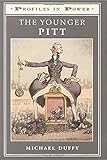
Michael Duffy. The Younger Pitt. Profiles in Power. Harlow and New York: Longman, 2000. xiv + 247 pp. $79.95 (cloth), ISBN 978-0-582-05279-6.
Jennifer Mori. Britain in the Age of the French Revolution 1785-1820. Harlow and New York: Longman, 2000. x + 259 pp. $99.95 (cloth), ISBN 978-0-582-23852-7.
Reviewed by Stephen M. Lee (School of Historical, Political and Sociological Studies, University of Exeter)
Published on H-Albion (June, 2001)
The Age of Pitt the Younger
The Age of Pitt the Younger
In 1996 John Ehrman published the final volume of his three volume biography of William Pitt, The Younger Pitt: the Consuming Struggle. Together with the earlier volumes, The Younger Pitt: the Years of Acclaim (1969) and The Younger Pitt: the Reluctant Transition (1983), this final volume took the length of Ehrman's massive trilogy to over 2,300 pages in which no aspect of Pitt's life and times was left untouched: it was truly a work to which that much overused book-reviewer's adjective "magisterial" could be justly applied. Its very size and scope, however, make Ehrman's masterpiece rather unwieldy, particularly for those wishing to use it in the context of undergraduate teaching and after Ehrman there was still a need for a shorter single volume study of Pitt's career as a whole. Indeed, to the extent that Ehrman's work had rendered all previous lives of Pitt redundant, one could argue that he had also created the need for such a shorter work. In his new work for the "Profiles in Power" series Michael Duffy has gone a considerable distance towards satisfying that need.
While not following a strictly chronological path through Pitt's life and career, Duffy's The Younger Pitt illuminates wonderfully in a broadly thematic approach, Pitt's domination of politics between 1783 and 1806. Thus, while the first and last chapters of this work deal with Pitt's rise to power and his decline and death respectively, the six chapters which intervene are each devoted to a lucid analysis of one particular aspect of Pitt's career: Pitt's relationship with George III; his approach to and development of the role of Prime Minister; his attitudes to the business of government, to the House of Commons, and to the people out-of-doors; and his foreign policy. Unifying this thematic approach is the argument that Pitt's career was best regarded as, in the words of Pitt's tutor and first biographer, George Pretyman Tomline (approvingly cited by Duffy in his introduction), "a consistent whole" (p. xiii). According to Duffy, the aspect of Pitt's career which gives it coherence over the years is his adherence in theory and in practice to the mid-eighteenth-century Patriot ideology which he had inherited from his father, William Pitt the Elder, later Earl of Chatham, and which manifested itself in such things as the Younger Pitt's preference for non-party forms of political organization, his awareness for the need to cultivate public opinion, and his self-conscious casting of himself, in imitation of his father, as another Great Commoner, refusing such peerages and emoluments that the crown might press on him. Duffy thus rejects the distinction commonly drawn in the literature between the reforming Pitt of the 1780s and the reactionary Pitt of the 1790s. He argues convincingly that even in the 1780s "it was not in Pitt's temperament to be a doctrinaire or systematic reformer" (p. 92), nor was Pitt a convert to the tenets of doctrinaire counter-revolution in the 1790s as the impact of the French Revolution was felt in Britain. Rather, the differing pace of reform in these two decades is explicable in terms of his pragmatic awareness of the "political needs and possibilities" (p. 92) present in each period. Moreover, as Duffy correctly notes, "war did not end Pitt's interest in improvement. Instead it moved his approving attentions to issues of war management" (p. 95), as evinced in his post-1797 restructuring of the financial basis of the state in order to enable Britain to fight what Pitt, somewhat belatedly, realized was going to be a lengthy war, one which could not be financed on the ad hoc basis adopted hitherto.
Furthermore, Duffy has provided not just a study of Pitt but, given Pitt's dominance of politics at the end of the eighteenth century, a useful study of the late Hanoverian state itself. Thus, for example, the excellent analysis of Pitt's relationship with George III or the clear account of the difficulties Pitt had with his cabinet in the 1780s and his resort to "men of business" outside it (such as Henry Dundas, Charles Jenkinson, or William Grenville) in order to get things done, tell us not just a great deal about Pitt but also a lot about the changing nature and location of power in the British constitution in the latter part of the reign of George III. Duffy has, therefore, by virtue of the thematic approach he has adopted, produced a real work of substance here, one which will give food for thought to scholars familiar with the field but also, and this would be no inconsiderable achievement in itself, one which could be given to newcomers to that field to serve as an introductory text. Perhaps the only thing this work lacks is some consideration of the posthumous impact which Pitt's legacy had after his death in 1806. How, for example, did a self-styled "independent Whig" become the semi-mythic figure around whose memory a new Tory party would coalesce in the early-nineteenth-century? In addition, greater attention to what it was about Pitt that inspired such loyalty and devotion amongst his followers both during and after his lifetime, despite the fact that he patently failed to bring the long war against France to a conclusion, would have been welcome. Nonetheless, these minor cavils should not blind us to the overall excellence of Duffy's study of the Younger Pitt.
The figure of Pitt, of course, also dominates Jennifer Mori's new volume, Britain in the Age of the French Revolution, 1785-1820. Mori has written on Pitt before in her 1997 monograph William Pitt and the French Revolution, 1785-1795 but the work under consideration here differs in both scope and intent from this earlier work. In chronological scope this work conceptualizes the "age of the French revolution" as 1785-1820 and it thus includes consideration of Britain in the immediate years prior to the outbreak of the revolution, the period of the French revolutionary and Napoleonic wars, and the initial period of postwar readjustment. The intention of this work is to introduce "an upper-year undergraduate audience" to current issues in the historiography of the British response to the French revolution "through a survey of the politics, diplomacy, strategy, ideas, society and economy of Britain from 1785 to 1815 [sic]" (p. vii). To this end the text of the book is organized into seven purportedly thematic chapters. Sometimes the decisions about where to place particular issues within these thematic chapters can appear a bit odd. For example, there is a chapter on "Radicals and Loyalists" but the discussion of Pitt's alleged "reign of terror" against radicals using, among other things, loyalist organizations, is dealt with in the following chapter entitled "Individuals and Institutions" and thus coupled rather awkwardly with consideration of poverty and religion. Or take the chapter "Ways and Means" which discusses the economy, economic and financial policy, and, again somewhat oddly, British wartime strategy which would surely have made more sense if included in the following chapter on foreign policy. These are but two examples of the structural problems that this book exhibits, problems which mean that information on any particular topic can be scattered through a number of chapters. This seems to run counter to Mori's aim of providing an introductory text for students. Furthermore, despite Mori's self-proclaimed intention of introducing students to current debates in the literature, these are often considered in a very truncated form or only in passing. What we are offered instead is a synthesis of current research in which the differences between contentious historical interpretations, say over the nature, extent and success of loyalist thought and organization, are smoothed over.
Below this structural level Mori's treatment of certain issues is also problematic. Let us begin with her interpretation of Pitt himself. According to Mori, the Younger Pitt inherited from his father Chatham "little more than a talent for public relations, a hatred of party politics, a spirit of conciliation towards the Thirteen Colonies and, come the war with France, a desire to emulate the swift and startling successes of the Seven years War" (p. 4). In the light of Duffy's account of Pitt's career discussed above, this attempt to play down Pitt's ideological debt to his father's brand of Patriotism seems inadequate. So, while both authors refer to Pitt's supposed pragmatism, Duffy's location of this within a self-conscious emulation by the Younger Pitt of his father's Patriot stance is the more convincing. The difference between Duffy and Mori on this point may be regarded simply as one of emphasis but it is a crucial difference nonetheless.
Other points of interpretation are also questionable. For example, subsuming all radical critiques of political economy (in either its classical or Christian manifestations) under the label "radical Toryism" (pp. 55ff) simply will not do. While it might be illuminating to refer to a figure such as William Cobbett as a "radical Tory" (p. 57) it makes no sense to lump together such diverse figures as T.J. Wooler, editor of the Black Dwarf, John Wade, William Hone, or Richard Carlile under this label. As Mori herself admits in the section on "Radical Toryism and Romantic Conservatism," Carlile was an "infidel republican" and Wooler and Wade "appealed to secular utilitarianism in a partial attempt to escape from the politics of nostalgia" (p. 57), none of which attitudes can be usefully summed up by the phrase "radical Toryism." It is at points such as this that the organizational problems of this volume actually mitigate against understanding.
Perhaps most worryingly of all in a book designed for use by students, this work is peppered with errors. Some of these amount to poor proof-reading at the level of syntax and grammar (for example on pp. 20, 90, 110) or in the spelling of names (Westmorland is misspelt "Westmoreland," p. 16; the editor of the History of Parliament volumes for 1790-1820, R.G. Thorne, is misnamed "Thorn" in the text and the bibliography, pp. 25, 246); and Grenville mutates into Granville, p. 100). More seriously, the Lord Liverpool referred to on page 4 by Grenville was Charles Jenkinson, first Earl of Liverpool not his son Robert Banks Jenkinson, second Earl of Liverpool as identified in the index. On the other hand on page 22 we find, in reference to the year 1812, Mori claiming that "Charles Jenkinson, second earl of Liverpool, took office" as prime minister, when of course it was his son Robert who took office as premier in that year, Charles Jenkinson having died in 1808. The reference to "Mitchell, 1992" on page 23 should be to "Smith, 1992"; William Huskisson was not Chancellor of the Exchequer "during the 1820s" (p. 29) but successively President of the Board of Trade and Secretary of State for War and the Colonies; the Anti-Jacobin was founded in 1797 by, among others, George Canning not "John Canning" (p. 43); and Catholic Emancipation was passed in 1829 not 1828 (p. 78). Contrary to Mori's claim (p. 92), the 1689 Bill of Rights did, and indeed still does, have "status as a legal enactment," as Neil Hamilton's recent attempt to overturn one of its provisions showed. The account of the Convention of Cintra (p. 183) is garbled: Arthur Wellesley was not "supreme commander" in the Peninsula, and Sir Hew Dalrymple was Wellesley's superior not his second in command, and it was Dalrymple not Wellesley who negotiated the terms of the convention. The Marathas were not a "Confederacy of Muslim powers" but of Hindus (p. 179). Finally, the phrase which states that Castlereagh "had become Foreign Secretary when the Liverpool ministry took office in April 1812" (p. 210) contains two errors: Castlereagh became Foreign Secretary in February 1812, appointed by the then prime minister Spencer Perceval. Perceval was assassinated on 11 May 1812 and Liverpool was only confirmed as prime minister after a period of high political uncertainty in June 1812. Each of these errors by themselves may be relatively minor but their cumulative effect is to undermine one's confidence in the text as a whole and it is to be hoped that they will be corrected in any future edition. On a more positive note, Mori's coverage of the recent extensive literature is admirable and her work includes a very useful bibliography. Nonetheless, students wishing for a lively and stimulating introduction to the politics of Britain in the late eighteenth century would be better advised to turn to Michael Duffy's admirable study of the Younger Pitt.
If there is additional discussion of this review, you may access it through the network, at: https://networks.h-net.org/h-albion.
Citation:
Stephen M. Lee. Review of Duffy, Michael, The Younger Pitt and
Mori, Jennifer, Britain in the Age of the French Revolution 1785-1820.
H-Albion, H-Net Reviews.
June, 2001.
URL: http://www.h-net.org/reviews/showrev.php?id=5184
Copyright © 2001 by H-Net, all rights reserved. H-Net permits the redistribution and reprinting of this work for nonprofit, educational purposes, with full and accurate attribution to the author, web location, date of publication, originating list, and H-Net: Humanities & Social Sciences Online. For any other proposed use, contact the Reviews editorial staff at hbooks@mail.h-net.org.

