



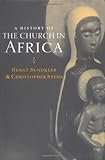
Bengt Sundkler, Christopher Steed. The History of the Church in Africa. Cambridge: Cambridge University Press, 2000. xviii + 1232 pp. $140.00 (cloth), ISBN 978-0-521-58342-8.
Reviewed by Isabel Mukonyora (Visiting Scholar, Dept. of Religious Studies, University of Virginia, Charlottesville, USA)
Published on H-SAfrica (May, 2001)
The Identity Of African Christians
'THE IDENTITY OF AFRICAN CHRISTIANS'
Readers will like this book a lot because its aim is to challenge westerners to think about Christianity as a religion of Africa in which African have always taken part in the spread thereof. As far as Sundkler is concerned it is problematic to think that European missionaries were vital to the spread of Christianity in Africa. This is partially true, but extremely important to grasp. In today's world, this voluminous book makes good reading for anyone serious about knowing African history.
NORTH AFRICAN INTELLECTUALS AND KINGS
The most interesting aspect of this book lies in the effort made to challenge Europeans into rethinking their role in spreading Christianity in Africa. From the outset, Sundkler and Steed focus on the role of African Christians in shaping their understanding of the belief system in North Africa from the first century onwards. The existence of a Coptic Church that is indigenous to North Africa and claims to be founded on the teaching of St. Mark, one of the gospel writers (pp. 8-9), is used to make a strong point about the claim that Christianity is as traditional to Africa as it is to the western world.
As I found when teaching a course on Christianity in Africa at the University of Zimbabwe, Donatists are a lot easier to accept as Africans than the Early Church Fathers of North Africa. Donatists were not as cosmopolitan in outlook as the master of hellenization, Origen at the School of Alexandria in the second century, or the well-traveled intellectual St Augustine who was baptized into Christianity in a far away Rome before he came back to Africa to settle in Hippo. As a movement of Berber origin, Donatists distinguished themselves in North African Church history by staging a rebellion against the imperial state in the name of Christian orthodoxy understood by them to separate the Church as a community for the Holy from the institutions of the imperial government that were considered corrupt, oppressive and certainly not worth giving honor through the worship of the Emperor (pp. 22-41). African students living in neo-colonial societies can probably identify with the Donatists as African Christians in the face of an imperial power responsible for their persecution.
Among the other wonders of this book that are widely known among Africanists but nevertheless important to mention in a book aimed at persuading us to think of Christianity as an African phenomenon is the discussion on the royalty of Ethiopia. Christianity was introduced to the royal courts of Aksum through the consecration of Frumentius as Bishop of Aksum. This was done by Bishop Athanasius as head of the Church in Alexandria between AD328 and 378 (pp. 12, 35). This led King Ezana of Aksum to embrace Christianity and declare it a state religion to mark the beginning of a long legacy of dynasties of confessing Christians (pp. 150-168). Readers who are not familiar with early Christianity in Africa might find it an amazing testimony to the permanence of Christianity in Africa to hear of an African King in Ethiopia making Christianity a state religion at the same time as Constantine in the fourth century Roman Empire (pp. 35-38). So it seems to be the case for Sundkler that from early Christianity in Africa, when royalty finds for itself a family religion, it expects the subjects to follow (passim).
The matters for discussion go deeper. Sundkler claims for Africa the theologians of North Africa such as, Tertullian, Augustine, Athanasius and others. These are widely known theologians providing us with enough material to read for weeks. Sundkler claims them for Africa without necessarily getting us lost in the deep theological arguments that usually go with the mention of these reputable men. As for the Hellenism, well, it appears to be taken for granted as a phenomenon that was pervasive in the Greco-Roman world wherever it extended. Alexandria and Carthage happened to be important areas of trade and with it came many Greek influences upon the indigenous people who reflect this in their literary works. Despite this, St. Augustine, widely known as the patron of western orthodox theology, is portrayed in such a way that his African identity is unmistakable. Sundkler observes that St. Augustine considered Punic "an honorable part of his native heritage" and chose it 'to explain biblical words' (p. 26). The news that St Augustine of Hippo had a high regard for Punic as his mother tongue is bound to raise eyebrows among western theologians already finding it hard to accept that Augustine, Tertullian, and Cyprian were African (pp. 22-41).
Sundkler even tries his hand at theology by pointing to what he calls the 'Unionite' doctrine of Christ, otherwise known as monophytisism. This, Sundkler maintains, is a distinct African view of Christ as a divine being. Since the statement of Chalcedon in AD 329, Christian orthodoxy insists on affirming the full humanity and full divinity of Christ. But, the African Christians in the Coptic Church of Egypt and Ethiopia reason about Christ their own way. For them Jesus Christ could only have been of one nature and that was a divine nature fitting of the only Son of God (p. 16). The Ethiopian delegation withdrew from Chalcedon and left western Christian orthodoxy with the perennial problem of having to try and explain how someone who shares fully in our humanity has also a perfect divine nature from eternity. It does not matter to Sundkler that the Christological formula that the Ethiopian Christians uphold to this day was dismissed as a heresy. The important point is that Africans had their own way of reflecting on the identity of Christ as the focus of their faith.
African theologians Kwame Bediako, John Mbiti and others would welcome the detailed way in which Sundkler writes about Christianity with African agency as a main theme. Over fifty years ago, Mbiti became well known among African intellectuals for questioning the European assumption that Africans were ignorant of God before Europeans brought the Gospel. Mbiti claimed that Christianity in North Africa during the Greco-Roman Empire is part of African history and the traditional African culture beyond the borders of the Empire shows many continuities of belief with Christianity. Since then, Pobee, Kwesi Dickson, Nyamiti, Sanneh and others have gone to great lengths to show that African religious idioms can be used to explain key doctrines of the Christian faith to an African audience. Names of high gods, images of chiefs and ancestors have been used to characterize the modern subject of African Theology. Bediako followed the footsteps of Mbiti and maintained that the Church Fathers from early Christianity such as, St. Augustine, Cyril of Alexandria, Tertullian, and Origen etc. are patrons of African theology (Bediako, 1992).
As indicated above, Sundkler would agree with this to some extent. At least, the detailed notes about Christian witness throughout North Africa, down the Nile leading to Ethiopia by Africans suggest the emergence of African theological thought to go with the history of the spread of Christianity on the continent. What the African theologians do, and Sundkler avoids, is to go further to show the extent to which the pre-Christian African religions found in areas remote to North Africa in Sub-Sahara Africa are preparatio evangelica. For Mbiti, it is very important to recognize that even though Christianity was presented to many Africans in European dress, it was not new insofar as the concepts that missionaries believed themselves to be introducing anew were found in the African religions. Hence, the names for the Judaeo-Christian God have today been taken from names of the high god in the various African religions. For example, Ngai, Mkulunkulu, Mulungu, Mwari, etc., and African theologians such as Pobee, Nyamiti and Dickson have gone further to suggest that one can go beyond naming God to articulate Christian doctrines using other traditional Africa religious idioms such as the ancestor, the Chief, the N'anga and so on. Sundkler points to the foundations of an African theology. But he does not go as far as the African theologians.
The latter are anxious to have their traditional cultures given the respect they have always deserved by drawing out the areas of continuity between past and present religions. In Sundkler's case, more attention is paid instead to the fact that Europeans did in fact contribute in a significant way to the spread of the new religion of Christianity in Africa beyond the Sahara desert through a missionary enterprise that recognize the importance of African evangelism. Plagued by diseases leading to a high death rate, European missionaries soldiered on to ensure that Africans where touched by the gospels (passim). The repeated references to missionary bodies from Europe and America such as Methodists, Presbyterians from Scotland, Anglicans, Catholics, Baptists, the Salvation Army and so on make it difficult to appreciate the indigenous character of Christianity that Sundkler is trying to help us to understand.
THE CONQUEST OF WEST, CENTRAL, EAST AFRICA AND BEYOND
Sundkler tries very hard, nevertheless, to show the active participation of Africans in the conversion of fellow Africans. Even in giving an account of the ways in which Europeans spread Christianity among Africans as subjects of conquista (pp. 44-45), he is quick to identify Africans who took up positions of leadership in the church, especially authority figures such as Kings and chiefs. He also makes a point of drawing attention to any evidence suggesting that Europeans sometimes encountered African people who were informed about Christianity through the evangelism of Africans among themselves. He cites Dr H. A. Junod, a Protestant commenting on a community found in Mozambique: 'Even if the Europeans were supposed to possess the Gospel, it was not they who brought the message to the Blacks in this area; it did not come via the ocean, with the civilization and great ships. It came down from the far and unknown interior, brought by an ignorant Black evangelist' (pp. 484).
The phrase 'ignorant Black evangelist' confronts the reader in the form of a citation from Junod. Otherwise, it is quite incredible to find a book based on records that are filled with a language of derision used by colonialists and missionaries alike to portray Africans across the continent, yet avoids this insulting language almost completely. Africans whose habit it is to attack missionaries for their paternalism and disrespect of African culture will get lost in Sundkler's work. For the portrayal of Africans as victims of superstition and ignorance is not a subject that concerns Sundkler; the conversion to the Christian faith and a readiness to witness is what interests him the most. The missionaries are made to sound genuinely interested in saving souls among a people who may be strangers to them, but not necessarily ignorant and primitive.
Nevertheless, "conquista" says a lot about the attitudes of Europeans. For "conquista" is a Portuguese word used by Sundkler to describe the nature of the partnership between the King of Portugal and the Pope in which finding out about the rest of the world hidden far way across the big oceans and trading was a welcome opportunity for spreading the gospel (pp. 44-45). Apparently, it was normal among Portuguese traders to have missionaries stocked up with bibles and the cross of Jesus as normal cargo with which to redeem souls. To anyone who knows that a large part of Portuguese and for a while British trade involved the enslavement of Africans for work in plantations and mines wherever new lands were conquered, priests bearing the cross sailing the oceans paddled by slaves highlight a serious contradiction in the understanding of missionary work as a way of redeeming people.
Sundkler mentions many times throughout the book that Africans were subjugated and exploited as slaves by Europeans. In fact, leaving out the way European missionaries talked about Africans makes the book easier to read for Europeans trying to understand the role of their own kin whom they want to remember as good people making sacrifices for others in far away lands. In this post-modern world, who wants to be reminded of the damage done to other cultures through colonialism? However, Sundkler confronts his readers with thousands of slaves converted to Christianity with missionaries standing by, not opposing the trade. I am left wondering what in the world could lead a people of the white race to do so much damage to blacks. Why the urgency to redeem Africans by educating them to renounce the world of their ancestors if the European missionaries were not viewing Africans negatively and speaking accordingly?
Anyway, Sundkler makes it plain that the missionary enterprise was riddled with problems. To begin with, the most striking feature of this book are the many kings, royal sons and chiefs meticulously listed in a running commentary on one ruler after another who became converts and grew to become church leaders. There are so many names I care not to list them. They all make the same point that Kings were important targets for missionaries in the story of Africa. For Sundkler, it is almost as if the conversion of the Kings of Ethiopia to Christianity who in turn declared that their subjects were to follow the same religion was a model by which to convert the entire continent (passim).
This is intriguing to me because Christianity is a belief system that centers on personal, and not cooperate, salvation. Moreover, the Kings mentioned betray fellow Africans into slavery and colonial subjection in a shameful way. Kings persuaded to follow the ways of the white man allowed masses of African men and women to be driven out of their homes in broad daylight and sold as slaves (passim). In West Africa and beyond on the East Coast where Arab traders were making their own inroads into Africa the burden of color among Blacks was heavy (pp. 510 ff). Sundkler could have critiqued more sharply missionary attitudes, even of those African agents trained along western lines.
Sundkler writes, 'The relationship between king and missionary was decisive for what there was of modernization' (p. 464). Leinhardt made the same point by saying that Christianity is 'often simply part of a larger package as it goes with education, new forms of income and a new way of life' (Leinhardt, 1982). Both are correct, although in my experience, vital to modernity in Africa are children brought under missionary care in large numbers to learn to read, write, do arithmetic, acquire skills for use in industry and even learn the basics of western science. Kings may have been favored as members of the privileged class but they were not at the heart of mission as suggested by Sundkler. In the fifteen years I spent at a mission station in colonial Rhodesia, not once did I see nobility walking around the school. Even if they learnt the same skills as authority figures such as Kings, the success of modernity in Africa depends on ordinary people who grew up doing hard work.
Yet Sundkler insists on giving names of Kings and noble men from different groups who received a good education that often took them to Europe and back again. They return having embraced many secular ideas, including the capitalist mentality, but also Christian leaders who must behave as expected of them in spreading the Christian faith. To Lisbon, Paris, London the Kings went for their theological education to return as leaders of the so-called Western Christian civilization in Africa. As a lay Christian who has managed to study theology abroad, I appreciate modernity at a more accentuated level than my African friends. But as a Christian of sorts, I have problems with the materialism of elites when they return home to live among people who have less western commodities. The Kings of Sub-Saharan Africa, whom Sundkler writes about at length, yielded their power to European invaders so much so that in becoming agents for mission they became the doorway for the exploitation of their own people in capitalist experiments intended to benefit the White invaders. In this sense, the great effort made to show that Africans took part in the spread of Christianity highlights serious ambiguities about African Christianity that deserve more attention than one finds in this book.
It is a bit difficult to feel proud of the history of the Church in Africa portrayed in this typically patriarchal fashion as a scholar sensitive about oppression. Just as I would join my students in sympathizing with the Donatists of North Africa for reacting against "traidores" (p. 27), the news for African readers that the religion that they now accept in their millions was transmitted to them by "traidores" of a modern kind, placating the demands of Imperial Europe at the expense of fellow Africans sold to slavery tarnishes the image of African royalty converting to Christianity.
MARGINALITY
Another idea found in this book that interests me is that of the 'gospel' becoming the religion for those who suffer. Several times, Sundkler draws attention to the attraction of Christianity to individuals whose sense of identity had been shaken through turmoil in society, especially that caused by the violence of the slave trade and resultant wars in West, East and Central Africa (p. 215). In fact Sierra Leone, Gambia, The Ivory Coast, indeed the whole West African coastline provides the strongest evidence of African agency in mission, but also the ambiguity of this agency vis-a-vis a white oppressive culture. Indeed, the acuteness of the suffering of slaves and those left behind in dysfunctional communities, created such distortions of the African identity of peoples it is a wonder there are African scholars dreaming about a residual African culture untainted by European invasions. In West Africa at least, Sundkler writes, 'freed slaves must be seen as part of a general category of marginalized groups, outcasts, aliens and refugees, on the outskirts of society, looking for a new identity and for some security in a world of social and economic destruction' (p. 87).
So it seems, that the vulnerability of people on account of the disruption of peace and harmony in their background world creates a window through which Christianity and new ideas about living in the world could be introduced. Africans whose homes were vandalized by slave traders and white settler armies demonstrate this process by causing people to turn away from their ancestors to appropriate Christianity. Unlike the Kings whom Europeans handpicked for training into western Christianity, the early converts to the Christian faith referred to by Sundkler here and there in this book, signify that experiences of oppression have led to the acceptance of Christianity as the framework for new growth. It is easier for people who have lost their sense of value to their world to accept new ideas, religious and otherwise. In this case, a new belief system, technical skills of people making claims to be as superior as they were powerful agents of change under colonialism, finds a ready clientele among the exploited and marginalized members of African society.
Sundkler does well to draw attention to this tragedy because it sheds some light on what caused the strong African religions associated with family structures and hierarchies of power to give way to Christianity. Moreover, the elaborate details about authority figures in this big book make it hard to notice that there were many ordinary people also involved in spreading the gospel in Africa, including the poor and even women (Gaitskell, 2000). Women are the main adherents of the Church in Africa and in many ways function as its backbone. It does not take much to show that women would have suffered acutely as people beholden to the two patriarchies in conflict in the encounter of Europeans and Africans (Schmidt, 1992). As I am trying to show in a forthcoming book, these unnoticed members of society found in Christianity a new plausibility structure where suffering could be grappled with by facing the cross and acquiring new skills for survival under the new patriarchy. Even if Sundkler's sources were silent on this subject, the popularity of Christianity as a religion that large numbers of women embrace is important to study in the interest of balance (Mukonyora, forthcoming book).
NATIONALISM AND INDEPENDENCY
As the author of a well-known book called Bantu Prophets in South Africa, Sundkler looks at southern Africa slightly differently by highlighting the fact that Africans broke away from European-led churches to found their own Churches. Independence has a special meaning in this region where whites exploited Africans and marginalized them through racial discrimination for many decades (pp. 818-814). The keyword Ethiopianism is used to describe the many Africans for whom the racism of whites presented problems (cf. Chirenje, 1987). This language is appropriate in African societies riddled with problems of racism because of tyrannical white governments refusing to yield power to blacks. South Africa and Zimbabwe (pp. 987-996) stand out for Sundkler in this regard.
Anyone concerned with the crisis of leadership in Africa today will be struck by Sundkler's assertion that the education that Africans received at the hands of missionaries, 'prepared them for the time when Africans would run their own affairs in Church and State' (p. 472). Sundkler observes that Christians led the demand for freedom in Zimbabwe: the Methodist Bishop Muzorewa; Ndabaningi Sithole, a Congregationalist Pastor; Mugabe, educated at Kutama Catholic Mission and first President of the new democracy; and Methodist Canaan Banana (pp. 800-801, 983). Apparently, missionaries anticipated such developments and when they taught they empowered Africans through an education based on principles derived from western culture (p. 464). This is an interesting observation that should be noted by western governments that, for the most part, do not consider religion, including Christianity, the religion of their forefathers, as in any way relevant to the quest for democracy. In Africa, religion is widely seen from a western secular viewpoint as a phenomenon that hinders democracy, not the arm for it.
Also worth mentioning is the fact that missionaries translated the bible into local languages to enable Africans to further themselves beyond the boundaries of missionary paternalism (Barrett, 1968). It was imperative in Protestantism to prioritize reading the bible in matters of faith in a spirit of libre examen - the free and unchecked study of the Holy Scriptures characteristic of this tradition (p. 770). According to Sundkler, Catholics also considered it important to adapt the Christian message to the culture of the people and would not, as a result, have hesitated to translate the scriptures into the vernacular (p. 774).
Consequently, there arose in African Christianity hundreds of groups, now too amorphous to count properly, but with a membership running in several millions. Throughout southern, central and other parts of Sub-Sahara Africa, for example, there are churches that anthropologists have described as Zion Churches (p. 995). The title Zion is used to describe Churches founded and led by Africans who specifically confront the fears and aspirations of believers that arise from background cultures and in the process draw attention to what might be described as vernacular Christianity. The continuities between Old Testament biblical culture and traditional African culture notwithstanding, I have always found the title Zionist Churches misleading. Surely, there are vernacular words that can be used in place of this biblical term to describe Africans who represent this type of Christianity. Recently, I wrote about the Masowe (Wilderness) Apostles using their own vernacular name to articulate the main ideas of the movement. Rather than describe the Masowe Apostles as Zionist, Prophetic, Messianic or whatever other Judeo-Christian name comes to mind, I describe them in my work as the Wilderness Church best understood accordingly. Masowe Apostles not only worship in fringe places in the open air, but also in doing so they communicate an important message about their marginality and conception of God as a being manifested in the world through the Holy Spirit. The ideas of the sun rising from the East to bring light upon the world and winds traveling through the atmosphere are used to express God's immanence. The keyword "masowe" is thus an appropriate descriptive term for the venues for prayer and thought pattern of this exemplary independent church (Mukonyora, 2001).
REWRITING HISTORY
It is time to resume studies of African-initiated Churches guided by new topical questions. The idioms chosen by Africans to describe their activities tell us more about the Masowe in a post-colonial and post-modern world than the word Zionism and lengthy details about chiefs and male executors. I would like to challenge European scholars to explain to themselves what Africans do by dealing first with what Africans have to say, not perpetuate colonialism by relying too much on records and ideas that are western- imperial.
There is plenty of scope for improvement through the reconceptualization of issues to discuss in a massive book such as this one. As someone particularly interested in understanding the Church in Africa along the lines that will correspond with the reality of millions of grassroots Christians who are women actively participating in the life of the Church, the long list of African kings leaves me wondering whether Sundkler fully appreciates that the most effective way in which Christianity grows in Africa is through oral traditions. These are accessible only to historians ready to balance information found in the archival records of colonial authorities with learning to sing, dance, pray and heal among the average Christians far removed from the authority structures of Church and speaking often in the vernacular.
Finally, I must end this review by mentioning, as Sundkler does, that Islam in Africa deserves some attention. Like Christianity, Islam has had roots in Africa from the time it plunged North Africa into the so-called "dark ages" from the fifth century onwards. In two pages, Sundkler draws attention to a project that scholars of Islam in Africa might wish to start, giving an account of the growth of Islam as an indigenous religion of Africa (pp. 1035-6). If anyone is taking on this challenge, it might help to focus on the various major themes separately and give them undivided attention in shorter books that students will find affordable and user-friendly.
For example, my favorite theme, marginality, is obviously very important to understand, according to Sundkler (pp. 87, 483). He writes about experiences of marginality, especially through slavery, as 'part of a general category of marginalized groups, outcasts, aliens and refugees, on the outskirts of society, looking for a new identity and for some security in a world of social and economic destruction'. But alas, in this book there is not that much more said in support of this dynamic thought. I finished reading over a thousand pages of small print and did not find any really thorough discussion of this important theme and I am sure other readers will find a similar problem with parts of this book. Yet Sundkler's book is an important achievement deserving of this lengthy review. For it is by far the most ambitious piece of writing I have come across as an instructor in matters to do with Christianity in Africa.
Works Cited
Barrett, David B. Schism and renewal in Africa; an analysis of six thousand contemporary religious movements. Nairobi: Oxford University Press, 1968.
Bedieko, Kwame. Theology and identity: the impact of culture upon Christian thought in the second century and in modern Africa. Oxford : Regnum Books, 1992.
Chirenje, J. Mutero, Ethiopianism and Afro-Americans in southern Africa, 1883-1916. Baton Rouge : Louisiana State University Press, 1987.
Gaitskell, Deborah, "Hot meetings and hard kraals: African Biblewomen in Transvaal Methodism, 1924-60" Journal of Religion in Africa 30(3) 2000.
Leinhardt, R, "The Dinka and Catholicism" in J. Davis (ed.), Religious Organization and Religious Experience, London and New York: Academic Press, 1982 (ASA Monographs, No 21).
Mukonyora, I. "Masowe Wilderness Apostles" in Encyclopedia of Religion and Nature (Forthcoming, 2001).
Mukonyora, I. Womanhood in an African Wilderness Movement. (Forthcoming)
Schmidt, E. Peasant, traders, and wives: Shona Women in the History of Zimbabwe, 1870-1939. London: Heinemann and Harare: Baobab, 1992.
Copyright (c) 2001 by H-Net, all rights reserved. This work may be copied for non-profit educational use if proper credit is given to the author and the list. For other permission, please contact H-Net@H-Net.MSU.EDU.
If there is additional discussion of this review, you may access it through the network, at: https://networks.h-net.org/h-safrica.
Citation:
Isabel Mukonyora. Review of Sundkler, Bengt; Steed, Christopher, The History of the Church in Africa.
H-SAfrica, H-Net Reviews.
May, 2001.
URL: http://www.h-net.org/reviews/showrev.php?id=5118
Copyright © 2001 by H-Net, all rights reserved. H-Net permits the redistribution and reprinting of this work for nonprofit, educational purposes, with full and accurate attribution to the author, web location, date of publication, originating list, and H-Net: Humanities & Social Sciences Online. For any other proposed use, contact the Reviews editorial staff at hbooks@mail.h-net.org.

