



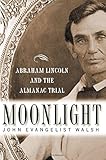
John Evangelist Walsh. Moonlight: Abraham Lincoln and the Almanac Trial. New York: St. Martin's Press, 2000. 166 pp. $22.95 (cloth), ISBN 978-0-312-22922-1.
Reviewed by Brian Dirck (Department of History, Anderson University)
Published on H-Law (March, 2001)
Moonlighting With Abraham Lincoln
Moonlighting With Abraham Lincoln
The "Almanac trial" is probably the most famous court case of Abraham Lincoln's career. Immortalized by Henry Fonda in his 1939 film Young Mr. Lincoln, it placed an indelible image in American culture of the homespun backwoods barrister, someday destined for greater things, using his innate wit and common sense to clear one William "Duff" Armstrong of murder.
The facts of the case are well documented. On the evening of August 29, 1857, Armstrong and James Norris savagely beat James Metzger after a drinking spree which had left all three in an inebriated stupor. Metzger's mood turned ugly; a large, brawny man, he tussled with Armstrong and Norris, who became so enraged that they together assaulted their tormentor with a club and a makeshift blackjack-type weapon called a "slung-shot." Suffering from severe head injuries, Metzger staggered home, where he died two days later. Armstrong and Norris were arrested and arraigned on murder charges. Norris was tried first, and the jury had no trouble pronouncing his guilt. Several eyewitnesses, after all, had seen Norris (and Armstrong) assault Metzger; they testified that the evening's full moon provided more than adequate lighting. Norris's quick demise frightened Armstrong and his parents, who sought help for their boy from Abraham Lincoln, an old family friend.
Lincoln took the case, which went to trial in Beardstown, Illinois in May, 1858. According to Walsh, Lincoln quickly ascertained that he faced an uphill battle. "For perhaps the only time in his career at the bar Lincoln found himself in the excruciating position of having to defend a client he thought guilty, a cause in which he didn't believe," Walsh wrote [p. 32]. But Lincoln supposedly swallowed his misgivings and prepared a case which depended upon planting seeds of doubt in the jury's mind concerning which assailant, Norris or Armstrong, had actually inflicted the blow that killed Metzger.
One stratagem involved calling a witness named Nelson Watkins, a local farmer who had actually made the slung-shot, and asking questions of Watkins in such a way as to imply that it had been in Watkins possession throughout the night of the murder and so could not have been used by Duff as a murder weapon. A second--and more famous--method Lincoln employed involved the light shed on the crime by the moon, and whether or not the prosecution's chief witness, Charles Allen, could possibly have seen with real clarity what Armstrong did or did not do. After extracting a statement by Allen that the moon was precisely overhead, thus illuminating the attack quite well, Lincoln then produced a copy of Jayne's Almanac from 1857 and showed the stunned witness and jury that, on the evening of August 29, the moon had been low on the horizon, providing less direct light and casting doubt on the veracity of Duff's primary accuser. Lincoln had "taken an undoubted fact, one that fully supported the prosecution's case--that the moon had not set, had in fact been a whole hour from setting, thus giving ample light for Allen and the other eyewitnesses to see by--and had deftly clouded the jury's perception of that fact, so that it appeared to support the defense," Walsh wrote [pp. 57-58].
In the end, Armstrong was found innocent. Lincoln won his case, but (according to Walsh) at a high ethical price. Faced with the competing moral and professional imperatives of helping Armstrong--and thereby repaying the kindnesses shown to Lincoln as a young man by Duff's parents--but at the same time advancing a miscarriage of justice by helping free a man guilty of murder, Lincoln, according to Walsh, chose friendship over justice, and was "ready to do violence to the principals that had always guided him. His sensitive spirit stirred to its utmost by that old debt of gratitude, he was preparing to subvert the law, something he'd never been known to do before, and apparently never did again [p. 46]."
Walsh declared that Lincoln's preparation of Watkins' testimony and his subversion of Allen's account with the almanac "involved witness tampering and the suppression of evidence, and may have involved the criminal act of suborning perjury [p. 2]." In making this case, Walsh did accomplish one goal; he made what this reader believes is a convincing case for Armstrong's guilt. But persuading a twenty-first century reader of Armstrong's guilt is not the same as persuading a nineteenth-century jury, or even Lincoln himself. How do we know that Lincoln believed his client was guilty? There is no direct evidence that he drew such a conclusion, and there is no evidence that the Armstrong case caused him any sort of moral dilemma.
Walsh assumed that the Armstrong case should have caused Lincoln to do a fair bit of moral hand wringing, because, according to him, Lincoln's conduct in the case transgressed the bounds of ethical propriety for lawyers who are trying to defend their clients to the best of their ability. This is the crux of the matter for Walsh, and the driving theme of his book. But exactly what are the moral and professional standards Lincoln violated? What was the nineteenth-century definition of subornation of perjury, suppression of evidence, and witness tampering? For that matter, what are the precise standards for such behavior among twenty-first century attorneys? Walsh does not say, and apparently conducted no investigation of what nineteenth-century legal authorities believed were the governing ethical rules of behavior for lawyers, or the voluminous modern literature on legal ethics. According to Walsh, Lincoln had simply "cross[ed] the line [p. 36]." But Walsh does not say exactly what that "line" was, or how he arrived at the conclusion that Lincoln had knowingly crossed it. Where Walsh sees a man who sacrificed his personal sense of justice for the sake of an old family friend, others could look at the same evidence and see a skilled, subtle trial lawyer who crafted a careful and ultimately successful defense strategy to win an improbable acquittal for his client.
To his credit, Walsh does not seem to have pursued his indictment of Lincoln as a means of committing character assassination on Lincoln; rather, he wants Moonlight to humanize the all-too-monolithic Lincoln mythos. "Under the peculiar burden of an unpaid debt of honest gratitude, Lincoln showed himself to be no different from the common run of men," Walsh wrote [p. 2]. This is a plausible argument in and of itself--Lincoln was human, after all--but it should have been pursued with care, and above all with due attention to the ethical, professional and social context within which Lincoln lived. Unfortunately, Walsh does not do so. Moonlight is a lively narrative (perhaps a bit too lively, at times shading off into melodrama and suffering from the author's overly exuberant use of italics and exclamation points), but it offers a perspective on Lincoln which is grounded neither in sound analysis or an understanding of Lincoln's times.
If there is additional discussion of this review, you may access it through the network, at: https://networks.h-net.org/h-law.
Citation:
Brian Dirck. Review of Walsh, John Evangelist, Moonlight: Abraham Lincoln and the Almanac Trial.
H-Law, H-Net Reviews.
March, 2001.
URL: http://www.h-net.org/reviews/showrev.php?id=5034
Copyright © 2001 by H-Net, all rights reserved. H-Net permits the redistribution and reprinting of this work for nonprofit, educational purposes, with full and accurate attribution to the author, web location, date of publication, originating list, and H-Net: Humanities & Social Sciences Online. For any other proposed use, contact the Reviews editorial staff at hbooks@mail.h-net.org.

