



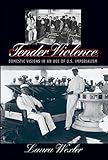
Laura Wexler. Tender Violence: Domestic Visions in an Age of U.S. Imperialism. Chapel Hill: University of North Carolina Press, 2000. xiii + 363 pp. $49.95 (cloth), ISBN 978-0-8078-4883-8.
Reviewed by Kristin Hoganson (Department of History, University of Illinois, Urbana-Champaign)
Published on H-SHGAPE (March, 2001)
"Domesticating Empire"
There is a movement afoot among historians of the Gilded Age and Progressive Era to reconceptualize their time period as an Age of Empire.[1] This trend stems in part from a sense that the older labels have limited -- and nearly exhausted -- utility in illuminating the period. But the trend toward foregrounding issues of empire also reflects a broader movement that of internationalizing the study of U.S. history regardless of time period. Keenly aware that U.S. historians' long history of self-centered, exceptionalist scholarship is not up to the task of historicizing contemporary transnational developments, a growing number of U.S. historians (cultural and social historians prominent among them), are calling for scholarship less bounded by the nation.[2]
Laura Wexler's recent book, Tender Violence: Domestic Visions in an Age of U.S. Imperialism, deserves to be cited as an exemplary work of scholarship by both of these movements. It is an interdisciplinary work (as one might expect from an associate professor of American studies and women's and gender studies at Yale) that weaves together the history of photography, cultural history, women's history, and literary analysis. The theme that connects Wexler's wide-ranging sources is empire. The major backdrop to her narrative is the war in the Philippines, but Wexler makes it clear that the "imperialism" invoked in her title cannot be neatly contained -- it intersects with Jim Crow race relations within the United States, efforts to assimilate and disappropriate Native Americans, a reluctance on the part of native-born, middle-class Americans to identify with working-class immigrants, and a popular ethnology, presented in venues such as worlds fairs, bent on justifying Western imperial power.
With empire and its adjuncts as her ever-present points of reference, Wexler focuses on photographic exegesis. She provides a model of reading photographs that historians should appreciate, since context is of paramount importance. By looking beyond the images themselves to their production and dissemination, she makes even seemingly sympathetic pictures of African-Americans, Native-Americans, immigrants, and others, appear deeply implicated in the project of extending the power of middle-class white Americans. "Under certain conditions of political domination, ordinary-looking family photographs can be highly manipulative weapons," she notes (3). As someone similarly vested in the project of recasting the late-nineteenth century as an age of empire, I found the contexts that Wexler chose to highlight (namely, ones of imperial, racial, and class privilege) to be highly germane.
However, since Wexler had access to personal papers and other materials not accessible to most turn-of-the-century viewers of the images in question, her method appears more useful in revealing the photographers' limited visions than in capturing the responses of the photographs' original audiences.
What types of photographs, then, does Wexler interpret for her readers? She focuses on images of domestic life -- but she interprets domestic life broadly, to include pictures taken in Admiral Dewey's flagship, Negro and Indian boarding schools, a Fifth Avenue studio, immigrant sanitation facilities, and the 1904 St. Louis World's Fair. Says Wexler of her understanding of domesticity, "Although it is common sense to think of pictures of mothers, babies, and family groupings as domestic images, this book takes the position that the presence of such figures is not necessary for the depiction of domestic space. Domestic images may be -- but need not be -- representations of and for a so-called separate sphere of family life. Domestic images may also be configurations of familiar and intimate arrangements intended for the eyes of outsiders, the heimlich (private) as a kind of propaganda; or they may be metonymical references to unfamiliar arrangements, the unheimlich intended for domestic consumption. What matters is the use of the image to signify the domestic realm" (21). This broad reading of domesticity helps us understand how assumptions about family and home arrangements could affect interpretations of a vast range of images, but it also positions some images -- such as photographs of working people performing their jobs on the streets of New York City -- in an ideological context that may not have been the most salient one to contemporary viewers.
Why some of the photographs Wexler analyzes struck her as "domestic" seems to have much to do with the gender of their creators, all of them women. Gender might make women photographers' work seem more "domestic," at least in Wexler's eyes, but it does not make their pictures any more benign than men's. Wexler argues that photography, whether as profession (as in the cases of Frances Benjamin Johnston, Gertrude Ksebier, Emme and Mamie Gerhard, and Jessie Tarbox Beals) or hobby (as in the case of Alice Austen), empowered white women in the late-nineteenth century. But where earlier feminist writers have seen cause for celebration, Wexler sees cause for sober reflection. She finds that white women photographers promoted "Anglo-Saxon aggression" through the medium (6). They did so particularly effectively because of "the innocent eye" -- Wexler's term for a gaze averted from the politics of the household and larger society, a gaze more readily attributed to middle-class white women because of their supposedly apolitical, sheltered domesticity. The belief that domesticity could not entail brutality made these women's photographs seem all the more innocent, even though they served political purposes. Wexler explains the dynamic as follows "if it was acceptable for 'lady' photographers to be on the scene, the scene itself must be acceptable" (42).
As the term "innocent eye" suggests, this book pays as much attention to what the photographers failed to depict, as to what they did. Wexler faults Johnston for not portraying Dewey and his crew as violent fighters, Austen for lacking a sense of personal implication in immigrant lives, Beals for failing to challenge the "violent framework" in which some people were "differentiated, primitivized, and separated from the 'higher' domestic forms of the 'white race,'" and so forth (283). At the start of the book, Wexler argues that "though a democratic vision may not be what is reified in the photographs, it can be aroused in the critical eyes of their beholders" (6). The ensuing pages take on the task of providing the democratic vision absent from her sources. In explaining why the "lady" photographer's eye wasn't really so innocent, Wexler holds gender accountable. "The denials in these women's photographs of the structural consequences of slavery, colonization, industrialization, and forced assimilation developed not as a matter of conscious policy but as a matter of gender -- that is, as a matter of course" (7). Such claims would be more convincing if she compared women's work to men's, for many of the photographs she discusses resemble those taken by men of the period. Attributing imperial myopia to gender also cannot fully explain the obliviousness towards empire that extended far beyond "domestic" images, indeed, that has prompted recent calls to address this persistent absence in histories of the time.
In a puff on the back of the book, Karen Sanchez-Eppler remarks "This is one of the most beautifully architected academics books I know," and though usually wary of such effusive plugs, I fully agree in this case. Wexler's close readings take surprising twists; her juxtapositions are often stunning. But Tender Violence is more than a good read. It is a thought-provoking book that should cause readers to look at turn-of-the-century photographs in a new light. Although "domestic" pictures of, say, madonna-like mothers and winsome babies may not be an obvious source for understanding imperial dimensions of turn-of-the-century U.S. culture, Wexler convincingly argues that such images are just as relevant as (and, in fact, closely related to) pictures of Filipinos in the constabulary police force. Ultimately, Wexler shows that even domesticity is deeply implicated in the project to reconceptualize the years from the Civil War through World War I as an age of empire and, beyond that, to internationalize U.S. history in general.
Notes:
[1]. See, for example, Amy Kaplan and Donald E. Pease, eds., Cultures of United States Imperialism, Durham Duke University Press, 1993; Leslie Butler, "The World According to GAPE," Reviews in American History 28, Sept. 2000, 399-407; Matthew Frye Jacobson, Barbarian Virtues The United States Encounters Foreign Peoples at Home and Abroad, 1876-1917, New York: Hill and Wang, 2000; Gilbert M. Joseph, Catherine C. Legrand, and Ricardo Salvatore, eds., Close Encounters of Empire Writing the Cultural History of U.S.-Latin American Relations, Durham: Duke University Press, 1998; Pennee Bender and Yvonne Lassalle, "Islands in History Perspectives on U.S. Imperialism and the Legacies of 1898," Radical History Review 73, winter 1999, 1-3; Robert W. Rydell, All the World's a Fair Visions of Empire at American International Expositions, 1876-1916, Chicago: The University of Chicago Press, 1984.
[2]. See, for example, John Carlos Rowe, "Post-Nationalism, Globalism, and the New American Studies," Cultural Critique 40, fall 1998, 11-28; Jane C. Desmond and Virginia R. Domnguez, "Resituating American Studies in a Critical Internationalism," American Quarterly 48, Sept. 1996, 475-90; Gesa Mackenthun, "Adding Empire to the Study of American Culture," Journal of American Studies 30, August 1996, 263-69; Thomas Bender, "Where is America? A Planning Conference on Internationalizing American History," OAH Newsletter, Nov. 1997, 21; Ian Tyrrell, "American Exceptionalism in an Age of International History," American Historical Review 96, Oct. 1991, 1031-72.
If there is additional discussion of this review, you may access it through the network, at: https://networks.h-net.org/h-shgape.
Citation:
Kristin Hoganson. Review of Wexler, Laura, Tender Violence: Domestic Visions in an Age of U.S. Imperialism.
H-SHGAPE, H-Net Reviews.
March, 2001.
URL: http://www.h-net.org/reviews/showrev.php?id=4999
Copyright © 2001 by H-Net, all rights reserved. H-Net permits the redistribution and reprinting of this work for nonprofit, educational purposes, with full and accurate attribution to the author, web location, date of publication, originating list, and H-Net: Humanities & Social Sciences Online. For any other proposed use, contact the Reviews editorial staff at hbooks@mail.h-net.org.

