



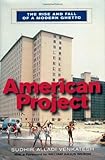
Sudhir Alladi Venkatesh. American Project: The Rise and Fall of a Modern Ghetto. Cambridge, Mass.: Harvard University Press, 2000. xvi + 332 pp. $32.50 (cloth), ISBN 978-0-674-00321-7; $21.00 (paper), ISBN 978-0-674-00830-4.
Reviewed by D. Bradford Hunt (Department of History, University of California at Berkeley)
Published on H-Urban (February, 2001)
Chicago's Robert Taylor Homes - once the nation's largest public housing project - is currently being dismantled. Half of its buildings have already been torn down, and the remainder will soon meet the wrecking ball. Completed in 1962, Taylor was the capstone to Chicago's south side "second ghetto" (to use Arnold Hirsch's term), housing 28,000 African Americans in 28 identical 16-story buildings. While the project replaced one of Chicago's worst slums, it in turn became the city's most infamous and troubled community.
Sudhir Venkatesh's new book, American Project: The Rise and Fall of a Modern Ghetto is both an ethnography and a history of Taylor from the mid-1960s through the mid-1990s. Venkatesh took exceptional risks by spending several years studying the idea of "community" by "hanging out," as he puts it, primarily with longtime tenant leaders and gang members. He describes this methodology as a throwback to earlier participant observer ethnographies of urban life but with an added historical dimension, and the approach has received praise from sociologists in several media accounts.[1] The personal danger involved proved harrowing at times; at one point, he witnessed a gang-related, drive-by shooting that killed a young man.
As an ethnography, the book is an innovative, insightful, and valuable examination of internal project politics and "project living," as tenants call their mode of habitation (p. xvi). As a history, however, it is relatively weaker, limited by its reliance on oral history at the expense of written sources. Finally, the book's implied policy prescription to save what remains of Taylor from destruction is difficult for this reviewer to embrace.
Venkatesh's ethnography addresses a long-neglected element of the public housing literature by giving voice to project tenants. The interactions and negotiations between Taylor's elected Local Advisory Council (LAC) leaders, gang members, community interests, and (to a lesser extent) project managers are described in detail through his observation and informal interviews. Residents are seen making earnest if not always successful efforts to win basic services (most importantly police protection) and improve their community. The narrative does not shy away from revealing the dark side of project life - the corruption of LAC leaders, the "hustles" of tenants seeking to get by, and the destructive activities of gang members. It describes the effects of systematic gang control of Taylor in the early 1990s and the resulting turf wars, drug trade, business extortion, attacks on young women, and vigilante justice. For its intimate look at project dynamics, American Project is a major contribution to our understanding of the struggles of public housing communities.
While it offers groundbreaking ethnography, the book's effort to construct a history of Taylor is more problematic. The reliance on oral history and the almost exclusive focus on tenants and gang members leave the story incomplete. Project managers, senior CHA administrators, and police officials receive only limited attention after the 1970s. (Undoubtedly, Venkatesh could not have been interviewing gang members and police officers simultaneously without serious endangerment.) Likewise, larger institutions like welfare agencies or elected city officials are absent. As a result, the story of why Taylor changed over time remains blurred and incomplete.
For instance, the book notes that between 1964 and 1973, the percentage of two-parent households in Taylor plunged from 60% to 18% (p. 45). Other data show welfare dependency doubled from 40% to 80% in the same time period. [2] Taylor, then, started out as a "mixed-income" community, in Venkatesh's words (p. 48), but in less than ten years experienced a dramatic shift in fortunes resulting in unprecedented concentrations of poverty. Why this crucial and catastrophic change took place is not entirely addressed. The book suggests that macroeconomic forces, surging applications, and federal bureaucratic rules are involved, but details and evidence are scarce. Since sustaining mixed-income communities is a vital concern of current policy, the need to understand Taylor's rapid decline remains pressing.
One answer to this question might center on the CHA's management and its resources over time. The book points primarily to a lack of funds to explain managerial problems, but here the evidence is again problematic. Citing an obscure Associated Press news story, the book states: "With HUD's funding for all housing programs reduced by 76% from 1980 to 1988, the CHA operating budget fell by 87% during the same time period, leaving little money for modernization of aging physical plants and apartments" (p. 116). The claim of dramatic budget cuts is repeated elsewhere (pp. 112, 148, 274) and, if accurate, would indeed be debilitating. But readily available data show that HUD spent $12.7 billion in 1980 and $18.9 billion in 1988 on all housing programs - a slight increase adjusted for inflation. [3] Federal subsidies to existing public housing projects rose from $1.36 billion in 1980 to $2.16 billion in 1990, again faster than inflation. [4] Spending data for the CHA are much harder to come by, but scattered reports show the Authority spent a total of $82 million in 1978, $144 million in 1984, $155 million in 1986, and $407 million in 1995, the year HUD took over the CHA citing gross mismanagement. [5] How this trend line amounts to an 87% cut is unclear. This discrepancy is not trivial, as Venkatesh asserts that Taylor could not have been expected to survive given drastic funding cuts. Whether the figures above were sufficient to run the public housing program is an open question, but the Authority's management problems suggest that far more than funding was at the root of public housing failure.
Hovering throughout the book is the fundamental policy question of Taylor's "viability" (p.10). Should Taylor be rehabilitated and saved as a sustainable, if poor, community? Or is it an unmitigated disaster that should be torn down? Given the current demolition, the point is somewhat moot, though several buildings remain that could still be rehabilitated for continued use as public housing. [6] Venkatesh concludes that Taylor is a viable community worth saving, a difficult proposition to reconcile with his blunt descriptions of gang control, project vice, and poor maintenance. Residents, he argues, have the same aspirations as all other Americans, with only poverty and societal neglect standing in the way of upward mobility. Viability would be readily achievable if only adequate police protection, social programs, schools, and maintenance funds were provided. Following sociologist Loic Wacquant's work, Venkatesh insists that Taylor is not "socially disorganized," as previous generations of sociologists have labeled the ghetto, just organized differently than mainstream society.
The semantic difference here is slim and at times borders on the romantic. In American Project, gangs are "corporate" actors (p. 211) pursuing financial gain in a well-structured business that just happens to involve narcotics, while other residents who engage in illicit activities (prostitution, organized gambling) are "entrepreneurs" (p.73), different from other Americans not in their aspirations but only in the illegality of their business. The consumers of the drug "product" and the devastating effects of addiction on low-income communities are not addressed. The cumulative effect of Venkatesh's ethnography of project politics and gang life does more to confirm than deny the vast gulf that separates Taylor from working-class neighborhoods. The tenants' use of the term "project living" suggests they understand their unusual situation. Venkatesh has found residents heroically scratching out "community" in the face of serious obstacles, but it does not follow that the project should therefore be saved.
Further, saving a portion of Taylor, even with a massive commitment of new resources, would likely still leave an extreme concentration of very poor residents separated from the larger middle-class black and white areas of the city. Such a policy prescription runs counter to the general direction of most proposed ghetto solutions. William Julius Wilson (Venkatesh's mentor) explained that residents in Chicago's ghetto were "truly disadvantaged" precisely because of their social and physical isolation from the wider world. Douglas Massey and Nancy Denton made the powerful argument that separation by race is at the root of the "underclass" problem. And Leonard Rubinowitz and James Rosenbaum find general success in Chicago's "Gautreaux" program, which moved seven thousand Chicago public housing families to the suburbs. [7] Venkatesh would have us put more resources into Taylor as opposed to dispersing residents to areas with resources. The dispersal approach might sever community ties for residents, but propping up Taylor would be far more expensive and less effective than moving the poor into relatively stable economic communities. [8] Either solution would face an uphill battle in today's political climate.
Despite its historical limitations, American Project should reinvigorate ethnographic studies of poor communities. "Hanging out" has many advantages, and Venkatesh should be commended for telling the tenants' side of the story - something far too neglected in the public housing literature. It took not only physical courage, but also emotional detachment to write objectively about the struggles of residents against significant odds. But whether this effort means that a disastrous situation like Taylor - with its hyper-concentration of poverty, dysfunctional high-rise buildings, and inadequate management - should be saved is another issue altogether. Current public housing policy is the antithesis of the Taylor model, stressing vernacular architecture, economic and racial integration, and privatized management. Saving Taylor is not the solution - rebuilding an improved and truly integrated community is.
Notes:
[1]. See Chicago Tribune Magazine, December 10, 2000 and Chronicle of Higher Education, September 10, 1999.
[2]. See CHA, Annual Statistical Reports, 1964-1973, available at the Harold Washington Library Center, Municipal Reference Collection.
[3]. The Budget of the United States Government, FY 2000, Historical Tables, Table 4.1.
[4]. See The Budget of the United States Government, FY 1982, p. I-L2 and FY 1992, part 4, p. 686 for outlays (actual spending) in the public housing program.
[5]. CHA budget data from CHA, Annual Reports, 1980, 1983-84; CHA, "Preliminary Report on the Authority's Financial Position," April 1987, and CHA, "Progress Report, 1995-1998," 1998, all in the Chicago Public Library.
[6]. Three Taylor buildings have been rehabilitated as "relocation" housing to accommodate some families forced to move from those to be torn down. The future of these three buildings is unclear.
[7]. William Julius Wilson, The Truly Disadvantaged: The Inner City, the Underclass, and Public Policy (Chicago: University of Chicago Press, 1987); Douglas S. Massey & Nancy A. Denton, American Apartheid: Segregation and the Making of the Underclass (Cambridge: Harvard University Press, 1993); Leonard S. Rubinowitz and James E. Rosenbaum, Crossing the Class and Color Lines: From Public Housing to White Suburbia (Chicago: University of Chicago Press, 2000).
[8]. Unfortunately, Taylor tenants receiving housing vouchers have not been given the kind of support program afforded participants in the Gautreaux program, who were offered counseling and resources to facilitate their move into suburban communities.
If there is additional discussion of this review, you may access it through the network, at: https://networks.h-net.org/h-urban.
Citation:
D. Bradford Hunt. Review of Venkatesh, Sudhir Alladi, American Project: The Rise and Fall of a Modern Ghetto.
H-Urban, H-Net Reviews.
February, 2001.
URL: http://www.h-net.org/reviews/showrev.php?id=4949
Copyright © 2001 by H-Net, all rights reserved. H-Net permits the redistribution and reprinting of this work for nonprofit, educational purposes, with full and accurate attribution to the author, web location, date of publication, originating list, and H-Net: Humanities & Social Sciences Online. For any other proposed use, contact the Reviews editorial staff at hbooks@mail.h-net.org.

