



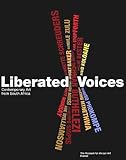
Frank Herreman, ed. Liberated Voices: Contemporary Art from South Africa. New York. Munich: Prestel Verlag, 1999. 190 pp. $65.00 (cloth), ISBN 978-3-7913-2195-0.
Reviewed by Elizabeth Rankin (Department of Art History, University of Auckland, New Zealand)
Published on H-SAfrica (February, 2001)
Contemporary art from South Africa: still segregated voices?
Contemporary art from South Africa: still segregated voices?
At a time when South Africa is attracting attention world-wide, her artists too, long excluded by cultural boycotts from the international scene, have attracted a great deal of interest. This should ensure attention for a substantial and well-presented publication like this one, which includes the work of a range of South African artists, some well, some little known, with essays by diverse writers, as well as numerous high-quality coloured illustrations.
The volume was produced to accompany an exhibition at The Museum for African Art in New York, Liberated Voices: Contemporary Art from South Africa, curated by Frank Herreman. Any catalogue is dependent on its exhibition, which is the primary generating form, particularly in the range of artists and the works selected. Exhibition and catalogue complement each other, the material presence of the works and the way in which they are displayed setting up a dialogue with the printed text. The fact that I did not view the exhibition must be a serious limitation on this review. Inevitably the exhibition remains an invisible presence in the catalogue, implicitly included in any critique, even if not itself seen -- and hence possibly misconstrued. Yet the publication is also an independent form, which has to survive beyond that occasion for readers like myself who see only the text, and it is from this perspective that I must consider it as a record of contemporary South African art.
Since the first democratic elections of 1994, South African artists have carried a curious burden. To a degree surely less pressing for those who belong to long-standing democracies, contemporary artists seem to be counted on to create an art that will express a national identity in the wake of the country's transformation. There is a high level of expectation that their art will reveal the nature of the 'new South Africa' and mark the coming of a 'brave new a way that economic realities may preclude. As Andre Brink has written of literature, '... it cannot come as a surprise to anyone that, ever since the first signs of the drastic socio-political shift in South Africa, there should have been expectations of new aesthetic responses to the changing circumstances.'[1]
A growing awareness of the role that culture could play in effecting change, at least indirectly by fostering political awareness, had by the 1980s engendered a self-appointed role for the majority of South African artists. The production of resistance a became virtually obligatory. Art curators, critics and historians, as much as artists themselves, gradually marginalised artists whose agendas did not seem to match the political aspirations of the 'struggle', whether they were categorised according to neutered 'township art' model amongst black artists or the conventions of self-referential modernism amongst whites. Only gradually was resistance art itself challenged as potentially equally stereotypical, as when Albie Sachs of the ANC called for the liberation of art from a tightly defined political model, in the cause of aesthetic and expressive freedom.[2] But at a time of increasing social confrontation, the need for artists to wrestle with these issues was a personal agenda too, and remained a leitmotif in 'cutting-edge' South African art, which paradoxically offered an individual yet shared vision.
The residue of the obligations of the time of struggle seems to have left contemporary South African artists with a heritage of collective responsibility. Just as much as artists under apartheid were required to take up a political position, so those und democratic rule seem to carry a similar obligation. And presumably critics, historians and curators too are expected to reveal coherent visual politics in art practice of the new era. However much they might resist this, citing the difficulties of generalising and the dangers of stereotyping, the expectation is an insistent one. Even sager readers, who would discount an essentialist reading, might anticipate a coherent curatorial position because of the unique historical circumstances for the current prod tion of South African art.
Thus, while selecting artists for any group exhibition and catalogue is a challenging task, in the case of a show that represents the 'Liberated Voices' of post-apartheid South Africa, the problem becomes a particularly acute one. Curator and editor Fran Herreman acknowledges the difficulties of selection, and talks of being guided by the frequent recurrence of names during his process of consultation, although he gives little indication of what criteria might account for this recurrence. While one might applaud the avoidance of an essentialist position and the pluralist character of the publication, the lack of a distinctive curatorial voice may seem disappointing to some. It would have been valuable to hear more about how Herremann made his final decisions, of how he tried "... to get a finger on the pulse of the tendencies and thoughts underlying current creative activity" (p. 180). Readers are left to make their own deductions as to why this specific group of thirteen artists -- seven black and two white men, and four white women --were chosen to represent this critical moment in South Africa's history.
Numerically black artists predominate and, while this does not nearly match actual demographic superiority, it does suggest a deliberate strategy on the part of the curator, when white artists have long dominated the art scene in terms of critical acclaim market prices and representation in public collections. It is telling, though, that there are no black women included, as their access to the resources and institutions of art has been even more restricted than that of black men. But beyond the issue of representivity, it is difficult to see a coherent agenda in the selected range, other than the chronological definition of the later 1990s from which all the works are drawn, with the exception of Paul Stopforth's powerful 'portraits' of Steve Biko's interrogators (1979). This work establishes a precedent for the lingering presence of resistance themes, represented by David Koloane's series on the death of Steve Biko, Sue Williamson's on the Truth and Reconciliation Commission, and Willie Bester's mixed-media representation of Cross Roads squatter settlement. These four artists, each represented by a single catalogue entry on the exhibition and no independent essay in the publication, seem to form a prolegomena to the exhibition proper and the main text, which is thus limited to only nine artists -- Bridget Baker, Mbongeni Richman Buthelezi, Samson Mnise, Zwelethu Mthethwa, Brett Murray, Thabiso Phokompe, Claudette Schreuders, Penny Siopis, and Sandile Zulu (to place them in alphabetical order).
The advantage of this limitation is that it makes possible the inclusion of a generous number of works for each artist, further supplemented in the catalogue by illustrations of earlier works in some cases. The disadvantage, of course, is that the range of artists is quite severely restricted. It might be thought that this would then reveal some consistency, a clear interpretative agenda on the part of the curator/editor. Yet it is difficult to see what, if any, commonality the artists might be intended to represent. Perhaps the range was indeed intended to reflect diversity as a characteristic of the South African art scene. Diversity is further stressed by the accompanying essays on individuals which are equally distinct, ranging as they do from sophisticated academic discourse (such as Jennifer Law's piece on Penny Siopis), to interviews and unpretentious artist's statements (like that of Claudette Schreuders). Many are enlightening about the work of the individual artist, and may even address something of the individual's position in the later 1990s but, not surprisingly, they shed little light on the broader development of contemporary South African art.
While Herreman acknowledges the impossibility of creating a representative overview, he does suggest a few unifying elements, which might be interrogated a little further. Regarding the white artists, Herreman rightly proposes that they are deeply concerned with "personal introspection" (p. 181). But one might ask whether this is limited to them as a group. One might discern a common thread for both black and white artists in that all are concerned with history and memory, although they explore it throug different lenses -- those of ancestors, biographies and autobiographies, for example, as well as through the histories of the materials deployed themselves.
Herreman has altogether avoided traditional easel painting in his exhibition, and this provides a second unifying element. He focuses on mixed media works and installations as dominant in contemporary South African art, and deduces that their preponderance is the outcome of a history in which education and resources were denied black artists. (p.180) It might be argued, however, that the earlier production of this group was characterised by media that were conventional enough in western traditions of painting and sculpture, albeit in their less expensive forms -- watercolour and gouache, clay and wood. While the wide utilisation of inexpensive found materials may in part have entered their art practice through the informal art sector and the popular art market, its more enduring examples seem dependent on modernist uses of collage and postmodern explorations of unconventional materials. The practice is often to be found amongst artists who had access to some art education, such as those who attended Bill Ainslie's Johannesburg Art Foundation and the Thupelo workshops (and it is surely noteworthy that the black artists included here all had some training). Thus it may well be related to international practice of the later twentieth century, rather than a lack resources per se. After all, the white artists included here also avoid 'high art' media, and favour the role of the "bricoleur," who "...interrogates all the heterogeneous objects of which his [/her] treasury is composed to discover what each of them could 'signify'."[3]
These two "themes" suggest areas of commonality, although they are certainly not unique to South Africa in the contemporary art world. The burden of drawing the material together for a South African context rests with a group of essays in the publication that address broader themes than those on individual artists. Apart from Herreman's own short contribution, there are five others. Mongane Wally Serote's highly personal and poetic opening essay talks of reinstating past art forms, notably the rock paintings of the Khoi San, as an aspect of redeveloping South African art history. The other essays examine aspects of that history to provide a context for the selected artists. Mark D'Amato selects important recent publications of South African art history which provided a revisionist discourse paralleling the period of resistance art. Andries Oliphant and Kristine Roome trace another theme, that of art education, concentrating on what was available to black artists. This is an important marker of apartheid in the arts and, while there are some minor misrepresentations in the detail of the account, it succeeds in bringing home the limitation of resources available to black artists.[4]
Both these essays are backward looking, caught up still in apartheid history. This is of course entirely apt for their chosen topics, but it is noteworthy that the shadow of that history still makes itself felt in the writing on the development and practice of art itself included in the publication. Just as Herremann's application of themes related chiefly to black and white artists as segregated groups, it is an indication of the continuing potency of apartheid that South African art practice in general hould be tackled in two essays -- one on the black artists by a black South African author, David Koloane, and one on the white artists by a white South African author, Sue Williamson -- thus reinforcing the very divisions of segregation which 'Liberated Voices' might seek to overcome.
Sue Williamson writes of the interaction of art and politics before and after the democratic elections. She concentrates chiefly on the artists who are included in the exhibition and publication in order to contextualise their production, and to suggest how it relates to the circumstances of working in South Africa. While staying with the exhibition selection might be viewed as relatively limited in relation to the 'bigger picture', this strategy gives the essay coherence in relation to the project, and the artists are sufficiently diverse to provide a variety of interesting insights. David Koloane's considerably longer essay recounts a history of black artists in South Africa. It is a story that has been traced elsewhere but can bear re-telling, especially for an American audience for whom it would be less familiar: one might have expected, however, as an increasing amount is published on this material, that it would become possible to problematise it more. Koloane selects judicious examples to illustrate his account, but they are not the artists included in the exhibition. Instead, his brief introduction to their work seems almost a postscript tagged on to the end of the essay. But the disjunction may well be a telling one. Whereas for white artists, the change in political dispensation has brought little change in the basic circumstances of their practice, for black artists it may mark a very pronounced break.
Koloane makes a key point when he writes that "It is important to note that very few black African artists have access to tertiary-level education, and that the reading ethic that is common among white artists is almost non-existent among their counterpar in the townships. If one tries to promote an aesthetic dialogue between these groups of artists, it soon becomes apparent that they often operate at different levels" (p. 25). While, as has been pointed out, the artists on this exhibition all had some educational opportunities, it is true that most of the black artists do not have tertiary qualifications. This situation is no doubt changing with the new social order -- but only slowly. What is of considerable interest, though, is that these artists are producing work in a mode that is different from most black artists of the past. Koloane singles out Lucas Seage as a rare example in the early 1980s when he produced conceptual art in which assemblages of discarded elements evoked political messages (p. 25). But most black artists, whatever the media they chose to work in, made representational art: even Willie Bester, who created unique works from debris that he collected at sites of conflict, none the less continued to deploy representational elements to ommunicate his messages.
When the Thupelo workshops, which Koloane correctly cites as an important stimulus for innovative art making in South Africa, encouraged experimentation with abstract forms, the attitude of art critics was largely dismissive. They spoke disparagingly of black artists 'imitating' American practice, and abstract works like those of Dumisani Mabaso, and Koloane himself, did not initiate a new art market at the time. Today many more black artists are making sophisticated conceptual works -- and they are being taken very seriously, as is demonstrated by their dominance on this exhibition. A change of attitude in the reception of art is surely a very important part of a transition in the art itself. Liberated listeners are necessary for 'Liberated Voices' to thrive. So perhaps we are seeing the beginning of a real transition, and the forging of a South African art world where artistic stereotypes are breaking down.
It is unfortunate that catalogue publications of this kind rarely have an index, so that they cannot be used as reference tools, and the essays must need be read independently. A general bibliography is supplied but its usefulness is curtailed as it is drawn from the references in the different essays (even though some of these already supply full references in endnotes). Thus rather arcane, certainly very personal inclusions like De Rerum Natura by Lucretius (cited by Colin Richards in his richly referenced essay on Sandile Zulu) are found amidst texts on general theoretical issues in contemporary art practice, as well as works that refer specifically to South African art. It would have been more useful for the reader to have a comprehensive bibliograp on South African art, or at least to have texts which deal with it marked in some way, as titles do not necessarily make this clear (for example, Ruth Rosengarten's Don't Mess with Mr Inbetween does not readily proclaim its South African content).
Such simple tools would have increased the usefulness of this publication, but it remains an interesting collection of writings on a range of artists, a number of whom have not previously enjoyed much attention. It also offers insightful essays into more general aspects of South African art, although these largely rehearse the apartheid past, rather than offering a close examination of what characterises the present. If it is difficult to achieve coherence in a collection of works by different artists and different authors, that very diversity may be construed to symbolise the individual freedom which becomes possible with political liberation, although whether art has yet been truly desegregated remains a moot point. Nonetheless, in contrast to the over-arching grand narratives of apartheid, and of opposing anti-apartheid, a platform has been created for discrete and more personal stories -- the "Liberated Voices" of this publication.
Notes
[1]. A. Brink, 'Stories of history: reimagining the past in post-apartheid narrative' in S. Nuttall and C. Coetzee (eds.) Negotiating the past: the making of memory in South Africa, Cape Town: Oxford University Press, 1998, p. 29.
[2]. See, for example, A. Sachs, 'Preparing ourselves for freedom' in Art from South Africa, Oxford: Museum of Modern Art, 1990, pp. 10-15.
[3]. C. Levi-Strauss, The Savage Mind, London: Weidenfeld and Nicolson, 1974, p. 17.
[4]. Minor errors of fact promoting slightly one-sided opinions are perhaps inevitable in so short an overview, and probably result from a reliance on a limited range of sources. For example, Cecil Skotnes has challenged the implication that his classes at the Polly Street Art Centre were deliberately racist in 'not teaching' art to black students, strongly argued by Koloane in his essay on Polly Street (in A. Nettleton and D. Hammond-Tooke, African Art in Southern Africa: From Tradition to Township, Johannesburg: Ad Donker, 1989), and repeated here. (p. 175) Skotnes claims that he used the same methodology that he had himself been exposed to shortly before as a student at the University of the Witwatersrand, where art classes employed little formal teaching. This teaching depended chiefly on the discussion of work produced by the students, which a number of those who worked at Polly Street recall as very constructive. (E. Rankin, 'Teaching and Learning: Skotnes at Polly Street' in F. Harmsen (ed.) Cecil Skotnes Cape Town: South African National Gallery, 1996, p. 70). Ben Arnold and Louis Maqhubela also stress a lack of racial tension at the centre (ibid., p. 74).
A similar slightly disparaging tone towards other early efforts in art education may be discerned in the statement that Rorke's Drift Art and Craft Centre '... was founded on training in weaving, pottery, and printmaking, conceived as means to provide Africans with skills in forms of artmaking that would provide employment and income for both them and the school.' (p. 178) It is certainly the case that the Centre aimed to provide its students with skills that could bring economic benefits. But the implication that the 'fine arts' were not taught is incorrect. There was differentiation between the teaching of 'crafts' (first established as part of the training of art and craft advisors for hospitals) and the teaching of art which developed as a separate enterprise from 1968 to 1982, and which included painting and sculpture as well as a variety of printmaking processes. Weaving, fabric printing and pottery continued after the fine art section was closed down.
None of this changes the reality that resources in art education were scandalously limited for black artists in South Africa. But it is not necessary to overstate the case to bring home this indisputable truth.
Copyright (c) 2001 by H-Net, all rights reserved. This work may be copied for non-profit educational use if proper credit is given to the author and the list. For other permission, please contact H-Net@h-net.msu.edu.
If there is additional discussion of this review, you may access it through the network, at: https://networks.h-net.org/h-safrica.
Citation:
Elizabeth Rankin. Review of Herreman, Frank, ed., Liberated Voices: Contemporary Art from South Africa.
H-SAfrica, H-Net Reviews.
February, 2001.
URL: http://www.h-net.org/reviews/showrev.php?id=4925
Copyright © 2001 by H-Net, all rights reserved. H-Net permits the redistribution and reprinting of this work for nonprofit, educational purposes, with full and accurate attribution to the author, web location, date of publication, originating list, and H-Net: Humanities & Social Sciences Online. For any other proposed use, contact the Reviews editorial staff at hbooks@mail.h-net.org.

