



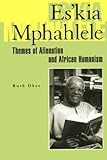
Ruth Obee. Es'kia Mphahlele: Themes of Alienation and African Humanism. Athens, Ohio: Ohio University Press, 1999. 288 pp. $39.95 (cloth), ISBN 978-0-8214-1249-7.
Reviewed by Ronit Fainman-Frenkel (Comparative Cultural and Literary Studies, University of Arizona, Tucson)
Published on H-AfrLitCine (February, 2001)
Es'kia Mphahlele
Es'kia Mphahlele
Ruth Obee's Es'kia Mphahlele: Themes of Alienation and African Humanism is an ambitious text that traces the life and work of one of South Africa's great writers. Obee aims to redress the Apartheid government's silencing of Black South African writers by focusing on work that was banned for twenty years, within the broader context of "the place and value of such works in the body of South African literature (p. 2)." The strength of this text lies in its extensive coverage of Mphahlele's works, but Obee's failure to utilize contemporary theory ultimately renders it problematical.
The book deals with each of Mphahlele's texts in chronological order, beginning with Man Must Live and Other Stories (1946). This collection is one of the only books to be published by a black South African writer during this period and examines the impact of racial domination on the lives of urban slum dwellers. Obee effectively integrates South African history of the 1940s into her handling of the stories, within a discussion that mainly focuses on defending this collection from its critics. She refutes the notion that the work is populated by flat characters on the grounds that we cannot "blame" Mphahlele because the depiction emerges "from a culturally colonized and therefore alienated writer" (p. 35) -- a statement that patronizes both the writer and his craft. Man must live and Other Stories is seen as valuable because it illustrates Mphahlele's metamorphosis into a writer "who arrives at a distinctive idiom fusing two streams of consciousness that speak from the authenticity of his own experience (p. 36)." This binary logic continues throughout the book: There is also in The African Image a persona, sometimes Westernized and individuated, other times, an African elder (p. 66)." This notion is problematical in that it postulates two homogenous cultures (Western and African), hermetically sealed off from each other until Mphahlele is able to fuse these distinct voices. The idea that cultures remain "intact" in the late twentieth century, particularly in the contest of three hundred years of colonialism, relies on an essentialist notion of culture that places it beyond change -- a notion that contemporary cultural and postcolonial theories have refuted.
A similar logic underlies Obee's brief invocation of "The Language Debate" in African Literature where the "linguistic textual evidence of [Mphahlele's] alienation is ambiguous" (p. 27), due to his insertion of African idiom into his usage of English. The idea that former colonial languages remain unchanged European cultural products, rests on the belief that Africans are not agents who are able to appropriate, change or indigenize cultural forms. This again enforces the idea of the absolute division between cultures and relies on what Valentine Mudimbe has called the dichotomizing structure of colonial discourse. This system of knowledge constructs a binary dialectic, based on absolute difference, in which current paradigmatic oppositions are found -- Us and Them, Western and African, Natural and Cultural, etc. Analysis that relies on this system of understanding is therefore seen to perpetuate colonial mechanisms of understanding.
The book summarizes Mphahlele's complete works to date including his brilliant autobiography, Down Second Avenue, which depicts South African social history through a personal narrative of survival and oppression. Obee's extensive coverage of Mphahlele's work includes a discussion of his Master's thesis, The Non-European Character in South African English Fiction, which compares the representation of "non-white" characters in the English canon to such representation in South African English literature. I was hoping for a discussion that included Toni Morrrison's seminal work on representations of blackness within the work of white canonical writers , either in terms of a comparative analysis or in terms of Mphahlele's impact on contemporary literary theory. Unfortunately, the chapter continues with the same type of analysis as in the preceding ones and does not incorporate contemporary literary theories.
Obee, however, does convincingly illustrate the debt that the Black Consciousness Movement owes to Mphahlele in his early indication of the mechanisms of alienation, be they cultural, economic, political or social. Obee's consistent focus on alienation as a theme, is one of the strengths of the book. Alienation is traced through Mphahlele's life in his struggles to live and work under Apartheid, through his years in exile and eventual homecoming, to the intellectual alienation of having his works banned. Themes of alienation are also traced through his creative works, in terms of both form and content.
The second theme Obee traces throughout the book is one of African Humanism. Mphahlele's conceptualization of African Humanism is his answer to alienation, or in Ngugi's terms, is the way to decolonize the mind. Mphahlele defines African Humanism as a way of life that is imbued with the wisdom and speech of the elders, where there is no duality between life and death, past and present, etc. Social relationships and family ties form the central core of life where everything is interconnected by a Vital Force (p.19). Obee sees this philosophy as the "resurrection of ancient indigenous African cultural norms" that are to be used as "a well-sharpened spear (p. 8)." This interpretation generalizes a vast array of cultural norms and practices, dehistoricizing the philosophy behind a veil of empty categories such as ancient or authentic. African Humanism also needs to be understood within the context of its intellectual history (Obee covers this within one paragraph on p. 63), and would have been greatly strengthened by being discussed within the scope of African philosophy more broadly.
Obee's book provides a comprehensive overview for those unfamiliar with Mphahlele's life and work. The themes of alienation and African Humanism are consistently covered, but are not situated within a broader context. Unfortunately, Es'kia Mphahlele: Themes of Alienation and African Humanism lacks the theoretical base that would have allowed for the requisite connections to be made between Mphahlele's work, contemporary theoretical paradigms and the intellectual traditions that are connected to his scholarship.
If there is additional discussion of this review, you may access it through the network, at: https://networks.h-net.org/h-afrlitcine.
Citation:
Ronit Fainman-Frenkel. Review of Obee, Ruth, Es'kia Mphahlele: Themes of Alienation and African Humanism.
H-AfrLitCine, H-Net Reviews.
February, 2001.
URL: http://www.h-net.org/reviews/showrev.php?id=4914
Copyright © 2001 by H-Net, all rights reserved. H-Net permits the redistribution and reprinting of this work for nonprofit, educational purposes, with full and accurate attribution to the author, web location, date of publication, originating list, and H-Net: Humanities & Social Sciences Online. For any other proposed use, contact the Reviews editorial staff at hbooks@mail.h-net.org.

