



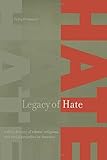
Philip Perlmutter. Legacy of Hate: A Short History of Ethnic, Religious, and Racial Prejudice in America. Armonk, New York: M.E. Sharpe, 1999. xv + 325 pp. $34.95 (cloth), ISBN 978-0-7656-0406-4.
Reviewed by David M. Reimers (Emeritus, History Department, New York University)
Published on H-Ethnic (February, 2001)
Legacy of Hate is a revised and updated book of Philip Perlmutter's Divided We Fall: A History of Ethnic, Religious and Racial Prejudice in America, published in 1992. Legacy of Hate covers the same themes as the earlier book. Perlmutter's account is a sweeping history of prejudice beginning in the colonial era when the Indians of the Americas (who had conflicts of their own) came into contact with European explorers and settlers. The strength of the book is the vast coverage. Not only are Indian and white conflicts explored from the colonial settlements to the present, but nearly every group experiencing prejudice or "hate," as he calls it, are discussed. Thus we have sections on black-white conflict and the resulting slavery and generations of segregation and discrimination, and the treatment of minority groups entering the United States.
Blacks and Indians suffered most at the hands of a white-dominated society, but Perlmutter also looks at how other non-Europeans, meaning Asians and Mexicans, fared. Even small immigrant groups such as the first waves of Asian Indians and Filipinos are discussed. As for Europeans, Perlmutter probes anti-Semitism and hostility toward Catholics, beginning in colonies and coming down to the present. He does not limit himself to looking at bigotry; rather he also examines the expansion of "Democratic Pluralism," as he calls it, and how American society became more tolerant. He concludes with a short chapter on the future of minorities. To cover such ground is a huge task, and the author rightly notes that his history is a brief one. If one is searching for a brief account (268 pages) of racial, ethnic and religious bigotry in American history, Perlmutter's book is useful, for the author covers an amazing number of incidents of hate.
Even allowing for the fact that so much material is covered, this reviewer finds Legacy of Hate has limited value. The reader is exposed to a virtual catalogue of prejudice and even violence directed against many Americans, but there is little analysis explaining prejudice or bigotry in American history. In part the lack of analysis is related to the organization. Perlmutter begins with the colonial era and moves chronologically to the 1990s. Yet the role of education in teaching hate and tolerance comes nearly at the end of the book. This placement gives the feeling of repetition. Clearly the "Teaching of Contempt," as he calls it, should have been integrated with the rest of the book instead of being located in a separate chapter near the end. While education was not the sole cause of bigotry, it was important and belongs in proper context.
The discussion of numerous events laced with hatred, including a considerable amount of violence, also leaves the reader with an unclear understanding of which events and conflicts are the most important. Perlmutter notes that hatred toward groups is a matter of degree, but in telling of so many incidents, he fails at times to indicate fully which groups suffered more. He is quick to remind the reader that the New York Times criticized Norwegians by telling them that if they had been naturalized they were no longer politically Norwegian. Such a rebuke hardly constitutes strong prejudice. In another example of the lack of explaining which incidents were most important, the internment of Japanese Americans in virtual concentration camps becomes lost in the discussion of the few thousand Germans and Italians who were also interned during World War II. Moreover, some of the events discussed were political or class based and not especially ethnic, racial or religious. Thus the discussion of women's rights in the nineteenth century does not seem to belong in this book.
American Indians and African Americans were the groups that clearly suffered most in American history. Religious and nationality hatred pales by comparison to the experiences of blacks and Indians. Perlmutter is stronger when dealing with Indians, but in general their experiences tend to get lost in the parade of bigotry that unfortunately is deeply ingrained in American society and history. Moreover, to Perlmutter, issues are rarely complex. For instance, he notes that Chinese Americans encountered prejudice in World War II industries. While true, World War II was a turning point for Chinese and Filipino Americans, a prelude for the growing toleration of the postwar decades.
Moreover, in the parade of bigotry, there are omissions. On page 136 the author notes that 11,000 Mexicans from the Los Angeles area were deported during the early days of the Great Depression. But he does not indicate that this was a minor repatriation compared to what followed when several hundred thousand Mexicans and their children (who were often American citizens) were sent back to Mexico during the 1930s. No other group in American history has undergone such an experience.
The book also is also puzzling in some sections. The author tells of how immigrants fared when they arrived on American shores, in housing, jobs and health. Italians, Jews, Irish and most immigrants lived under appalling conditions, in overcrowded housing, and found themselves at the bottom of the economic ladder, laboring at dangerous jobs that paid low wages. To be sure, the Irish encountered signs saying "No Irish Need Apply," and other groups were barred from participation in certain American social and economic institutions. Yet European immigrants suffered in part because of their characteristics. Landing on American shores with little or no education, few skills needed in the emerging American economy, and lacking English meant that the newcomers had few options. To what extent bigotry added to their woes is not explained satisfactorily, and the discussion of conditions among immigrants seems out of place in this book. Workers in the nation's mines, often English by background, also suffered in this dangerous occupation, but not because necessarily because of bigotry. The conditions aboard emigrant sailing vessels in the colonial era and early nineteenth century were often dangerous and filthy, but what role ethnic or racial prejudice played in the journeys described by Perlmutter is left unclear.
Perlmutter's book leaves the reader with an overview of prejudice, or hate, as he calls it, but one lacking in analysis. It can be read with profit to gain a picture of the extent of ethnic, religious and racial hatred, but the reader will have to turn elsewhere to understand this part of American history.
Copyright (c) 2001 by H-Net, all rights reserved. This work may be copied for non-profit educational use if proper credit is given to the author and the list. For other permission, please contact H-Net@h-net.msu.edu.
If there is additional discussion of this review, you may access it through the network, at: https://networks.h-net.org/h-ethnic.
Citation:
David M. Reimers. Review of Perlmutter, Philip, Legacy of Hate: A Short History of Ethnic, Religious, and Racial Prejudice in America.
H-Ethnic, H-Net Reviews.
February, 2001.
URL: http://www.h-net.org/reviews/showrev.php?id=4910
Copyright © 2001 by H-Net, all rights reserved. H-Net permits the redistribution and reprinting of this work for nonprofit, educational purposes, with full and accurate attribution to the author, web location, date of publication, originating list, and H-Net: Humanities & Social Sciences Online. For any other proposed use, contact the Reviews editorial staff at hbooks@mail.h-net.org.

