



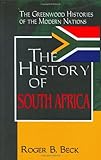
Roger B. Beck. The History of South Africa. Westport, Conn. and London: Greenwood Press, 2000. xxx + 248 pp. $35.00 (cloth), ISBN 978-0-313-30730-0.
Reviewed by Bill Nasson (Department of Historical Studies, University of Cape Town)
Published on H-SAfrica (January, 2001)
Roger Beck, an American scholar known for some good writing on South Africa's pre-industrial past, has produced a new general history of the country in a textbook series of 'national histories' targeted at students and 'interested laypeople.' These, in the view of the Series Editors, are citizens of 'a superpower whose influence is felt all over the world' yet 'who know very little about the histories of the nations with which the United States relates'. The stated intention of these volumes is to provide a general historical lens which focuses particularly on the 'modern era' in the life of selected nations, as the recent past has 'contributed the most to contemporary issues that have an impact on U.S. policy'. Those of us a long way from Brandeis and Berkeley or Purdue and Princeton can be thankful to publishers like Greenwood for doing their bit to keep educated Americans and their field intelligence operatives on their best behaviour. Who knows, if the day comes when the last embassy staff are airlifted from their Pretoria rooftop, left behind in the library will be a copy of Professor Beck's History of South Africa. In Saigon it was Barrington Moore's Social Origins of Dictatorship and Democracy, but that is a story probably best left to Oliver Stone.
This is, then, a book with two kinds of interest. One is as a straightforward overview history of South Africa for an American readership. The other is as a new concise historical narrative of South Africa. On the first count, Roger Beck has done a good job of an introductory text on South Africa for a target audience. The book has a long reach, from pre-human ancestral habitation several million years ago to the advent of the Mbeki presidency. Its ten core narrative chapters are clearly set out and sub-headings flag key issues, such as the economy and the shifting stages and periodisation of apartheid. Care has gone into providing various layers of accessible and useful reference information. These include a substantial timeline, solid index, concise annotated bibliography, crisp summary of current national features (900 species of birds, snow a rarity), glossary, and maps, although the book is too short on graphic illustration. The author also provides a nice list of South Africa's Notable People, listing some of the usual suspects. Disappointingly, it omits the notorious poisoner, Daisy de Melker. Professor Beck brings together a fair wealth of information and detail with ease and writes with fluency and authority, making his History of South Africa a clear and easy read.
Wedded to a politically-driven narrative, the author provides a reliable version of the familiar South African story, starting with the precolonial past, running through Dutch and British colonial periods, pondering the balance between African kingdoms, Afrikaner states and British imperialism, charting the mineral revolution and the the completion of imperial conquest, and chronicling the segregationist and apartheid twentieth-century, before rounding off with the coming of majority rule.
For all the virtues of a familiar story told well enough, there are oversights and lapses. The weight attached to a political interpretation means that social and cultural aspects of the South African story are rather neglected. Readers who learn that English is the majority language of Coloured people should try the farms and townships of the Western Cape. As the Cape Corps, Coloured troops were armed in the First World War, and were not wholly restricted to non-combatant service. It is stretching things to suggest that in the 1970s 'many mines' made an effort to replace male migrant housing with family accommodation for workers. For an appraisal ending in 1999, the absence of any reference to South Africa's AIDS crisis is quite odd, as is the absence of any analysis of the strains and contradictions besetting the ANC government. Still, such questionable points are inevitable in any introductory synthesis of this kind.
On the second question, the book's standing as an up-to-date, concise history of South Africa for the reader who does not wear checked golfing trousers, the obvious question is this. Given that in recent years we have had meaty concise histories from Nigel Worden, William Beinart and Robert Ross, is there room for another (lightish) history which essentially retells the standard South African story? Bringing in the jury on this is difficult. Still, for a non-specialist wanting a neat historical outline which takes South Africa up to the end of the 1990s, Professor Beck's volume provides an easy enough narrative. A word of caution. This is not a book to judge by its cover, which looks to be aimed at some sort of 'retro-chic' look, just the ticket for Barnes and Noble when Dwight Eisenhower became president. Here, it just makes Roger Beck look as if he were publishing alongside Arthur Keppel-Jones.
Copyright (c) 2001 by H-Net, all rights reserved. This work may be copied for non-profit educational use if proper credit is given to the author and the list. For other permission, please contact H-Net@H-Net.MSU.EDU.
If there is additional discussion of this review, you may access it through the network, at: https://networks.h-net.org/h-safrica.
Citation:
Bill Nasson. Review of Beck, Roger B., The History of South Africa.
H-SAfrica, H-Net Reviews.
January, 2001.
URL: http://www.h-net.org/reviews/showrev.php?id=4870
Copyright © 2001 by H-Net, all rights reserved. H-Net permits the redistribution and reprinting of this work for nonprofit, educational purposes, with full and accurate attribution to the author, web location, date of publication, originating list, and H-Net: Humanities & Social Sciences Online. For any other proposed use, contact the Reviews editorial staff at hbooks@mail.h-net.org.

