



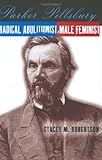
Stacey Robertson. Parker Pillsbury: Radical Abolitionist, Male Feminist. Ithaca: Cornell University Press, 2000. xv + 232 pp. $35.00 (cloth), ISBN 978-0-8014-3634-5.
Reviewed by Deborah Bingham Van Broekhoven (American Baptist Historical Society, Valley Forge, Pennsylvania)
Published on H-SHEAR (January, 2001)
One Maligned Abolitionist Rehabilitated
One Maligned Abolitionist Rehabilitated
This gracefully written biography of abolitionist Parker Pillsbury is worthy of careful reading by those with interests in antislavery reform and race relations, feminist views on gender and family, or the art of biography. By depicting Pillsbury's wide-ranging travels, mentally and geographically, Stacey Robertson undercuts these negative caricatures, even as she explains why Pillsbury was quickly labeled "eccentric," "fanatic," or "zealot." Early chapters show the maturing of a provincial young cleric, eager for encouragement and connections to a larger social and intellectual world, while the later chapters depict the mature Pillsbury as a radical and feminist reformer who spent his entire life on the northern lecture circuit, an evangelist for a radically egalitarian vision of America.
Drawing on more than thirty archival collections, Robertson constructs a richly textured biography of Pillsbury from youth to his death in 1898. Unlike some of his contemporaries, Pillsbury never retired. He continued his lecturing after the Civil War, in part because he lacked the financial resources to quit. When Pillsbury did inherit a sum that would have permitted retirement, he still continued to travel and lecture on human rights. Robertson argues this was because his "perfectionist" convictions prohibited retirement in the face of only a partial victory. While the author provides many examples of Pillsbury's intellectual and moral rigidity, this simple explanation of his persistence as an active reformer is not wholly satisfying, particularly given the contrasting behavior of fellow perfectionists. Readers who are uneasy attributing so much of Pillsbury's career to "perfectionism" (in this biography a vaguely defined theological presupposition) can find alternative or supplementary motives in Robertson's thorough discussion of Pillsbury's personality, particularly his concept of masculinity, which she describes as requiring both physical and moral courage in the face of hostile or indifferent listeners.
This biography provides much more than a richly textured account of Pillsbury's life. Most chapters include details about how Pillsbury worked in countless obscure villages to engage and cooperate with less traveled reformers. Always an itinerant lecturer, Pillsbury depended on support from these local families, some of whom taught him the importance of women's organizing skills, both for raising funds and consciousness about reform issues. While the focus remains on Pillsbury, Robertson makes clear the important work done by local residents who hosted visiting lecturers. Only Dorothy Sterling's fine biography of Abby Kelley Foster provides readers with as rich a sense of the difficult and crucial organizing work done by antislavery lecturers. [1] The difference between Abby Kelley and Pillsbury, however, is that Kelley is better known as a feminist and leader; it was the nomination of Kelley in 1840 to serve on the business committee of the American Antislavery Society that precipitated the organizational split among national leaders. Pillsbury, as one would assume from the book's title, took the side of "feminists," arguing strongly for inclusion of women in the formal, not just informal, organizing of antislavery work.
How did Pillsbury, an ordinary farm youth from rural New Hampshire, become the champion of political and social equality, regardless of race or gender? Chapter one, "The Roots of Radicalism," attributes his later championing of the disenfranchised to Pillsbury's youthful experiences with personal insecurity and revival religion. The revivals which were then awakening thousands of American youth, Robertson notes, not only swept Pillsbury into the fold of the converted and devout, but propelled him off the farm and into the broader world. Counseled by Stephen Foster, then another young convert from New Hampshire, Pillsbury in 1835 began studying for the Congregational ministry, completing his training at Andover Seminary in 1839. That education reinforced in Pillsbury the perfectionist and millennial expectations aroused during his revival experiences. Another consequence of his seminary education was more insecurity and greater identification with social inferiors. Robertson argues that his experience of being the outsider, a rustic and poor young man at a school for New England's best and brightest, as well as an earlier stint as a day laborer in Lynn, Massachusetts, always stayed with Pillsbury and helped him identify closely with African Americans.
Pillsbury's early mentors in antislavery reform included New Hampshire natives Stephen Foster and Nathaniel Rogers, firebrand editor William Lloyd Garrison, and fellow seminarian John Collins, each of whom pressed Pillsbury to view slaves as the most oppressed outsiders in American society. That close identification with slaves remained central to Pillsbury's character and career. Appointed an antislavery lecturer in 1840, Pillsbury's most frequent companion on the lecture circuit was Rogers, editor of the Herald of Freedom, beloved leader of antislavery activists in northern New England, and according to Robertson, a mentor and father figure for Pillsbury. His marriage in 1840 to Sarah Sargent appears just as crucial to Pillsbury's long career: their marriage lasted fifty-eight years, through years of separation, poverty, and sickness. It was sustained, according to Robertson, by their mutual affection and commitment to reform and by Sarah's able management of finances, household, and the rearing of their one child.
Pillsbury developed what Robertson calls a feminist sense of his masculinity early in his career of lecturing. Pillsbury was a large man and his notion of proper manhood drew in part on the physical strength he developed as a youthful farm and day laborer. During his many travels, Pillsbury lodged with sympathizers, a reliance which made him aware of how often women performed hard physical tasks. A more correct notion of equality, Pillsbury concluded, would require stronger men to aid women by handling that heavier work (p. 51). While Robertson concedes that Pillsbury was not the only reformer to comment on the inequality of male and female roles in society, she does argue that he was one of a very small group of male abolitionists who subverted usual notions of manhood, primarily by arguing for female suffrage, sexual choice, and divorce, but also by suggesting that male strength should be used to defend female equality, and that men needed to master the self-control urged on them by (often female) temperance reformers.
The major trauma in Pillsbury's early career as a reformer came in 1844-45, when conflicts between Rogers and his "no organization" faction and Garrison's old organization forced him to chose between two revered mentors. After multiple attempts to repair the broken relationship between Rogers and Garrison, Pillsbury chose Garrison and the continuing need for reform organization. Robertson suggests how personally devastating to both Sarah and Parker Pillsbury this break was, particularly since it ended the frequent visiting among an extended family network on which Sarah had relied while Parker was lecturing in the west (pp. 70-72). Because of that choice, one that Robertson argues was principled and agonizing, Parker Pillsbury moved from the New Hampshire circuit of lecturing into the much larger web of communities across the northern Atlantic world--that wide world of reformers which was linked through literature and through itinerants like Pillsbury into the Garrisonian antislavery network.
In chapter five Robertson vividly sketches the world of "grassroots abolition" into which Pillsbury then moves as one, in which both local and national leaders play crucial and complimentary roles (pp. 76-90). In sickness and in health, that network sustained Pillsbury, who received cash gifts from these friends when they heard that Parker was sick, unable to earn any dollars lecturing. Sickness and money were not the only problems encountered. Robertson includes and explains the many stories published about Pillsbury baptizing a dog (this often recycled legend is worth the price of the book!), a vivid example of how anti-abolitionist distortions of their message complicated the struggle of lecturers like Pillsbury to communicate their message.
Pillsbury continued this tough lecture circuit until 1854, when broken health--including a warn out voice--forced him to take a rest. Resistant to the idea of a vacation, Pillsbury gladly accepted the offer of a friend to pay his way to Europe, where presumably he could both recuperate and lecture about American slavery to more varied audiences (p. 91). On that tour Pillsbury was disconcerted when some British and Irish abolitionists seemed to condescend to him, perhaps because of obvious class differences. Always sensitive to his feelings as outsider, Pillsbury found British women more kind and receptive to his rough message. This alliance with the fairer sex, Robertson argues, was strengthened by Pillsbury's uneven reception abroad. He greatly appreciated the kindness of Mary Estlin, who nursed him through acute illness (and secretly shared his private letters with critics) and then aided him in securing similar hospitality in other locations. Pillsbury was not the most effective ambassador of abolition sent abroad, but there he did gain a broader sense of the community of reformers in which American operated. He also strengthened the network of financial supporters for American work and enlarged his own sense of the importance of female abolitionists in sustaining reform efforts.
Pillsbury returned to America and to the wide-ranging lecture circuit, this time finding increasing support for his antislavery cause in the western states of Ohio, Indiana, and Illinois. Robertson compares Pillsbury to better known abolitionists on this same lecture circuit, and in doing so shows both Pillsbury and other abolitionists as more complicated than the commonly depicted "fanatics." Pillsbury, she points out, was even more shrill than Garrison in denouncing political compromises. Generally depicted as an uncompromising radical, Garrison was more moderate than Pillsbury on the matter of political means; for example, Garrison conceded what Pillsbury never did, that some might foster reform by working through Liberty, Free Soil, or even the new Republican Party. By contrast Pillsbury always argued that change must come through moral, not political means. Pillsbury was also more radical and consistent in his denunciations of churches; in the 1850s, when other leaders quieted their attacks on northern churches, Pillsbury continued to condemn the role of non-slaveholders in sustaining slavery.
Because of his uncompromising stands, Pillsbury was increasingly isolated from other reformers, particularly when war and Reconstruction came. In retrospect, Robertson argues, continued racism makes his extremism look like wisdom: in 1864 he supported Wendell Phillips against Garrison on the need to continue the work of the American Antislavery Society. (Garrison believed that the Emancipation Proclamation had made further antislavery organization unnecessary.) Yet Pillsbury could not comfortably work at the center of any organization, or so it appears. Unwillingness to compromise meant that Pillsbury's appointment as editor of the National Antislavery Standard was untenable: he could not write editorials that reflected the more moderate position of subscribers. Instead he attacked all reconstruction plans and called for a thorough restructuring of both northern and southern states, in which equal rights for all would be a legal and social reality. Robertson admires Pillsbury's stubborn defense of egalitarianism, even as she recognizes that for him, there was no other career option: "Antislavery continued to provide Pillsbury with both a career and a spiritual center, and he was not about to declare the movement moribund" (p. 133).
While Robertson argues that perfectionist theology led Pillsbury to espouse egalitarian ideals, her acknowledgement that Pillsbury could not operate except as a minority critic suggests a more complicated Pillsbury. Without disavowing Pillsbury's perfectionism or his early experience of revival religion as pushing him toward egalitarian reform, one can see additional motives in the psychological profile provided by Robertson: Pillsbury's assumption that masculinity required brave, sometimes physical resistance to critics, also seems to have shaped Pillsbury's approach to human rights.
After emancipation Pillsbury remained disdainful of parties and legislative change, arguing that constitutional amendments alone would fail (and he later pointed out they did) to provide equal rights for freedmen. For Pillsbury, a moral transformation was the first imperative, after which legal and social change could occur. Whether this perfectionist approach was rooted more in theological beliefs or psychological traits, we can admire with Robertson Pillsbury's commitment to full citizenship for African Americans, something that made it impossible for him to accept either an imperfect Reconstruction or retirement from moral reform.
I have just a few quibbles with Robertson's analysis. One is rooted in admiration for the author's clear presentation of Pillsbury's links to his hosts on the lecture circuit, those many obscure antislavery women and men who resided in communities scattered across the north. Social geography is important, both for showing the extent of a movement's influence and for tracing patterns of influence. Because of a paucity of evidence, Robertson's depiction of Pillsbury as influential on the western lecture circuit is less convincing that her argument that Pillsbury was influenced by those who hosted him, both by feeding him and organizing his meetings. Perhaps Pillsbury did influence the Western Anti-slavery Society (Ohio) to adopt a more "uncompromising" stance toward the Republican Party than assumed by any other antislavery organization (121). But what are we to make of this link, since Ohio's political conversion to the Republican Party came early and more easily than in other states? Robertson senses the importance of tracing influences, including that of grassroots women on traveling agents like Pillsbury, but we will need to wait for her next book for a clear understanding of the nature of the east to west (or possibly west to east) influences in reform circles.[2]
Another quibble I have is with the presentation of Pillsbury as a feminist. I agree that Pillsbury made many statements advocating women's rights, more than did most male abolitionists. But Robertson goes beyond the argument for which she has ample evidence, which is that Pillsbury was a feminist in theory and in his relationship with fellow agent Abby Kelley and with those local women abolitionists he met on the lecture circuit. She also suggests Pillsbury was a feminist in his marriage, but the examples offered of Pillsbury's relationship with his wife Sarah and with his daughter (who interestingly never left her parents' rural home) provide only slight evidence of feminist behavior in the family context. While traveling Pillsbury apparently did write his wife and daughter, but the surviving letters include only a few that discuss family relations or gender roles. [3] Most of the letters used by the author document Pillsbury's activities on the lecture circuit and not the rare times spent with his family.
There are a couple of places where the author stumbles on details. She incorrectly describes an abolitionist co-worker as the son-in-law of Wendell Phillips (139) and states incorrectly that the 1837 gag rule on petitions dealing with slavery "destroyed the popular tactic of antislavery petitions" (77). This second error is the more serious one, since it comes at the beginning of her otherwise excellent chapter on grassroots abolitionism and is presumably why there is no discussion about canvassing for petition signatures. The error perhaps comes from the author following her subject and his disdain for political means just a little too closely.
These are small matters, however, and I think that most readers will find compelling this story of how radical beliefs propelled Pillsbury both into the reform centers of Boston, New York, and Philadelphia, but also out to Ohio and Illinois. This is a well-crafted and copiously documented book, one that draws together and analyzes a great variety of unpublished information. For this reason the biography is unlikely to be superceded by any later analysis of Pillsbury. Those studying social reform during the nineteenth century will find Robertson's analysis of Pillsbury useful, both for its detailed examples of how national and grassroots leaders worked together and as a model for studying other types of political and social movements. Author Stacey Roberts stated that one of her aims was to rescue this colorful but under-appreciated abolitionist from the obscurity of his New Hampshire roots and from the caricatures of his enemies: in this fine book, she meets that goal and more. Readers will appreciate Pillsbury for his tireless and enthusiastic campaigning and will also glimpse how support from his many friends and acquaintances enabled him to embrace and sustain this life of commitment.
Notes
[1]. Dorothy Sterling, Ahead of her Time: Abby Kelley and the Politics of Anti-slavery (New York: Norton, 1991).
[2]. See Robertson's fine paper on this subject, "'Ladies, Will You Meet With Us?': Women Abolitionists in the Old Northwest, Gender, and Third-Party Politics," presented at the annual meeting of SHEAR (July 2000), http://www2.h-net.msu.edu/~shear/s2000.d/pa/RobertsonStacey.htm.
[3]. For those interested in detailed analysis about how a feminist abolitionist viewed and practiced child-rearing, see Elizabeth Stevens, "'From Generation to Generation': The Mother and Daughter Activism of Elizabeth Buffum Chace and Lillie Chace Wyman," (Ph.D diss., Brown University, 1993).
Copyright (c) 2001 by H-Net, all rights reserved. This work may be copied for non-profit educational use if proper credit is given to the author and the list. For other permission, please contact H-Net@h-net.msu.edu.
If there is additional discussion of this review, you may access it through the network, at: https://networks.h-net.org/h-shear/.
Citation:
Deborah Bingham Van Broekhoven. Review of Robertson, Stacey, Parker Pillsbury: Radical Abolitionist, Male Feminist.
H-SHEAR, H-Net Reviews.
January, 2001.
URL: http://www.h-net.org/reviews/showrev.php?id=4868
Copyright © 2001 by H-Net, all rights reserved. H-Net permits the redistribution and reprinting of this work for nonprofit, educational purposes, with full and accurate attribution to the author, web location, date of publication, originating list, and H-Net: Humanities & Social Sciences Online. For any other proposed use, contact the Reviews editorial staff at hbooks@mail.h-net.org.

