



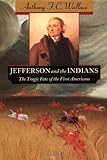
Anthony F.C. Wallace. Jefferson and the Indians: The Tragic Fate of the First Americans. Cambridge, Mass., and London, England: Harvard University Press, 1999. ix + 394 pp. $29.95 (cloth), ISBN 978-0-674-00066-7.
Reviewed by Donald A. Grinde (Department of History, University of Vermont)
Published on H-SHEAR (January, 2001)
Anthropology, Native Americans and Jefferson: A Troubling Analysis
Anthropology, Native Americans and Jefferson: A Troubling Analysis
This work is an exploration of the troubled duality in Jefferson's perceptions of American Indians. The author ably details Jefferson's interest in Native American vocabularies, burial grounds and Native American cultures, but all of these interests were unfortunately in tandem with Jefferson's ideas about westward expansion and Indian removal. In this tome, Wallace gives us an informed but limited analysis of the contradictory aspects of Jefferson's sometimes positive and yet ethnocidal and genocidal views about American Indians.
Wallace strength's in this work are in his ability to comprehend Native American cultures and their interface with luminaries like Jefferson. Too often, American historians, imprisoned by their own monocultural views, neglect to fully explore even the most fundamental aspects of the Native American cultures on the other side of the frontier. Wallace gives keen insights into the American Indian scholar side of Jefferson as well as his rhetoric of westward expansion. We are also treated to a detailed analysis of Jefferson's quest for American Indian vocabularies and explanations about ancient Native American inhabitants. In dealing with these complicated ethnohistorical issues, Wallace is at best.
We are also given some analysis of Jefferson's ideas about "civilizing" American Indians. However, Wallace gives only cursory mention to Bernard Sheehan's Seeds of Extinction: Jeffersonian Philanthropy and the American Indian (Chapel Hill: University of North Carolina Press, 1973) in his analysis of the "civilizing policies" and this is unfortunate. Often, Wallace clings too closely to his anthropological roots when he seeks to understand the Indian policy and intellectual sides of Jefferson in a historical context. It is clear that Wallace has not examined much of Jefferson's political theories and how Native American people influenced them, since he fails even to address Richard K. Matthews' statement in The Radical Politics of Thomas Jefferson; A Revisionist View (Lawrence, Kansas: University of Kansas Press, 1984), p. 122 that "...the American Indian ... provides the empirical model for Jefferson's political vision." Similarly, scholarly works that touch on the Jeffersonian period that are written by Native Americans like Philip DeLoria's Playing Indian (New Haven: Yale University Press, 1998) are omitted in his analysis.
When discussing the frontier, Wallace does not deal with pioneering works in American Indian economic history like Linda Barrington, ed., The Other Side of the Frontier: Economic Explorations into Native American History (Boulder, Colorado: Westview Press, 1999). While Wallace bemoans Jefferson's policies of land grabbing and its effects on American Indian people, he never fully addresses the issues relating to Jefferson's genocidal pronouncements. On August 28, 1807, President Jefferson writes to his Secretary of War (the primary administrator of Indian affairs in the Jefferson administration), General Henry Dearborn, that "if we are constrained to lift the hatchet against any tribe, we will never lay it down until that tribe is exterminated." Later in the letter to Dearborn, Jefferson adds that "[I]n war, they will kill some of us; we will destroy all of them."[1] Wallace makes no allusions to this quote in his analysis and its obvious import for Jeffersonian Indian policies. Is he skirting the issue of Jeffersonian genocidal tendencies while feigning sympathy for Native Americans? Even if Wallace believes that Jefferson was not genocidal towards American Indians, he must confront the blunt statement by Jefferson to Dearborn that leads some historians towards a genocidal interpretation of the Jefferson Administration.
Overall, Wallace gives us a general and well organized analysis into a side of Jefferson that needs to be examined more fully and with sensitivity. He has ably delved into many of the dualities and racist assumptions that haunted Jefferson in his day and even policy makers today. But his analysis is circumspect about important issues like genocide, ethnocide and the impact of Native American ideas of democracy on Jefferson. Wallace's book takes us a long way in understanding the ambiguous nature of Thomas Jefferson's views on American Indians, but it is flawed by its inability to deal with historical scholarship on this topic in the last generation or so. With that said, the reviewer still considers it a worthwhile read for Jefferson scholars and Native American historians of the era.
Notes:
[1]. Andrew A. Lipscomb and Albert Ellery Berg, eds., The Writings of Thomas Jefferson, 20 vols. (Washington: Thomas Jefferson Memorial Association, 1903-4), XI:345-46.
Copyright (c) 2001 by H-Net, all rights reserved. This work may be copied for non-profit educational use if proper credit is given to the author and the list. For other permission, please contact H-Net@h-net.msu.edu.
If there is additional discussion of this review, you may access it through the network, at: https://networks.h-net.org/h-shear/.
Citation:
Donald A. Grinde. Review of Wallace, Anthony F.C., Jefferson and the Indians: The Tragic Fate of the First Americans.
H-SHEAR, H-Net Reviews.
January, 2001.
URL: http://www.h-net.org/reviews/showrev.php?id=4863
Copyright © 2001 by H-Net, all rights reserved. H-Net permits the redistribution and reprinting of this work for nonprofit, educational purposes, with full and accurate attribution to the author, web location, date of publication, originating list, and H-Net: Humanities & Social Sciences Online. For any other proposed use, contact the Reviews editorial staff at hbooks@mail.h-net.org.

