



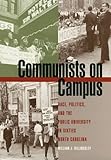
William J. Billingsley. Communists on Campus: Race, Politics, and the Public University in Sixties North Carolina. Athens: University of Georgia Press, 1999. xvi + 308 pp. $29.95 (cloth), ISBN 978-0-8203-2109-7; $29.95 (cloth), ISBN 978-0-8203-2460-9.
Reviewed by Robert Emmett Curran (Department of History, Georgetown University)
Published on H-South (January, 2001)
Subliminal Politics and the Rise of Jesse Helms
Subliminal Politics and the Rise of Jesse Helms
In the waning hours of its annual session in June 1963 the North Carolina General Assembly, passed an "Act to Regulate Visiting Speakers" at state-supported colleges and universities. The law, in effect, banned any person from speaking at any of the state's public universities and colleges who was a member of the Communist Party or had used the Fifth Amendment before an investigating body. The law seemed patently anachronistic, a staple of the McCarthy era of the Fifties. At a time when other states were repealing their speaker bans, North Carolina, seemingly out of nowhere, passed a speaker law unprecedented for its severity that became a prominent political issue for the next five years. Billingsley sets out to determine how and why it happened and what consequences it had. He concludes that it was employed in North Carolina for quite different political purposes than preventing the subversion of state campuses by communists, that anti-communist measures really served as an antidote to racial liberalism, whose bastion was seen to be the state's university campuses, particularly that at Chapel Hill.
Events in late 1962 and early 1963, according to Billingsley, conspired to confirm to many white southerners the inextricable connection between communism and the convulsive social changes they were confronting. The Cuban Missile Crisis had rekindled a fear of communism that all too easily conservatives found present in the disrupting social forces challenging the old order of the South. The spring of 1963 saw a number of events ranging from protests in Birmingham to the use of federal power to enforce the integration of the University of Alabama to the Kennedy Administration's introduction of a Civil Rights bill that seemed to signal "the death knell of the Jim Crow system" in the South (p. 8).
Compounding the frustration of southern conservatives in North Carolina was the defeat of proposed state legislation that would have authorized the amending of the federal constitution by three quarters of the state legislatures and have established a Super Court composed of the chief justices from the fifty states empowered to act as a final review board of decisions of the United States Supreme Court. And looming on the horizon was the prospect of reapportionment which held the threat of a swing of power from conservative rural areas to more liberal urban ones and a subsequent realignment of racial relations. As the North Carolina legislature held its annual session in Raleigh, protesters, many from local colleges and universities, took to the streets in protest of segregation.
Charges of communist infiltration of Chapel Hill had a long history. As early as 1949 the North Carolina American Legion had passed a resolution urging the trustees to take appropriate action to deal with communists on campus. Highly publicized trials and congressional investigations in the Fifties had fed local suspicions that communists were rampant at UNC. The reality was that leftist radicalism at the university had been virtually nonexistent until the early sixties when three tiny radical organizations -- the Student Peace Union, the New Left Club, and the Progressive Labor Movement -- organized on campus. This was enough to revive claims of UNC as a center of subversion, particularly when student and faculty activists became involved in civil rights demonstrations and protests.
Leading the accusers was a local television journalist, Jesse Helms, who in nightly editorials denounced the role student radicals were playing in the civil rights actions and called for measures to treat the problem at its source. "What worries us," Helms observed in one address, "is the constant advocacies of increased federal powers, of centralization of government, of downgrading of capitalism and free enterprise originating with those wearing the mantle of intellectual respectability" (p. 20). Billingsley notes: "Helms was not concerned about the presence of student radicals at UNC but about the authoritative voice of the university advocating political trends --from racial equality to Keynesian economics . . . The existence of radical students served as a convenient means to attack an institution that represented the abolition of segregation, support of a liberal interventionist strategy, and a closer involvement between federal and state agencies in resolving social and economic problems" (p. 40).
As one legislator who supported the ban admitted, "The Speaker Ban Law was . . . passed more to curb civil rights demonstrations than to stop Communist speakers on state campuses . . . [I] thought many of the demonstrations were Communist inspired, and this was primarily what the General Assembly was trying to prevent" (p. 63). "Witnessing the demise of segregation," Billingsley writes," and unable to make direct use of state power to restore their authority, conservative lawmakers grew increasingly angry, "particularly with student protestors literally outside their doors (p. 86). Their retribution was the speaker ban law.
No sooner was the law in effect than UNC faculty began utilizing academic pressures both within and outside the university to rescind or revise the ban. Professional societies boycotted the state; state professors resigned or threatened to do so. For its own part the university policed itself, taking the lead in banning leftist speakers, even those who were neither communists nor invokers of the fifth amendment, in a pyrrhic attempt to regain control over campus speech, and cooperating with various federal and state enforcement agencies to suppress any radical presence on campus. Only when a commission of the regional accrediting association threatened to revoke the accreditation of the state's colleges and universities because of the ban did the general assembly consent to establish a commission to examine the issue. The resulting amendment in 1965 simply transferred the charge of enforcing the standing laws of the state regarding public speech to the university trustees. The speaker ban itself remained unchanged.
Despite university attempts to eliminate radical organizations on campus, UNC students formed a branch of Students for a Democratic Society in the spring of 1965. One of their initial goals was to challenge the speaker ban. With widespread university support, SDS-UNC issued invitations in the spring of 1966 to two leftist activists to speak on campus, one of whom was the Marxist historian, Herbert Aptheker. When the university, opting for its long-range interests over academic freedom, denied the speaking requests, they gave their talks on a sidewalk just off campus to an audience of several thousand students. The students themselves, with the quiet support of the UNC president himself, sued the university for violating their constitutional rights through the speaker law.
At the beginning of 1968 the court found the speaker law and its implementations unconstitutional and hence "null and void" (p. 209). Three months later the Board of Trustees approved a new policy that was basically as restrictive as the overturned law. As student dissent escalated over the war in Southeast Asia, the Executive Commission of the Board of Trustees passed a resolution that any disruption of "educational processes" would be subject to "suspension, expulsion, or termination" (p. 230). The university administration stepped up its own efforts to collaborate with police and intelligence agencies to contain campus radicalism. Departments within the university were given the charge to screen faculty applicants for their prior political activity. In effect, Billingsley suggests, the state's conservatives lost the speaker ban battle but won the war of repression. Jesse Helms' use of the ban as a catapult to national political power was but one dimension of that victory. The author even argues, beyond the evidence, it would seem, that North Carolina's dismal record of social change in the wake of the civil rights revolution was another consequence of the ultimate success of those who invoked anti-communism to preserve the social status quo.
Billingsley has recovered a significant story that probably could have been more succinctly told and more sharply developed. There is a good deal of repetition and restating in various ways of the author's thesis. Indeed one is tempted to believe that this work, significant as it is, could have been better cast in a much smaller frame, perhaps even as a major journal article. The occasional postmodern rhetoric (e.g. anti-communism as "signifier") only serves to muddle Billingsley's thesis about the relation between anti-communism and civil rights. At times Billingsley says that promoters/supporters of the speaker ban were cynically using anti-communism as a tool to counter liberal forces. At others he more than suggests that the same ban backers saw "communist" elements behind the civil rights movement within the vague parameters (central authority etc.) that defined communism for them. Billingsley cannot seem to decide whether the ban was successful in its aim or not. Inasmuch as it effectively paralyzed the university as a progressive force within the state, it clearly was. Even after the state supreme court ruled in 1968 that the speaker ban law was unconstitutional, the university continued to do the suppressive work that the law itself could no longer do.
Copyright (c) 2001 by H-Net, all rights reserved. This work may be copied for non-profit educational use if proper credit is given to the author and the list. For other permission, please contact H-Net@H-Net.MSU.EDU.
If there is additional discussion of this review, you may access it through the network, at: https://networks.h-net.org/h-south.
Citation:
Robert Emmett Curran. Review of Billingsley, William J., Communists on Campus: Race, Politics, and the Public University in Sixties North Carolina.
H-South, H-Net Reviews.
January, 2001.
URL: http://www.h-net.org/reviews/showrev.php?id=4846
Copyright © 2001 by H-Net, all rights reserved. H-Net permits the redistribution and reprinting of this work for nonprofit, educational purposes, with full and accurate attribution to the author, web location, date of publication, originating list, and H-Net: Humanities & Social Sciences Online. For any other proposed use, contact the Reviews editorial staff at hbooks@mail.h-net.org.

