

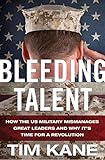
Tim Kane. Bleeding Talent: How the US Military Mismanages Great Leaders and Why It's Time for a Revolution. New York: Palgrave MacMillan, 2012. 271 pp. $32.00 (cloth), ISBN 978-0-230-39127-7.
Reviewed by Anne-Marie Contreras (Air University, Air War College)
Published on H-War (January, 2017)
Commissioned by Margaret Sankey (Air University)
As a United States Air Force Academy graduate with nineteen and a half years of service as a helicopter pilot, I have definitely experienced frustrations while in the military. I have often wondered how a person who is a cancer to an organization continues to get promoted while another, who gives their heart and soul on a daily basis, is passed over. I have joked with friends about the assignment process being akin to playing Russian roulette. I have worked with leaders who made me want to quit and other leaders I wanted to emulate. I have lost personnel who decided to leave the service rather than put their family through another move or another deployment. Over the years, each of my frustrations can be attributed to one question: what is wrong with the system?
There are many books discussing problems with retention and leadership in the military. In Bleeding Talent (2012), former United States Air Force intelligence officer Tim Kane attempts to answer the age-old question, “Why does the American military produce the most innovative and entrepreneurial leaders in the country, then waste that talent in a risk-averse bureaucracy” (p. 10)? Although I was apprehensive about his legitimacy at first, given that Kane only served five years in the Air Force, it is clear Kane is knowledgeable and has conducted a great deal of research on this subject. Bleeding Talent gets to the heart of the matter by offering solutions which attempt to fix the system—change the military’s human resource programs and policies.
Other books on this subject aim to fix the problem in the military by adjusting attitudes or relationships of people. George Reed, in his book Tarnished (2015), puts the blame on toxic leadership in failing organizations and helps the reader identify problems and suggests solutions to deal with bad leadership. In Supreme Command (2002), Eliot Cohen demonstrates a successful, balanced relationship between politicians and generals as the key to wartime (and daily) success. However, neither of these books looks at weaknesses within the system.
The premise for Kane’s proposed changes is based on G. I. Wilson and Donald Vandergriff’s four flawed assumptions of the military’s human resource system in America’s Defense Meltdown (2008): “(1) the generalist assumption that all officers should have many broad experiences that aim them for operational command rather than specialized expertise; (2) the up-or-out promotion system with incessant box-checking to make rank, even if officers are not interested in making rank nor on track for command; (3) a centralized bureaucracy that oversees evaluations, promotions, and jobs assignments; and (4) standardized evaluations based on one-size-fits-all measures for all officers” (p. 125). I agree that these assumptions, which made perfect sense under conscription, are outdated with the current all-volunteer, professional force. In Bleeding Talent, Kane suggests implementing principles from what he has termed the Total Volunteer Force (TVF), to revolutionize the current human resource system in the military.
Kane evaluates surveys completed by 250 West Point graduates across six different graduating classes with lessons learned from companies in the private sector to come up with ten drastic changes that will make a lasting impact on the retention of officers in the military. Some of these radical concepts include: eliminating year groups to expand eligible promotees while increasing competition; permitting officers to specialize in one rank rather than continue to promote; allowing former officers to re-enter the military laterally after a break in service; pro-rating retirement packages for time served rather than only receiving retirement after twenty years; and developing a job search/hiring mechanism to allow personnel to directly apply for the jobs they are interested in and give leaders the opportunity to decide who fills their open positions. Throughout Bleeding Talent, Kane demonstrates how the military’s archaic and bureaucratic assignment and promotion practices have not kept up with evolving management practices. Through private-sector examples such as Procter & Gamble and IBM, he shows there are alternative ways to manage personnel. Currently, the parameters of the military human resource system have become so strict, leadership can no longer effectively manage their people, which often results in shorter careers for some very qualified individuals.
Kane’s ideas can be applied to current military human resources with varied amounts of effort. For example, the Navy is already looking at break-in-service programs, launching the Career Intermission Pilot Program in 2013 which allows members to move from active duty to the Individual Ready Reserves (IRR) for one to three years. This program, with a cap on the number of participants, allows the member to keep healthcare and base privilege benefits during their IRR period but requires a pay-back upon completion—serving an additional two months of service for every one month taken upon return to active duty.
Kane’s recommendation to adjust the retirement system is also underway within the Department of Defense. Currently less than 20 percent of service members actually leave the service with retirement benefits. Under the new system, which will affect members who join in 2018 and beyond, or who opt in with previous time served, will contribute to their own retirement accounts, as in the civilian world, with matched contributions by the government. If service members do not serve all twenty years, they still walk away with some retirement benefits which can then transfer to their next job.
The hardest hurdle to overcome would be leadership moving beyond the concept of time-honored traditions to see the value of a more flexible force. Eliminating year groups sounds like a good concept in practice, but expanding eligible promotees may add too much work for already strained personnel centers when it comes to preparing for/executing promotion boards. Additionally, the ability to apply for and hire personnel may create additional obligations that commanders may not have the capacity to add to their already overloaded schedules. On the other hand, the opportunity to staff your organization with the personnel you want and who want to be there could greatly enhance mission success. Finally, permitting officers to specialize in rank definitely has merits although in many ways it is already being practiced—the Army utilizes this system in its Warrant Officer Corps, who serve as specialists. The Air Force currently allows members to serve until retirement as a major (O-4), utilized most in flying operations.
There are a couple of areas I took issue with in Bleeding Talent. Kane exclusively focuses on the promotion and advancement opportunities of the military while ignoring the retention issue. The reader can infer that if the military fixes the promotion and advancement system, retention will no longer be a problem; however, I would have liked to see a chapter or two on the subject. Additionally, Kane’s research is quite thorough; however, he name-drops throughout the book. This hints at an attempt to gain legitimacy through distinguished personnel rather than letting his work stand for itself.
Tim Kane’s 217-page Bleeding Talent is not the first book about the problem of leadership retention in the military, but it is the most personal look at this issue I have read so far. As a fellow United States Air Force Academy (USAFA) graduate, I was able to immediately identify with Kane. His introductory remarks using USAFA-specific verbiage instantly drew me in. I then spent the rest of the book wondering why he was so focused on the Army. Additionally, his surveys, which are the source for his conclusions, only involved commissioned officers who graduated from West Point (the United States Military Academy)—yet he applies his conclusions to the entire military. Finally, his mottled use of capital letters when it comes to the branches of the United States military is extremely distracting. Why do “Army” and “Marines” deserve capital letters but “air force” and “navy” do not?
In his conclusion Kane allows the reader to disagree with his proposals, but compels the reader to understand “there is no productive outcome when we force a soldier to choose between the family’s best interest and the nation’s best interest” (p. 215). In the three years since his book was published, the military is working to address some of the problems identified in Bleeding Talent. The retirement system is being overhauled and services are experimenting with returning to duty after a break in service. In any organization, people are the greatest resource. I would like to see a military that considers the needs of the people and incorporates some of his proposals. Unfortunately, leadership will have to change significantly before the system can. Perhaps a future generation will not have to ask what is wrong with the system.
If there is additional discussion of this review, you may access it through the network, at: https://networks.h-net.org/h-war.
Citation:
Anne-Marie Contreras. Review of Kane, Tim, Bleeding Talent: How the US Military Mismanages Great Leaders and Why It's Time for a Revolution.
H-War, H-Net Reviews.
January, 2017.
URL: http://www.h-net.org/reviews/showrev.php?id=48248
 | This work is licensed under a Creative Commons Attribution-Noncommercial-No Derivative Works 3.0 United States License. |

