

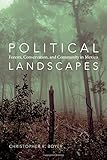
Christopher R. Boyer. Political Landscapes: Forests, Conservation, and Community in Mexico. Durham: Duke University Press, 2015. 360 pp. $26.95 (paper), ISBN 978-0-8223-5832-9.
Reviewed by Timothy Lorek (Yale University)
Published on H-LatAm (February, 2017)
Commissioned by Casey M. Lurtz (Johns Hopkins University)
From Revolutionary Forestry to Narco-Loggers in Mexico’s Temperate Highlands
Christopher R. Boyer’s insightful new study of the shifting contours of Mexican forestry succeeds in linking environmental history and social histories of state formation in the Mexican countryside. Political Landscapes: Forests, Conservation, and Community in Mexico focuses on indigenous highland villages and the surrounding pine-oak forests of Michoacán and Chihuahua. Boyer chronicles changing strategies on the part of would-be loggers, as well as those that would resist them, in these temperate forests from the reign of Porfirio Díaz in the late nineteenth century through the present.
Boyer examines forests as “political landscapes”--“spaces where conflicts over the use of forests both provoke and are provoked by state intervention that historical actors regard as illegitimate” (p. 254). Looking at a century of forestry in Mexico, he contends that state authority did not politicize forest landscapes per se, but rather that mismanagement, corruption, and the oft-changing application of regulations led to social and economic conflict in the woodlands. This process of politicization and conflict presented one of the most severe ecological threats to Mexican forests as disputed claims led to strategic destruction. Boyer focuses his attention on the temperate forests that conjured images of civilization and rational management to Mexico City elites, but at the same time provided livelihoods to the Rarámuri peoples of Chihuahua’s Sierra Tarahumara and the Purépecha peoples of Michoacán’s Meseta Purépecha. As intermediaries between federal policymakers and local populations, foresters made these conflict-ridden landscapes legible to the Mexican state.
Boyer divides his study into two chronological parts, focusing first on “The Making of Revolutionary Forestry” and second on “The Development Imperative.” Boyer begins in the 1880s and follows the thirty-year reign of Porfirio Díaz and his embrace of foreign capital investment and scientific expertise, exercised by the regime’s cadre of científicos. The rapid acceleration of land titling (the so-called disentailment of communally owned property) and privatization of terrenos baldíos (unoccupied public land) and resources spurred the growth of commercial logging to meet the demands of the expanding newsprint industry and railroads. Observing the growing corporate commodification of timber resources, Boyer shows how members of the intellectual elite organized for conservation of the woodlands through a “regime of scientific management,” premised on similar initiatives in Europe and the United States (p. 30). Chief among these early conservationists was Miguel Ángel de Quevedo, whose long career in public policy withstood political transitions and revolution. Quevedo and the early forest service viewed conservation as a scientific and rational practice best orchestrated by urban Mexico City elites rather than the inhabitants of the woodlands themselves. What little consideration his urban foresters did give to rural peoples such as the Rarámuri of Chihuahua or the Purépecha of Michoacán, Boyer argues, was to criticize them as backwards, wasteful, and an impediment to rational management.
Chapters 2 and 3 chart the rise of “revolutionary forestry.” A rich historiography exists on the Mexican Revolution (1910-17) and on the subsequent agrarian reform which continued until 1992. Article 27 of the constitution of 1917 cleared a path for two legal channels for securing land rights: the restitution of communal land (restauración) or the granting of parcels (ejidos) of public land for usufruct use (dotación). And yet, Boyer points out, few scholars have noted Article 27’s significance in mandating the state’s right to manage natural resources on behalf of the nation. This charge led to the postrevolutionary state’s partnership with Miguel Ángel de Quevedo and his determined application of rational conservation in forestry. Yet Quevedo and other conservationists’ preferences for a state-regulated management bureaucracy complicated indigenous land rights supposedly protected under the postrevolutionary state’s social agenda. For example, the Forest Code of 1926 required ejido and native communities to form producers' cooperatives whose timber harvests were guided by scientific management plans approved by the new forest service. Other elements of the code, such as the ban on hatchets for felling, had the arguably unintentional effect of restricting native access to cutting timber in favor of commercial operations. As Boyer shows, the new bureaucratic hurdles presented challenges for ejidatarios and native villagers in Chihuahua and Michoacán, who struggled to assert their rights over unscrupulous outsiders and, when that failed, resorted to clandestine logging and the black market.
When Lázaro Cárdenas assumed the presidency (1934-40) and raised the forest service to a cabinet ministry, he assigned Quevedo to oversee its operations and sort out its propensity for generating conflict. This era of “revolutionary forestry” increased the educational and technical assistance available to rural communities, intending to inculcate these populations in the state’s vision of scientific environmental management. Villagers who created formally recognized organizations enjoyed wide latitude in the harvesting of timber under the paternal eye of state foresters and regulators. As Boyer notes, “no one believed in the rule of experts more firmly than did Quevedo himself” (p. 103).
Quevedo’s scientific authority clashed with the populist spirit of cardenismo. Yet the undoing of revolutionary forestry owed more to the heightened demand for natural resources during World War II and Manuel Ávila Camacho’s (1940-46) turn towards industrial growth. At the same time, an ascendent new generation of forestry experts began to shift “from cultural to sociological explanations for deforestation,” blaming poverty rather than rural people's essential backwardness for the forests' destruction (p. 133). As chapter 4 describes, forest management thus pivoted to a focus on wages through the growth of a modern, corporate timber industry. A new forestry code in 1949 cemented private industry’s enhanced access to woodlands through a system of timber concessions deemed to be in the public’s interest. Paradoxically, the political move away from community-led forestry actually presented some opportunities for rural and indigenous people to negotiate with logging companies and regional government agencies to secure access to the employment and income generated from forestry. On the other hand, an increase in temporary logging bans could provoke villager tactics such as girdling trees, setting fires, or cutting trees ostensibly for legal domestic use and then selling the timber illegally to sawmill owners--weapons of the weak in the politicized sierras of Michoacán and Chihuahua.
Boyer attributes deforestation in the contested woodlands to a constantly changing and inconsistent management regime, rather than to any one flawed approach. He shows how Mexico City leadership in the 1970s shifted yet again toward a regime of “state forestry” managed by state-controlled corporations known as paraestatales. Yet another reorientation did little to calm intercommunity conflicts, such as those between resin-tappers and loggers in the Meseta Purépecha. The avocado boom of the late 1970s further fueled economic rivalry over land use in Michoacán, the state that supplied 40 percent of global demand for the fruit by the mid-1980s. The economic downturn of that decade and resultant neoliberal austerity led to the demise of paraestatales. By the new millennium, development projects in forestry had largely been replaced by a neoliberal landscape checkered by the unlikely combination of private and community-driven operations. The withdrawal of the Mexican state from the forests has prompted, in some cases, the rise of narco-loggeing and other illicit activity, which Boyer compares to the incursions of foreign loggers a hundred years prior in the deregulated free market terrain of Porfirian liberalism. With this echo from the past, Boyer writes, “neoliberalism has thus placed many rural communities on the precarious boundary between self-determination and abandonment” (p. 242).
Boyer tells this history with evidence from government documents, personal papers, and municipal archives. His blend of social and environmental history is refreshing. He consciously avoids a narrative of declension, emphasizing instead how deforestation and community empowerment waxed and waned. This book should help correct a lingering prejudice among somein the field of Latin American history who remain skeptical of environmental history as a subfield devoid of people or complex social negotiations. By balancing a topic such as forestry between federal and grassroots historical actors, Boyer’s work reaffirms the potential for environmental histories of Latin America immersed in processes of state formation and political economy.
This is an ambitious book. Readers unfamiliar with the intricacies of Mexican history or geography may have trouble navigating Boyer’s sweeping narrative, which spans more than a century and weaves back and forth between national contexts, two regional case studies, and some comparative attention to the quite different set of circumstances affecting tropical forests in the country’s south and coastal zones. Environmental historians may wish for more attention to the ecological ruin of these latter ecosystems or more sustained attention to landscape transformations in either Chihuahua or Michoacán. Boyer notes that by the 1990s Mexico had the fifth-highest rate of deforestation in the world (p. 254). This startling statistic suggests an opportunity for greater use of visual and cartographic sources. Historians and social scientists in recent years have produced dynamic GIS-based maps of deforestation and its change over time, which could assist readers’ spatial understanding of the regions under investigation. These mild and predictable requests for more should not detract from the skill of Boyer’s narrative nor the significance of his historiographic intervention.
This book will be essential reading for scholars interested in the postrevolutionary Mexican state, environmental histories of Latin America, and the role of experts in twentieth-century development initiatives. It should provoke excellent conversation in seminars on Mexican history and histories of sustainability and/or resource use.
If there is additional discussion of this review, you may access it through the network, at: https://networks.h-net.org/h-latam.
Citation:
Timothy Lorek. Review of Boyer, Christopher R., Political Landscapes: Forests, Conservation, and Community in Mexico.
H-LatAm, H-Net Reviews.
February, 2017.
URL: http://www.h-net.org/reviews/showrev.php?id=48086
 | This work is licensed under a Creative Commons Attribution-Noncommercial-No Derivative Works 3.0 United States License. |

