



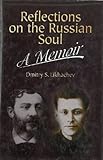
Dmitry S. Likhachev. Reflections on the Russian Soul: A Memoir. Translated by Bernard Adams. New York and Budapest: Central European University Press, 2000. xvii + 296 pp. $35.00 (cloth), ISBN 978-963-9116-46-7.
Reviewed by Karl Qualls (Department of History, Dickinson College)
Published on H-Russia (January, 2001)
"Last of the Intelligentsiia"
Dmitry Likhachev stands out as one of the most remarkable Russians of whom laypeople in the West probably have never heard. To specialists, however, the debt owed to Likhachev's scholarship is immeasurable. As a student of literature and culture, history, and religious philosophy, D. S. Likhachev has shed light on many previously little-known facets of Russian history and culture. His passing in September 1999 at 93 years old was something of a national tragedy for many. Besides his scholarship, Likhachev was a survivor and critic of the Soviet regime who ended his years of service to Russia as a member of the Duma. The English-language edition of his "reflections" covers roughly the first half of his life. This "memoir," which is really a combination of memoir, essay, and diary, says much less about the often-invoked "Russian soul" as the title suggests, than the survival of intellectual activity amidst the horrors of prison camp life, repression, and war.
In his "memoirs," Likhachev clearly shows how his experiences during the Soviet period of Russia's history haunted his mind. In fact, the vast majority of this nearly 300 page volume consists of three parts: his childhood and adolescence, time spent in the island prison camp of Solovki, and a section that he and his wife wrote for their twin daughters in 1957 about life during the first year of Leningrad's blockade. The reader looking for either his views on old Russian literature or his activity as a dissenter in the 1960s and 1970s will be greatly disappointed. Except for a few dozen pages at the end of his "memoirs," Likhachev avoids discussion of how his research was welcomed or condemned by the academic community.
Throughout the work, the reader is introduced to characters nearly as numerous as Tolstoy's War and Peace. A man with Likhachev's upbringing and training met most of the intellectuals of his day. However, his reflections on meetings with the Bakhtins, Meyerholds, Annenkovs, and Repins, and conversations with Gorky, Mayakovsky, and Kornei Chukovsky at dachas were less important for Likhachev than exploring the everyday people and events in his life. For example, he wrote of knowing Vladimir Nabokov "of course," but then quickly turned his attention to a Punch and Judy puppet show (p. 24).
For much of his narrative, Likhachev discusses the people who meant most in his life. In the section on his childhood he gives Tolstoyan sketches of his parents, siblings, and other near relatives. He devotes one brief chapter (and nearly all of the chapters are no more than a few pages each) to his nurse Katerinushka who often stayed with the Likhachev family whenever there was an illness, expectant mother, or wedding for which to prepare. It is clear that Likhachev's childhood prepared him for an intellectual life. Although his parents were modest people (his father was an engineer, but his mother came from an Old Believer merchant background), they sacrificed and saved so that the family could live in apartments near the theater and spend evenings watching ballets and plays. His loving tales of St. Petersburg before war and revolution hint at one of the central themes of the book: the good old days were lost with 1917. Subsequent chapters detail life in the Finnish artists' dacha colony at Kuokkala, vacations in Crimea, a Volga cruise, and his school days. One will not find here either strict chronology or a reflection of history much beyond his milieu. The revolutions of 1917, for example, are "described" (or avoided) in about two pages. Likhachev prefers to devote his energies to preserving for the ages the memory of the people who meant most to him, which included his teachers and classmates.
"One of the main aims of these memoirs," writes Likhachev, "is to dispel the myth that the period of harshest repression began in 1936-37" (p. 62). Specifically, Likhachev means the repression against intellectuals that he saw starting even before the Red Terror's official initiation in September 1918. In fact, two-thirds of his "memoirs" shows how intellectual activity continued despite repression, even in the camps. Those readers familiar with camp literature will find startling Likhachev's portrayal of camp life not one of drudgery, routine, and brutality like Aleksandr Solzhenitsyn and Varlam Shalamov, but rather a place where intellectuals carried on, even publishing a prison-camp journal and newspaper! Much of this is indeed due to his time and place.
Likhachev was arrested for participation in a relatively small and harmless student group in February 1928. His nearly five years at Solovki, while difficult, are portrayed as an ongoing intellectual endeavor. But these were not the same camps of the 1930s and 1940s. For Likhachev and many of the other intelligenti at Solovki, the time in camp was spent with intellectual engagement. Two chapters deal with the Solovki museum and theater started by inmates before most were sent off to help build the White Sea Canal in 1931. The inmates performed pieces by Zamiatin and Lermontov and even staged satiric reviews of the regime and camp authorities. Much of the work at the museum concerned the preservation and restoration of icons and other pieces from the churches and monastery of Solovki. What matters most to Likhachev in this section, as in all others, are the people.
By far the longest chapter, nearly forty-five pages, is devoted to 17 "biographies" of people he met at the island prison camp, most of whom were everyday people, not cultural luminaries. In fact, it was while he was at Solovki that Likhachev began to collect notes for his memoirs. His was a relatively easy lot, which speaks volumes for his comparatively positive presentation of camp life as compared with other writers. For most of his time, Likhachev worked in an office and administered a children's camp on the island. This allowed him to write, to avoid the hard labor that killed many, and to move about the archipelago of islands on camp "business." Readers should not take this as typical camp "labor."
With his unconditional release in late 1932, Likhachev began nearly a decade of work in publishing, furthering his education, and beginning to write, but this period was also punctuated with repression. For most of the decade he was socially isolated because of his past; few people wanted to befriend a "former." He seemed to pattern his life after a quote he read in the press: "If St. Isaac's Cathedral isn't there in the morning, pretend it's always been that way" (p. 196). In other words, mind your own business and you may stay out of trouble.
The final section of the book details life during the war. The 1940s brought him success (he defended his doctoral thesis in June 1941) and pain (he lived in Leningrad for the first year of the blockade). Few will find much new in Likhachev's rendering of life during the Nazi encirclement. Death, disease, and hunger dominated the winter. People sold their valuables for food or small sums of money. Many resorted to cannibalism, eating dogs and rats, and boiling carpenter's glue into jelly to survive. Likhachev does not pass judgment, however. Even the thieves were trying to survive as best they could. He and his family finally left via the "Road to Death" of Lake Ladoga--incorrectly called the "Road to Life" by other writers he argues--as the ice melted in the summer of 1942.
What then is Likhachev's "reflection on the Russian soul"? Although the point of the title is never clearly articulated, it seems that Likhachev is arguing that despite the horrors of the Soviet period the "Russian soul" (i.e. a desire for freedom and intellectual and cultural enrichment) continued. Not even the camps, the repressions of the 1930s, or the war could stop the intelligentsiia. Of course, many artists and scientists cooperated with a regime that Likhachev feels destroyed most of Russia, but the vast majority, he argues, opposed the regime in many different ways. For example, the "memoirs" conclude with a chapter on the ritualized bloodletting in the academic community during the Soviet period in which some members attacked their colleagues in order to survive and prosper. However, a great many refused. In 1976 Likhachev, like many others in opposition to the regime, were victims of arson. He equates this fortunately unsuccessful attack on his person and residence as retaliation for the draft chapter he wrote about Solovki for Solzhenitsyn's Gulag Archipelago and his refusal to sign a letter condemning physicist and dissident Andrei Sakharov. Intellectual independence had to be preserved.
Likhachev writes, "I hope that my Memoirs will take their place on the bookshelves of those to whom Russia means something" (p. xvii). This reviewer concurs. Although the text is disjointed and connections between some chapters seem to have little relevance, this should not stop readers from gaining insight from one of the "last of the intelligentsiia," those intellectuals and artists with a profound social conscience.
Copyright (c) 2001 by H-Net, all rights reserved. This work may be copied for non-profit educational use if proper credit is given to the author and the list. For other permission, please contact H-Net@h-net.msu.edu.
If there is additional discussion of this review, you may access it through the network, at: https://networks.h-net.org/h-russia.
Citation:
Karl Qualls. Review of Likhachev, Dmitry S., Reflections on the Russian Soul: A Memoir.
H-Russia, H-Net Reviews.
January, 2001.
URL: http://www.h-net.org/reviews/showrev.php?id=4801
Copyright © 2001 by H-Net, all rights reserved. H-Net permits the redistribution and reprinting of this work for nonprofit, educational purposes, with full and accurate attribution to the author, web location, date of publication, originating list, and H-Net: Humanities & Social Sciences Online. For any other proposed use, contact the Reviews editorial staff at hbooks@mail.h-net.org.

