

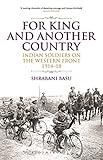
Shrabani Basu. For King and Another Country: Indian Soldiers on the Western Front, 1914-18. New Delhi: Bloomsbury Publishing, 2016. 256 pp. $30.00 (cloth), ISBN 978-93-8405291-1.
Reviewed by Brett Bebber (Old Dominion University)
Published on H-War (March, 2017)
Commissioned by Margaret Sankey (Air University)
Shrabani Basu’s recent addition to the emerging literature on the British Indian Army in the First World War is full of the sentimentalism that has long characterized popular histories of military engagement. The book weaves together several stories of individual soldiers in a mostly coherent narrative that begins with the German ship bombing of Madras in September 1914 and ends with the Amritsar Massacre of 1919. Basu’s central contribution is tracing the lives of twelve Indians across a wide range of social ranks—from a sweeper to a rifleman to a maharaja—throughout the war years. Throughout, Basu attempts to include the experiences of disappointment, disillusionment, and frustration Indian recruits suffered, but her emphasis on sacrifice and mutual appreciation between British and Indian participants often washes out these other threads.
Especially in the early chapters, Basu endlessly praises Indian soldiers’ bravery in battle and loyalty to Britain. Indeed, her characters rarely display any emotions besides their despair of the war and their fealty to the empire’s cause. The frames of this story are well known: Indian soldiers enthusiastically signed up for war, suffered the poor weather and terrible conditions of the trenches, experienced massive death and destruction, and within weeks wanted to return home. The opening chapters cover her characters’ departure from Bombay and Karachi in August 1914 and their first action defending Ypres in October. She is keen to point out their valiant and indispensable contribution to defending the western front. “The Germans would have reached the ports, were it not for them,” she declares (p. xxi), and points out that the 1.5 million soldiers that British India sent to the front lines outnumbered the combined armies of Scotland, Northern Ireland, and Wales. In each descriptive chapter—of the trenches, of the long winters, of Indian aviators—she underscores the reciprocal feeling of admiration between Indian soldiers and British officers, and uses their words to highlight this profound respect. But one cannot help noticing that this dominant impression has been selected by an author keen to play on well-tested mechanisms that can inspire an audience, but render much of the struggles and desperation about war and identity in the margins.
Basu’s most enlightening additions come from her finely detailed descriptions of the accommodations the British made for the Indians at the front and in Britain to allow soldiers to maintain their religious practices and diet. The third chapter on the Comfort Kameti, a group of high-society Britons with interests in India, discusses the construction of two hospitals for ailing Indian men. Despite providing respite and care for the wounded, the Kameti (Committee) established a network of gift-giving and provision specifically for Indian soldiers. It graciously distributed teas, spices, sweets, foods, board games, coconut oil, Indian tobaccos, and copies of religious texts across Britain and France. Basu acutely details how the Kameti acquired funds, took requests, and delivered specialized items to meet Indian entreaties. Basu suggests that the British volunteers “learnt the lessons from the Mutiny” and attempted to ensure good relations while Indians were far away from their homes (p. 40).
Another series of interesting insights comes from the letters written by Indian soldiers collated by the War Office under new censorship guidelines that attempted to minimize the ability of sepoys to inadvertently reveal strategic operations and prevent them from proactively fomenting resistance to the war effort. The British clearly feared Indians in their midst, and constantly monitored their activities as they carried out their duties. Outside of the censored files, Basu does not discuss her other sources specifically. The notes and bibliography suggest that she pulled much of her information from early published histories of the war, diaries and journals of soldiers, and interviews with their descendants. The author has put in some time at the National Archives and the British Library as well to elicit British officers’ views of their Indian charges. This research has led to the book’s lasting achievement. The volume effectively makes the stories of twelve Indian men accessible to a wide audience in plain language. Basu’s book is sure to be devoured by those who would like to understand Indian participation from a personal perspective. It also allows the reader to see the war through multiple sets of Indian eyes, and Basu should be applauded for following the stories of a wide cast of characters. Chapter 6 on the first winter in Europe does this well, tracing how Indians of various backgrounds felt about the extension of the war beyond Christmas.
Other sections of the book briefly explore more troublesome and conflictual narratives of Indian participation. Sections on topics like Indian desertion, and specifically on British fears of Indian defectors, become more frequent as the book progresses. But these accounts are truncated, and lack the analytical thrust to dislodge Basu’s insistence on the twin themes of loyalty and mutual respect with the British. Indian frustrations with British racisms and fears of miscegenation in Brighton in chapter 10, for example, are outlined well but eventually elided as the result of Indian soldiers—like all soldiers—wanting to return home. Interrogating the origins and importance of overt racisms and gendered medical discourses about Indian “hysteria” during the war must await further attention elsewhere. More focus on the strategic contributions of Indian regiments, as well as on the recruitment of soldiers in India, would also help satisfy military historians’ desire to understand their contribution beyond the perspective of the subjective individual. Nonetheless, in the end, the book hopefully stirs more interest in colonial troops, and especially Indian volunteers, to the British war effort. Basu demonstrates that seeing the war through Indian eyes can be both frightening and inspirational.
If there is additional discussion of this review, you may access it through the network, at: https://networks.h-net.org/h-war.
Citation:
Brett Bebber. Review of Basu, Shrabani, For King and Another Country: Indian Soldiers on the Western Front, 1914-18.
H-War, H-Net Reviews.
March, 2017.
URL: http://www.h-net.org/reviews/showrev.php?id=47942
 | This work is licensed under a Creative Commons Attribution-Noncommercial-No Derivative Works 3.0 United States License. |

