



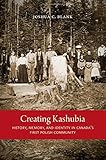
Joshua C. Blank. Creating Kashubia: History, Memory, and Identity in Canada's First Polish Community. Montreal: McGill-Queen's University Press, 2016. 364 pp. $34.95 (paper), ISBN 978-0-7735-4720-9.
Reviewed by Mark Stolarik (University of Ottawa)
Published on H-Nationalism (January, 2017)
Commissioned by Cristian Cercel (Ruhr University Bochum)
This is a revised doctoral dissertation accepted by Carleton University in Ottawa. Joshua C. Blank set out to reconstruct the past and deconstruct “hegemonic or commonly held definitions and/or delineations of certain labels, events and practices” as they have appeared in previous works on the Kashubs of Ontario (p. x). The essence of the book is that professional historians have long ignored the history of the Kashubs of Ontario and, therefore, some of the latter set out to write their own history. Because most of the local historians were amateurs, they incorporated many myths into their stories. Blank set out to investigate which of these stories were myths, and which were true.
In reconstructing the history of the Kashubs of Ontario, Blank read all of the secondary sources on the subject, much of the professional literature pertaining to the history of immigration to North America, and original sources in the Archives of Ontario and Library and Archives Canada. He also read the newspapers and newsletters pertaining to Renfrew County of Ontario (where the Kashubs settled) as well as American, Polish, and German-language newspapers pertaining to the history of the Kashubs in Polish Pomerania. He also interviewed a number of descendants of the original Kashubian settlers of Ontario.
After having consulted the above sources, Blank discovered that many myths permeated previous histories of the Kashubs as written by amateurs. For instance, the original settlers did not call themselves Kashubs but, rather, Poles. They emigrated not for political reasons, but rather economic ones. Most of the immigrants were not literate but, rather, illiterate, and their children were not less literate than their parents, but much more so. Canadian government agents did not deceive the pioneer Polish immigrants with tall tales of good land and the immigrants did not cross the Ocean on overcrowded immigrant ships but rather in standard third-class steerage, as did millions of other migrants to North America.
Perhaps Blank’s greatest contribution to the history of the Kashubs is his showing that, originally, they considered themselves Poles, who spoke “low Polish.” Only in the late nineteenth century did a Polish slavophile named Florjan Cenôva come along and codify the local “Kashubian” dialect of Pomerania. Other Polish scholars followed and promoted a distinct Kashubian language and culture. Post-World War II Polish intellectuals who emigrated to Canada then applied this name to the Poles of Renfrew County and, hence, “an invented tradition” was born. The net result is that the Poles of Renfrew County are divided in their loyalties--some consider themselves Kashubs, others simply Poles. Blank concluded, as have many other scholars in the last thirty years, that “ethnicity is a fluid concept that is continually reinvented and renegotiated” (p. 241). Amen.
Even though this is a fine work of microhistory, it does contain a few mistakes/drawbacks. Foremost among them is the statement that in the 1960s Poland celebrated the “300th anniversary of Catholicism” (p. 38). That should have been the 1000th anniversary! Blank also failed to provide a table of abbreviations and a map showing the specific villages from which the Kashubs emigrated. Was there any chain migration from certain villages and not from others? He does not say. He also uses the singular “they,” which may be off-puting to some readers, as in, “How did each author arrive at their [sic] conclusions?” (p. 20). The footnotes are also problematic. They appear at the end of the book and are incomplete. For the full title of a book or article one has to skip to the bibliography, thus necessitating much page-turning. Indeed, the cheapness of the binding (glue) contributed to the book falling apart when I finished reading it. McGill–Queen’s University Press can do better.
If there is additional discussion of this review, you may access it through the network, at: https://networks.h-net.org/h-nationalism.
Citation:
Mark Stolarik. Review of Blank, Joshua C., Creating Kashubia: History, Memory, and Identity in Canada's First Polish Community.
H-Nationalism, H-Net Reviews.
January, 2017.
URL: http://www.h-net.org/reviews/showrev.php?id=47902
 | This work is licensed under a Creative Commons Attribution-Noncommercial-No Derivative Works 3.0 United States License. |

