



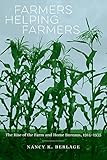
Nancy K. Berlage. Farmers Helping Farmers: The Rise of the Farm and Home Bureaus, 1914-1935. Baton Rouge: Louisiana State University Press, 2016. 320 pp. $48.00 (cloth), ISBN 978-0-8071-6330-6.
Reviewed by Dana M. Caldemeyer (South Georgia State College)
Published on H-SHGAPE (November, 2016)
Commissioned by Jay W. Driskell
Farmers Helping Farmers is a history of the American Farm Bureau Federation (AFBF), a nationwide organization open to men and women associated with the agricultural industry. The bureau, founded in the early 1910s, was an important factor in updating farms in the early twentieth century, yet as author Nancy K. Berlage observes, the organization has been understudied and misunderstood. Scholars such as John Mark Hansen, Pete Daniel, and Christiana Campbell, she claims, dismissed the AFBF as a group of elite white men “who, along with Big Science and Big Government, advanced the commercialization and industrialization at the expense of marginalized groups” (p. 6). Berlage challenges this interpretation of the bureau by tracing its formation and function in the communities it aided. Her aim is to show how the bureau helped form connections between “capitalist development and the family farm,” merging “‘traditional’ and ‘modern’ farming and farm life” in rural communities (p. 13).
Berlage’s claim that modernity and tradition are not mutually exclusive, though not a new argument, fits well with the work of recent scholars such as Charles Postel and Lou Martin, who have respectively demonstrated farmers’ embrace of scientific farming methods and rural industrial workers’ holding on to tradition as their communities transformed. Berlage’s assessment shows how these changes looked in local farming communities. Focusing on the Illinois, Iowa, and New York chapters of the AFBF, she draws from bureau records, government documents, and miscellaneous scrapbooks and manuscript collections to show how concepts of gender and culture changed as the bureau aided in families’ efforts to update their farms. This examination is interwoven with the organizational history of the bureau. Taking her cue from business historians, Berlage gives careful attention to the organizational structures and development that enabled the AFBF to function on a national level.
The merit of Berlage’s work is in her ability to convey the hopes and motivations of the farmers. The book is broken into six chapters, with the first three chapters discussing the origins and activities of bureaus in farming communities. Berlage pulls in stories of individual farmers to show how their values of cooperation, progressivism, and entrepreneurship dovetailed with the Progressive Era’s drive to provide order, structure, and science to a chaotic society. The AFBF emerged amid this “search for order” and became an intermediary that connected local farmers not only to each other, but to the organizations and entities that collected farming statistics and the latest techniques. Through the AFBF, farmers could become “experts” who remained informed on the latest developments in the farming industry and had access to a cooperative network strong enough to address local concerns such as cooperative ventures or recreational activities.
This merging of scientific knowledge with collective action is further explored in the third chapter. Here, Berlage documents the cooperation between government agencies, health reformers, veterinary professionals, and dairy farmers to eradicate bovine tuberculosis. These groups worked together to overcome resistance to the effort that came from the high expense of tuberculosis testing, the mistrust some farmers had for veterinarians who might “cheat” honest farmers, or their fears that this would begin government involvement in all farming affairs. The movement, Berlage notes, coincided with other efforts in health reform and fit well within the popular rhetoric involving purity, patriotism, and science to cultivate the support needed to fight the disease.
The final chapters contribute to the growing scholarship on farmers’ wives and children. Berlage argues that the inclusion of women and children in AFBF activities reinforced family traditions within the farming culture, but also intensified gender roles in several ways. On one hand, the drive to specialize created gendered skill sets that increasingly pressed women to become experts in home economics while the men tended to farming affairs. The division reinforced a “separate sphere” which many women used as a platform to push for gender-specific goals such as suffrage. At the same time, however, many women pursued an “integrationist” model that involved working with men not only on the family farm, but also within the AFBF to determine general organizational practices. Berlage notes that although women often maneuvered between these two approaches, using each to their advantage, many of the general practices of the bureau excluded female participants. Whether by habit or by design, AFBF programs favored boys over girls, heralding them as the future of the farming industry, and effectively excluding girls from such aspirations.
While Berlage’s focus on northern chapters of the AFBF allows her to emphasize the ground-level involvement in the order, her scope does create limitations regarding how far the AFBF’s influence extended. She acknowledges the difficulty of determining who actually joined the bureau in these communities, but in a period when smaller farmers felt the pinch of an oversaturated market, one wonders who could afford to “update” their farms and who was left behind. The fact that many AFBF chapters closed with the economic depression indicates a significant connection between membership and having money to invest in farming updates. It is likely that small-scale farmers or tenant farmers simply did not have the means to participate. Although Berlage is careful to note that some tenant farmers did participate in local bureau activities, it is unclear how common involvement was among poorer farmers or if this trend of tenant farmer involvement extended to regions outside the North and Midwest. The AFBF had a nationwide scope by 1930 but it is doubtful that poor black tenant farmers in the cotton-growing South would have found much in common with the farmers fighting bovine tuberculosis. This intersectionality of class, race, and region within the effort to update the farming industry is beyond the scope of Berlage’s assessment, but its absence from this examination indicates that there is still much more to be explored in the farming industry during the interwar years.
Gilded Age and Progressive Era scholars may find it curious that Berlage gives little historical context for the AFBF’s formation. Although many agrarian reforms began in the late nineteenth century, Farmers Helping Farmers begins in the 1910s and, despite the emphasis on the importance of tradition, makes little mention of the agrarian organizations that preceded the AFBF. As a result, Berlage misses a great opportunity to highlight the continuity of agrarian reform across generations of farmers. Her analysis would have particularly benefited from much of the existing scholarship on the Patrons of Husbandry (commonly called the “Grange”), which had a particularly strong influence in Illinois and New York—two of the three states in this study. Indeed, Berlage notes that at least some AFBF members were also affiliated with the Grange, but discussing the order in more detail would have added much depth to Berlage’s examination of rural farming culture. The Grange’s nationwide scope, efforts to understand and navigate trade in a national market, inclusion of women, and push for scientific developments in agriculture indicates that farmers’ desires to forge a community while improving farm production and efficiency were rooted deeper than this assessment credits. The Grange was past its prime by the 1920s but it did still exist, and many of its programs were strikingly similar to those of the AFBF. It placed substantial emphasis on the “specialization” of the farming industry, including encouraging home economics for women. One wonders how much these older agrarian orders affected AFBF policy.
Berlage’s research gives a local voice to the chorus of historians documenting the technological developments of the twentieth century that greatly transformed farming as an industry and as a culture. The rise of the “expert” changed who worked, how they worked, and where they worked. And in the process, it segmented what had previously been collective and family-oriented tasks into more rigid, gender-specific duties. Organizations like the AFBF therefore served to mitigate the growing power of nationwide industries and organizations while fortifying family and community ties. The AFBF may not have been the first agricultural organization to employ such practices, but this account is a terrific demonstration of how local farming families used such entities to adapt their livelihoods and cultures in this crucial period of social and technological change.
If there is additional discussion of this review, you may access it through the network, at: https://networks.h-net.org/h-shgape.
Citation:
Dana M. Caldemeyer. Review of Berlage, Nancy K., Farmers Helping Farmers: The Rise of the Farm and Home Bureaus, 1914-1935.
H-SHGAPE, H-Net Reviews.
November, 2016.
URL: http://www.h-net.org/reviews/showrev.php?id=47740
 | This work is licensed under a Creative Commons Attribution-Noncommercial-No Derivative Works 3.0 United States License. |

