

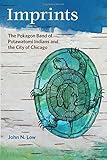
John N. Low. Imprints: The Pokagon Band of Potawatomi Indians and the City of Chicago. East Lansing: Michigan State University Press, 2016. 328 pp. $29.95 (paper), ISBN 978-1-61186-188-4.
Reviewed by Kyle Mays (University of North Carolina at Chapel Hill)
Published on H-Environment (October, 2016)
Commissioned by David T. Benac (Western Michigan University)
Over the last decade, scholarship on the presence of indigenous people in urban spaces has increased. Scholars have moved away from limited community social histories to studies of memory and representations of indigeneity in cities. Collectively, these works have challenged the longstanding assumption that Native people moved to cities after World War II. These works also make the implicit assumption about urban history methodology, suggesting that, in order to conduct a thorough urban indigenous history, scholars must use a variety of sources to reinsert indigenous presences back into urban spaces. It is in this light that urban indigenous histories are currently being written.
John N. Low's Imprints: The Pokagon Band of Potawatomi Indians and the City of Chicago is an examination of the persistent presence of the Pokagon Potawatomi in Chicago. Low demonstrates that they remained in Chicago long after settlers believed they had disappeared. More than this, the book reveals that Native Americans and cities are, in fact, not incompatible. The book argues that the Pokagon Band of Potawatomi Indians, as people, representations, and monuments, remained a consistent presence in Chicago's history. As Low writes, "Pokagon Potawatomi experiences represent an important and understudied example of the ways in which American Indian peoples retained a presence in the urban centers of the United States despite efforts at removal, assimilation, and marginalization" (p. 9). To illustrate the long presence of the Pokagon Potawatomi in Chicago, he frames their presence as a collective memory. Throughout the book, he uses a variety of sources, including oral histories, newspaper accounts, and written materials by the Pokagon Potawatomi.
Low contends that (collective) "memory serves as a means of producing knowledge, and as an agent in the preservation of the past" (p. 9). But memory is not just about preseving the past. Memory can also be demonstrated through rituals, religion, and connection to place. One way in which the Potawatomi maintained a collective memory was through making claims to the Chicago lakefront. As Low notes in chapter 3, "the Pokagon Potawatomi people were here long before Chicago became incorporated as a city." Even today, the Potawatomi have a program called "Ezh N'bamandamen" (How we think about caring for the water), which is an important spiritual and literal part of the Potawatomi care for the land underneath Chicago and Lake Michigan (p. 81).
In the early twentieth century, the Pokagon Potawatomi claimed that they had never ceded land on the lakefront, in spite of the Treaty of Chicago (1833), in which the majority of the Potawatomi moved west of the Mississippi and to neighboring states Wisconsin, Michigan, and Indiana. Unfortunately, on January 8, 1917, the United States Supreme Court ruled that the Potawatomi were occupants of the city but had long ago abandoned their claim to Chicago. Although they would never gain the lakefront land as their own, the Potawatomi were persistently present in Chicago. Indeed, as Low notes, "the Pokagon Potawatomi claim undermines those frontier mythologies, and so becomes an 'inconvenient truth'" to settler views of land ownership to Chicago (p. 137).
The Pokagon Band of Potawatomi Indians found numerous ways to illustrate their connection to Chicago, and the author demonstrates this through a variety of sources. For example, in chapter 5, he examines the records of the Canoe Club formed in 1964 by Leroy F. Wesaw Sr., a Pokagon Potawatomi tribal member. Some Indians, like Simon Pokagon, as discussed in chapter 2, wrote numerous texts, including some written in birch bark, a traditional material used by the Potawatomi for a variety of items, such as canoes and writing surfaces.
Low is an exceptional storyteller and writes in an engaging manner. A minor criticism of the book is that in doing urban indigenous history, it is still important to understand indigenous relationships; a missing part of this book is the social life of the Potawatomi. What was their daily life like? Did they interact with other races besides other Native people? To be fair, there are a few books that discuss Chicago's Indian community, but this context is still worth noting for the reader. Furthermore, Low asserts that his book is about modernity, but he does not explicitly theorize about what modernity is.
Imprints is a welcome contribution for scholars of indigenous studies, urban history, and ethnic studies. This book is for people inside and outside of the academy, and is surely an important contribution for Chicagoans. Finally, it illustrates that Native people, specifically the Pokagon Band of Potawatomi Indians, have survived centuries of US settler colonial genocide, and shall continue to remain a part of Chicago's past, present, and future.
If there is additional discussion of this review, you may access it through the network, at: https://networks.h-net.org/h-environment.
Citation:
Kyle Mays. Review of Low, John N., Imprints: The Pokagon Band of Potawatomi Indians and the City of Chicago.
H-Environment, H-Net Reviews.
October, 2016.
URL: http://www.h-net.org/reviews/showrev.php?id=47617
 | This work is licensed under a Creative Commons Attribution-Noncommercial-No Derivative Works 3.0 United States License. |

