



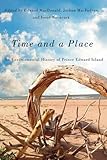
Edward MacDonald, Irené Novaczek, Joshua MacFadyen, eds. Time and a Place: An Environmental History of Prince Edward Island. Montreal: McGill-Queen's University Press, 2016. 460 pp. $34.95 (paper), ISBN 978-0-7735-4693-6.
Reviewed by Henry V. Nelles (McMaster University)
Published on H-Environment (December, 2016)
Commissioned by David T. Benac (Western Michigan University)
Ferry Tale
Insular is generally thought to be a mildly pejorative word. Its cognates, listed in Roget's Thesaurus, give a clear impression of its associated derogatory meanings: insulated, secluded, separate, alone, narrow-minded. Insular is the opposite of cosmopolitan, connected, mainstream. History too, the editors of this collection claim, similarly slights islands. History is the story of mainlands, of continents, countries, urbanity. In these meta-narratives islands get pushed to the margins of consciousness if they are noticed at all. Considered peripheral, islands get dismissed as small, derivative, latecomers to a bigger story that has been set in motion elsewhere.
This collection of essays on the environmental history of the Canadian island province, Prince Edward Island (PEI), aims to correct the biases of both language and historiography. It goes beyond the heuristic argument of social scientists ("Islands are good to think with") to insist that islands in general, and Prince Edward Island in particular, have been at the cutting edge of environmental and cultural change. They propose a historiography centered on islands rather than continents in which PEI would have a larger role. In the editors words: "Instead of a tiny province perched on the periphery of a great landmass where power tilts towards the centre, Prince Edward Island can locate itself within an island-centric world view in which islands are the norm rather than an anomaly" (p. 12). This interdisciplinary endeavor of overturning the continental bias of History requires so much heavy lifting it has given rise to a subfield with a new name, nissology.
The goals of the book are clearly stated: to provide "much more than a beginning" (p. 10) of an environmental history of a coterminous bioregion-jurisdiction, and secondly to sustain or make the case for an island-centric history. The collection opens with two bravura keynote pieces addressing the second objective by old academic stagers- John R. Gillis and Graeme Wynn. Gillis makes a cosmic case for islands being central in the course of human history; Wynn, with more modest ambition, shows how Prince Edward Island has been the seedbed for historical geography and environmental politics in Canada.
The core of the book consists of nine chapters divided into two sections which might be loosely titled Nature and Culture. The first section groups together essays which deal with the consequences of human interaction with the natural world: pre-contact indigenous resource use, nineteenth-century forest exploitation and regeneration, wildlife depletion with settlement clearance, and the harvest of seaweed. The second section focusing on culture deals mainly with the history of agriculture (two essays), fishing and aquaculture, tourism promotion imagery, and energy production and use. A meditation on what might be learned from island environmental history and a compendium of provincial environmental legislation bring the volume to a close.
The interdisciplinary essays in this volume document the ways in which the island environment has sustained economic opportunities; how labor, capital, and technology combined to capitalize those resources; and in turn how the production of these commodities for the market and the table transformed the environment. The main protagonists of Prince Edward Island environmental history are gastronomy, vacations, and French fries. Taken together these cultural practices have fired the demand for Island lobsters, oysters, mussels, tuna, Irish moss, milk, meat, beaches, scenery, and potatoes upon which the local population has subsisted over time. These changing appetites have made and remade the island in waves of organized capitalist exploitation.
A repeated declensionist refrain marks many of the chapters, with the exception of the one on indigenous resource use, which conveys a whiff of the "ecological Indian" approach. About nine hundred people with stone tools did not make much of a dent in the land or seascape. But everything else afterwards did. External demand depleted the fishery. Land clearance, forest fire, and shipbuilding leveled the forests and extirpated wildlife. The "sour soil" could not provide enough fodder for livestock to winter, which led to the mussel beds in the estuaries being mined for mud to fertilize the fields. The ice cream and drug industries exhausted the supply of Irish moss. The potato is dethroned in one essay as a major historical actor in a more complex, mixed-husbandry agriculture only to be recast in the next chapter as a malign soil miner, silt producer, pesticide- and fertilizer-dispersing agent of industrial monoculture. On the other hand a highly regulated fishery of catch (lobster) and culture (mussels and oysters) seems for the moment to have staved off resource exhaustion.
Collectively these chapters do provide a reasonably comprehensive, if sometimes uneven, picture of the environmental history of an island province in the Gulf of St. Lawrence. The only factor missing in my reading of the case is an account of the massive inflow of transfer payments from the federal government that gradually became one of the main underpinnings of the society, the foundation of a majority non-agricultural population, which in turn had equally profound environmental consequences. The agricultural and fishery activities that predominate in these pages occupy only slightly more than 5 percent of the current labor force. PEI has been a service economy in a socialized polity for quite some time. And that makes for quite a different ecological footprint than the ones pictured here.
What about the first goal? Most of the essays simply ignore the "islands as the centre of the world" argument, and several by inference refute it. But it would be the height of pedantry to test each of the thematic essays against the stated goal of creating an island-centric history. After all Islanders are prone to exaggeration, have a great sense of humor, and have been known to pull one's leg on occasion. Mainlanders should rise to the bait with caution.
But that still leaves the "islands are good to think with" possibility. What I thought about as I read this book was that shibboleth of environmental history, sustainability. An island brings that concept much more sharply into focus. Curiously it is not a major theme of this collection. First of all, what does sustainable mean in application in history? And secondly, could any socioeconomic regime on the island have ever been considered sustainable? These essays seem to imply the answer historically to the second question has been no and that external demand, technological change, and off-island connectivity have been so pervasive as to make the self-contained island concept ahistorical. It turns out that on the basis of the evidence presented here, if no man is an island, neither is an island.
If there is additional discussion of this review, you may access it through the network, at: https://networks.h-net.org/h-environment.
Citation:
Henry V. Nelles. Review of MacDonald, Edward; Novaczek, Irené; MacFadyen, Joshua, eds., Time and a Place: An Environmental History of Prince Edward Island.
H-Environment, H-Net Reviews.
December, 2016.
URL: http://www.h-net.org/reviews/showrev.php?id=47566
 | This work is licensed under a Creative Commons Attribution-Noncommercial-No Derivative Works 3.0 United States License. |

