

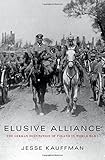
Jesse Kauffman. Elusive Alliance: The German Occupation of Poland in World War I. Cambridge: Harvard University Press, 2015. 320 pp. $35.00 (cloth), ISBN 978-0-674-28601-6.
Reviewed by Nicholas Sambaluk (Air Command and Staff College)
Published on H-War (October, 2016)
Commissioned by Margaret Sankey (Air University)
Jesse Kauffman shines light on an important topic from the First World War that has won little thought and even less serious attention in English-language historiography: Germany’s occupation of Polish lands from 1915 through 1918. As Kauffman notes, prevalent assumptions involve the conflation of the world wars. The actual history that he reveals, however, shows a great deal more nuance.
Germany’s Second World War occupation of Poland, from 1939 through 1944, was defined by Nazi racial theories and genocidal practices, as a key theme of Nazi ideology was expansion eastward and the murder of indigenous populations, particularly Jews. Germany’s First World War policies regarding eastern Europe were considerably less sinister and murderous but were nonetheless seriously convoluted and led to significant suffering. Germany’s ranking occupation official between 1915 and 1918 was Governor-General Hans Hartwig von Beseler, a career army officer and the central figure of Kauffman’s study. Beseler arrived in Poland initially intent on establishing control and maintaining order in the conquered land, but his tenure lasted for the duration of German occupation. As months progressed, Beseler came increasingly to conclude that the most practicable long-term policy alternative for Germany was to nurture the development of a reconstituted Polish state. This Poland would be nominally independent but would be economically and militarily a subordinate client state to Germany.
Several factors posed ongoing complications for Beseler in these efforts, however. One was the almost grotesquely rivalrous relationship between Germany and its wartime partner, Austria-Hungary. Throughout the war, their relationship was poor, and cooperation and coordination were extremely difficult regarding policy questions in eastern Europe, including the future of Poland. Neither German nor Austro-Hungarian policymakers were eager to find Polish lands and populations under the dominant influence of the other, and outmaneuvering Austria was a significant problem for German officials.
Added to this were Beseler’s own challenges in persuading Berlin to accede to his advice; in striving to convince German officials that the absorption of excessive amounts of Polish lands would be politically counterproductive; in balancing Polish, Jewish, and ethnic German interests and opinions in the occupied lands; and in extracting resources from Poland in order to serve Germany’s voracious wartime appetite for people and war materiel. Kauffman explicitly points out that the Polish population suffered in substantial ways during the 1915-18 occupation, particularly because Germany’s extraction of food prompted shortages and hunger. While not dismissing this privation and suffering, Kauffman notes that the German wartime regime treated its own homeland almost as piteously, and he contrasts tragic starvation in 1915-18 with the deliberate policies aimed at mass murder during the occupation of 1939-44.
Kauffman also points to fundamental differences in Germany’s handling of Polish national sentiment. “The Germans tolerated, and even supported ... displays of Polish national feeling, especially when it aroused memories of Russian oppression” (p. 51). Beseler’s occupation authorities reopened Warsaw’s university and a technical school and established a more coherent elementary education system. Tentative steps were taken to permit elections and earnest steps were taken to promote local self-government, principally because the occupiers expected that this would simplify their own administrative and political burden. Political divisions among Poland’s populace, a serious cleft between Poland’s Jews and non-Jews, and fissures within the region’s Jewish population all added layers of complication that German occupiers seemed unable to fully master. All these German efforts at supporting education and self-government aimed principally to maintain order in Poland but also to groom the Polish population for readiness to govern itself—according to German interests. Kauffman identifies the ironies of German policies, including an interest in constructing apolitical educational institutions but expecting the graduating students to be Polish nationalists loyal to German ideals.
German leaders did hope to extract valuable materials from the lands it conquered, in order to support its war effort. Nonetheless, readers cannot mistake these ironies as somehow reflecting a common purpose between Germany’s two occupations. Whereas ethnic Germans during World War II were used as racial chess pieces to dominate conquered territory, Beseler’s occupation regime ensured that ethnic Germans in a postwar Poland would be treated by Germany as foreign nationals. Furthermore, British and French officials “operated in much the same way [in China] as the German labor recruitment offices in Poland” during the war (p. 60). The resulting suffering was, implicitly, a tragedy of the time rather than the reflection of genocidal intent.
Kauffman shows that the First World War occupation was far from pleasant and Poland’s population felt little love for their conquerors, even if they typically liked their Russian former overlords even less. German recruitment drives yielded few volunteers and many of these refused to swear a contorted loyalty oath pledging fealty to a country and kingdom to be established sometime in the future. Beseler’s policies, from a German standpoint, achieved little. As Germany’s wartime fortunes crumbled in late 1918, Poles rose up and seized independence. Josef Pilsudski, a rambunctious left-wing nationalist who Beseler distrusted, was arrested during the loyalty oath crisis and released the day before the war’s end. By November 11, Polish representatives had installed Pilsudski as interim national leader and Beseler was fleeing the country.
Beseler’s nominally coequal civilian counterpart, Wolfgang von Kries, had secured transfer out of Poland a year earlier. Kries quickly and firmly ascribed to the most anti-Semitic of the “stab-in-the-back” mythology regarding Germany’s defeat. In the concluding chapter, Kauffman indicates that if there is a linkage between the two occupations, it is to be found in German hatred of Poland in reaction to its own failures during the first occupation. “When German armies arrived back in Poland in 1939, they carried with them a toxic combination of long-existent antipathies to Poland, anger generated by the First World War and the Treaty of Versailles, and, maybe most fatally, Nazi racial theories” (p. 227).
Kauffman’s work accomplishes a critical and long overlooked task by providing an accessible and informative history of Germany’s First World War occupation experience in Poland. German policies included convoluted inconsistencies, they engendered some real suffering as well as fostering patriotic hopes, and they bore ultimately bitter fruit. But readers can certainly derive from this work a more complete understanding of Germany’s approach to occupation and to eastern Europe during the First World War, and Kauffman confidently establishes that the First and Second World Wars cannot be mistaken for one another. At the first war’s centenary, this is a particularly apt time to make a long overdue recognition.
If there is additional discussion of this review, you may access it through the network, at: https://networks.h-net.org/h-war.
Citation:
Nicholas Sambaluk. Review of Kauffman, Jesse, Elusive Alliance: The German Occupation of Poland in World War I.
H-War, H-Net Reviews.
October, 2016.
URL: http://www.h-net.org/reviews/showrev.php?id=47502
 | This work is licensed under a Creative Commons Attribution-Noncommercial-No Derivative Works 3.0 United States License. |

