

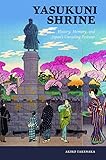
Akiko Takenaka. Yasukuni Shrine: History, Memory, and Japan's Unending Postwar. Honolulu: University of Hawaii Press, 2015. 287 pp. $57.00 (cloth), ISBN 978-0-8248-4678-7.
Reviewed by John Nelson
Published on H-Asia (August, 2016)
Commissioned by Douglas Slaymaker (University of Kentucky)
The first sentence of a book can sometimes provide a sense of the entire project that follows, as well as revealing a bit about the disposition of its author. In the acknowledgements to Yasukuni Shrine: History, Memory, and Japan's Unending Postwar, Akiko Takenaka informs her readers that "this project took one and a half decades to complete" (p. vii). She then goes on to express gratitude to the many colleagues and mentors who shaped her research. It is a fitting way to launch a detailed, nuanced, and highly engaging discussion on the vexing topic of Japan's shrine to the spirits of the war dead.
Not only does the topic require as much time and as many scholarly resources as one can manage, it also demands considerable patience and fortitude to untangle any number of tightly wound issues. That Takenaka has largely managed to do this in her new book is a considerable achievement that advances our understanding of Yasukuni Shrine in many positive ways. In this review, I will point out topics and issues where greater clarity has been gained in seeing the overall historical and political topography of Yasukuni Shrine. In a social landscape of this scope and breadth, it is to be expected that a few conceptual and interpretive "clouds" continue to linger.
The role of Yasukuni Shrine in Japan's modernization is by now fairly well established. For readers of English, Helen Hardacre's pioneering study of 1989, Shintō and the State: 1868-1988, brought many aspects of the shrine's history and politics into sharper focus.[1] With the addition of John Breen's 2008 edited volume, Yasukuni, the War Dead, and the Struggle for Japan's Past, a group of diverse scholars looked at an array of issues that appeared in Hardacre's book and were still in play over a decade later.[2] Due in part to repeated visits from 2001-06 to the shrine by then Prime Minister Koizumi Junichiro, the "Yasukui problem" had expanded into history textbook reform, international relations between China, Korea, and Japan, numerous right-wing organizations that used the shrine for symbolic legitimacy, as well as tens of thousands of individuals who found meaning in the themes of patriotism, cultural identity, and veneration of the emperor.
What is less known--and what Yasukuni Shrine helps to illuminate--are some of the particular dynamics and circumstances about the development of the shrine through the long Meiji, Taishō, and Shōwa prewar periods. Following Japan's defeat in the Pacific War, and after lengthy negotiations between occupation officials and Japanese powerbrokers, the shrine was allowed to continue its primary purpose of enshrining the spirits of military personnel who died because of the war. At no other place in Japan does one find such persistent (and well-funded) efforts to redeem the nation's defeat, and deflect war responsibility, through patriotic renditions of history, institutional politics, and most importantly, personal sacrifice.
This brief review cannot do justice to the thoughtfully developed discussions of each of these topics other than to say that readers will come away with nuanced and sometimes surprising information relevant to a deeper appreciation for just how complex Yasukuni remains. Takenaka gives particular attention to the interactive relationship between "the belief, the site, and the issue" of Yasukuni shrine (p. 6), topics expounded convincingly in successive chapters.
The book's opening chapters are rich with historical details as well as analysis about some of the central circumstances and negotiations that created the shrine. For example, in tracing the origins of how the original institution (then called Tokyo Shōkonsha, founded in 1872) came to memorialize the military dead, Takenaka points to precedents that contributed to the invented tradition that later became Yasukuni. First are the memorial practices of the Mito and Chōshū clans (both prime movers in the Meiji revolution and restoration of the imperial line), by which families ceded control for memorializing their war dead to the authority of the clan. Second, the appropriation of a medieval samurai named Kusunoki Masahige (c. 1294-1336)--said to have died in service to the emperor against the warlord Ashikaga Takauji--provides a noble if tragic example of going beyond clan loyalty to willingly offer one's life to the emperor and imperial cause. There is plenty here to consider about the origins of the shrine, and yet I wished for a little more attention to elements of shrine Shintō ritual and notions of sacred space (the shrine is registered as a "religious corporation," or shūkyō hōjin), ancestor veneration, and the proximate relations between religious institutions and state power in Japanese society. Additional details could have extended connections between this newly formed institution and existing cultural patterns.
As important as memorialization is to the shrine and its varied constituencies, Takenaka impresses upon the reader that the institution multitasks to "function as a convenient tool that aids in forgetting" (p. 13). Drawing upon the work of writers as diverse as historian Takahashi Tetsuya and Theodore Adorno, Takenaka highlights a long-standing domestic narrative about war responsibility that blames military leaders and positions the Japanese people (including lower-ranking military personnel) as victims. In this scenario, Yasukuni and its many affiliated organizations and lobbying groups (such as the Nippon Kaigi, various War Veterans Associations, the Bereaved Families Association, the Group to Promote a New Japanese History, and so on) obscure history and thus promote forgetfulness about the efforts of the state to convert regular citizens into imperial subjects, whose greatest achievement was to die for the nation and emperor. Takenaka complicates the picture by emphasizing that, throughout most of the Meiji period, personal belief in the efficacy of Yasukuni-based claims may not have accompanied individual participation in patriotic associations, school and community events, and newly created nationwide holidays centered on the emperor or state. "Yasukuni the belief" is thus nuanced beyond simple patriotism and nationalism to include intragroup coercion, intimidation, and political pressure at various levels of society.
Anyone who has visited Yasukuni or seen maps of its precincts knows that the site is organized in such a way as to discipline individual behavior the closer one comes to the main sanctuary, where the spirits of dead soldiers (and civilians aiding the imperial cause) are thought to reside. Takenaka helps the reader understand that despite the somber origins and main function of the shrine, in the public mind it was at first a site for celebrating military victories and promoting imperialism. Mobs of people came to see Noh performances, sumo matches, and fireworks--accompanied by the usual food stalls, sweet and snack vendors, games, and freak shows (misemono goya). But they were also attracted to European-style circuses and horse races around a track that circled an enormous bronze statue of Ōmura Masujirō, the samurai who envisioned the Kudan hill region of Tokyo as the best location for the shrine. The shrine's accompanying Yūshūkan museum also served to educate and indoctrinate visitors (see especially pp. 173-178 for a tour of the newly remodeled museum) as it combined visual and auditory technologies to convey the glory of war victories and military sacrifice.
Despite its singularity, Yasukuni was part of a network of "nation preserving shrines" (gokoku jinja) and public spectacles. In Tokyo, the latter category included parades through the city, streets and trolley cars festooned with lanterns and flags, displays of captured weapons, and triumphal arches--all to celebrate war-related victories against the Chinese (1894-95) and Russians (1904-05). The Russo-Japanese conflict in particular seems to have galvanized strategies of mobilization that would be extended in the Pacific War two decades later. Takenaka demonstrates convincingly the important roles played by technology (newspapers, mass-produced illustrations of war-glorifying battlefield action, and panorama pavilions that were marvels of realism for the time), the educational system (with its Rescript from 1899 imploring students to consider offering their lives to the imperial system), new institutions (such as local gokoku shrines), and conscription of able-bodied young men. All of these dynamics helped to localize a master narrative that institutionalized and aestheticized the honor of death in war.
Even with the growing emphasis on the state institutionalization of military deaths, Takenaka does not neglect what she calls "counter-narratives." She cites news accounts from 1904 that are heartbreaking to read, where individual suicides of older family members as well as cases of mothers killing their children were intended to eliminate the burden of dependents should that family's breadwinner fall in battle. Additionally, readers learn about self-censorship among bereaved family members when speaking in public, as well as the anguished cries of family members at Yasukuni enshrinement ceremonies in the 1940s that caused radio broadcasters to cover their microphones. During the final years of the Pacific War, Takenaka utilizes secondary scholarship about a monthly report (Tokkō Geppō) by the Special Higher Police (sometimes called the "thought police") that logged incidents of subversive graffiti on Tokyo walls and passageways. As early as 1942, citizens were voicing their discontent by writing "Stop the war: we have no rice" and "Give us back our freedom!" (p. 128).
One of the major contributions of this study can be found in its treatment of the politics of enshrinement at various historical periods, including the present day. Drawing upon newspaper reports as well as published accounts by individuals in attendance for an April 1940 shōkonsai ritual, Takenaka skillfully leads readers through the steps whereby individual spirits are merged into a collectivity that becomes a Yasukuni "god". She also investigates the surprisingly brief history of eirei, a key term for the process of enshrinement. The word appears first around 1907 and is used to change the "nature of the war dead by eliminating individuality and transforming individuals into an anonymous collective" (p. 91). Since all eirei (including certain civilians) died in service to the emperor, a spirit was "worthy of respect ... from members of the new expanded family, which encompassed all of Japan" (p. 92). Takenaka sees this development as nothing less than a nationalized form of ancestor worship.
The history she relates of postwar enshrinements is especially fascinating and disturbing. It was a major revelation to me that 90 percent of all enshrinements took place after the war. Thanks to the constitutionally prohibited transfer of information about military deaths from the Welfare Ministry directly to Yasukuni, Takenaka points out how a law called the War-Injured-and-Bereaved-Families Relief Act (referred to as Engohō) became a major resource in compiling over two million names that qualified for eirei status. The Association of Bereaved Families (Izoku-kai) was also instrumental in transferring the names of Class-A war criminals for enshrinement in 1976. This discussion makes it clear that prewar ideologies and religious practices were not only reenacted but also empowered in the post-occupation period, with the Liberal Democratic Party (LDP) trying five times between 1969 and 1974 to reinstate official funding for the shrine.
Another important aspect of the politics of enshrinement in the postwar period regards individuals and groups--Taiwanese, Koreans, Okinawans, Japanese Christians and regular citizens as well--who challenged enshrinements of their loved ones made without their knowledge or consent. These histories, as presented here, are detailed and even inspiring in their attempts to hold the state accountable for inflicting severe emotional distress upon bereaved family members, with the cases from Okinawa particularly vivid and tragic. Despite lower court victories, all these cases end up being dismissed by Japan's Supreme Court. One telling case regarding a self-defense soldier who died in an automobile accident in Japan and who was enshrined against the wishes of his Christian wife (but with the consent of his parents), attracted much attention in the press and in earlier studies.[3] However, Takenaka stops short of the Nakaya story's dramatic conclusion: the Supreme Court overturned an earlier verdict in Nakaya's favor when it ruled that any claim by a plaintiff on the grounds of religious freedom would also apply to Yasukuni's religious freedom. Therefore, the shrine could continue to enshrine anyone it wanted to.
There are a few other places where information could be presented more completely and conclusively. Regarding former Prime Minister Koizumi's multiple visits to Yasukuni from 2001-06, Takenaka concludes a discussion about a 2001 lawsuit that challenged the constitutionality of the first visit with a 2004 ruling by the Fukuoka district court in favor of the plaintiffs. To stop here without including the next two rulings on appeal--one by the Osaka High court in 2005 and the second by the Supreme Court in 2006 that threw out the case entirely--could easily give a reader the impression that Japan's legal system can stand up to and challenge state interests. As a byproduct of the lawsuits against Koizumi's shrine visits, a fitful discussion was launched in his and the next administration to establish an alternative site for official commemorations (p. 134). It seems important here to add at least a couple of scholarly references for readers who might be interested in the existing and wholly secular site at Chidorigafuchi, where civilians and unknown military personnel who perished in the war are memorialized.[4]
Takenaka mentions how "Yasukuni-the-site" survived the war in part through the advocacy of Fr. Bruno Bitter, a German Jesuit priest serving at Sophia University, who told occupation authorities that the shrine should not be razed (p. 162).[5]. There is no reference, however, to a foreigner of even greater importance to the shrine's agendas, Ranhabinod Pal, an Indian jurist appointed to the International Military Tribunal for the Far East. Because of Pal's definitive statement that all accused war criminals were not guilty, Yasukuni has an impressive monument on its grounds (with a photo of Pal and the crucial text inscribed).[6] Takenaka's otherwise fruitful discussion of Japan's postwar politics could also have benefited by including references to how Germany dealt with war commemorations and "postmemory" traumas (see p. 164 for a discussion). Finally, a correction also should be made regarding a missing zero for the total number of casualties from the March 10, 1945, firebombing of Tokyo (p. 220n36; more accurate figures can be found on the website provided in the endnote).
These critiques do not detract from the valuable contribution made by Yasukuni Shrine to a more complete history of this institution. Takenaka's determined effort to relate as well as interpret the shifting dynamics of history, belief, state policies, culture, and personal involvement through eight decades of social change is a significant achievement. It will serve as both a pivot and catalyst for future studies that, like the current work, attempt a fuller comprehension of this institution and all it encompasses.
Notes
[1]. Helen Hardacre, Shintō and the State, 1868-1988 (Princeton, NJ: Princeton University Press, 1988).
[2]. John Breen, ed., Yasukuni, the War Dead, and the Struggle for Japan's Past (New York: Columbia University Press, 2008).
[3]. See Hardacre, Shintō and the State; and Norma Field, In the Realm of a Dying Emperor (Chicago: University of Chicago Press, 1993).
[4]. See Hardacre, Shintō and the State; Breen, Yasukuni; Breen, "The Nation's Shrine: Conflict and Commemoration at Yasukuni," in The Cultural Politics of Nationalism and Nation-Building: Ritual and Performance in the Forging of Nations, ed. R. Tsang and E. Woods (London: Routledge, 2013), 133-149; and Mark Mullins, "Sacred Sites and Social Conflict: Yasukuni Shrine and Religious Pluralism in Japanese Society," in Religious Pluralism, State and Society in Asia, ed. Chiara Formichi (New York: Routledge, 2013), 35-50.
[5]. See also http://www.asahi.com/ad/sophia/history/hi1932.html.
[6]. The statue is noted on Yasukuni's website map of the precincts at http://www.yasukuni.or.jp/precincts/monument.html.
If there is additional discussion of this review, you may access it through the network, at: https://networks.h-net.org/h-asia.
Citation:
John Nelson. Review of Takenaka, Akiko, Yasukuni Shrine: History, Memory, and Japan's Unending Postwar.
H-Asia, H-Net Reviews.
August, 2016.
URL: http://www.h-net.org/reviews/showrev.php?id=47427
 | This work is licensed under a Creative Commons Attribution-Noncommercial-No Derivative Works 3.0 United States License. |

