

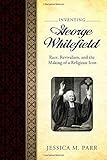
Jessica M. Parr. Inventing George Whitefield: Race, Revivalism, and the Making of a Religious Icon. Jackson: University Press of Mississippi, 2015. 235 pp. $60.00 (cloth), ISBN 978-1-62846-198-5; $30.00 (paper), ISBN 978-1-4968-0963-6.
Reviewed by Emily Conroy-Krutz (Michigan State University)
Published on H-AmRel (July, 2016)
Commissioned by John D. Wilsey (Southwestern Baptist Theological Seminary)
The Ironic and Iconic George Whitefield
In 1834, Andrew Reed and James Matheson, two Congregationalist ministers from England, walked into the Old South Presbyterian Church in Newburyport, Massachusetts. After asking the permission of the minister, they entered a tomb, removed the lid of a coffin, and looked inside. One of them picked up the skull, unable to say much as he considered the remains. This was all that was left of George Whitefield, the transatlantic minister of the mid-eighteenth century who electrified congregations in his own time and long after his death. Reed and Matheson were hardly the first to visit Whitefield’s tomb, nor the first to handle his remains. In Inventing George Whitefield, Jessica M. Parr seeks to understand how Whitefield became a figure whose bodily remains would inspire such reverence, and what this can tell us about transatlantic religion in the eighteenth and early nineteenth centuries.
Whitefield has already been the subject of biographical studies and has been featured prominently in work on the First Great Awakening. Parr’s contribution to this field is to argue that to understand Whitefield, we must see him as an icon in three interconnected senses. He was at once “Whitefield the American icon, Whitefield the British Atlantic icon, and Whitefield the accidental abolitionist” icon (p. 154). How he became iconic and how his image was used by a diverse group for different ends are the subjects of Parr’s book. She is particularly interested in including Whitefield’s complicated relationship to slavery and to enslaved Christians into discussions of Whitefield and his legacy. In six brief chapters, she traces Whitefield’s origins in England, his early tours of the mid-Atlantic and southern colonies, his complex role in debates about slavery and Christianity in Georgia and South Carolina, his tours of New England, and the shifting meaning of his memory after his death in 1770.
In tracing Whitefield’s various tours of colonial America, Parr does a wonderful job of highlighting the contentious religious landscapes that Whitefield encountered everywhere he went. In England he emerged in an Anglican Church that was being challenged by dissent and the Methodist reforms of his friends Charles and John Wesley. Colonial America introduced additional divisions and tensions. Whitefield became an important figure for discussions of religious tolerance as he preached across denominational (and racial) lines and sought to unify Protestant Christians in his emphasis on the New Birth and revivalist practice. In Pennsylvania, New Jersey, New York, Virginia, South Carolina, Georgia, and Massachusetts, Whitefield’s arrival acted as a lightning rod in already intense conflicts within the individual colonies over many of these questions. Whitefield at first attempted to present himself as a reformer within the Anglican Church. He quickly became an icon of the New Lights and revivalism. He was warmly welcomed by some and loudly critiqued by others. To his critics, Whitefield seemed to pose a great risk to the public peace. Focusing particularly on heated disagreements with Commissary Andrew Garden in South Carolina, Parr draws our attention to moments in which Whitefield became both a participant and a subject of debate and conflict over the meaning and practice of Christianity in British America. Of particular concern were the dangers that could arise if the enslaved heard his message of human equality before God, inspiring them to rise against their masters.
In light of the book’s subtitle, race is clearly a central interest for Parr. Indeed, making sense of Whitefield involves grappling with the full complexity of the relationship between Christianity and slavery in eighteenth-century America. Whitefield is hardly consistent. In 1740, we see Whitefield criticizing South Carolinian slaveholders for both their cruel treatment of slaves and their reluctance to introduce them to Christianity. The enslaved and their masters were equal before God, Whitefield insisted. Both sinners, they stood in equal need of God’s grace and the experience of conversion. Whitefield was not convinced, though, that this spiritual equality related to any kind of earthly equality. Later in the decade, we see Whitefield campaigning for the legalization of slavery in Georgia after the initial colonial laws had banned it there. He preached a proslavery Christianity that emphasized paternalism and the importance of submission and obedience. He owned a plantation, and he owned slaves who were not freed either during his lifetime or upon his death. Due to these inconsistencies, Parr argues, “Whitefield became a symbol of the hypocrisies that his opponents saw in revivalism, and Whitefield particularly” (p. 61).
How, then, Parr asks, do we make sense of the way that Whitefield lived on after his death as an inspiration to African American Christians who made religious arguments against slavery? Prominent African Americans including Olaudah Equiano, Phillis Wheatley, and John Marrant claimed Whitefield as an important figure for their own religious lives. The three found inspiration in Whitefield’s arguments that “equality in the eyes of God suggested that freedom should extend to their earthly lives.” Given his proslavery statements in the final decades of his life, Parr notes that this was at least “somewhat ironic” (p. 148). Parr addresses the question of Whitefield’s use by abolitionists in a very full chapter that also discusses his place in the history and memory of the American Revolution. This was just one of many examples of Whitefield’s memory being used to different purposes, and Parr highlights these in the final chapters of the book. It was this tension around Whitefield and slavery, though, that had first inspired Parr to work on Whitefield, as she explains in the introduction. Although she found that there was not enough to build an entire book around, I found myself wanting to hear more in these sections and would have appreciated more of Parr’s keen insights into how to reconcile these seeming inconsistencies.
The use of the language of iconography in the book is significant and worth examining. In its casual usage, it is easy to identify Whitefield as an “icon” of revivalism. For both his supporters and his detractors, he was deeply identified with this movement to the point that he became a symbol of it. To critique Whitefield was to critique the movement he stood for; to support him was, in turn, to support the centrality of the New Birth to true Christianity. In his own writings, as Parr argues, Whitefield carefully constructed an image of himself as one upon whom Christian readers could model themselves. He presented himself as Christlike, emphasizing the ways that his own life story and his behavior paralleled that of Jesus. This was, Parr notes, in line with the concept of “Imitatio Christi” (p. 5). During his life and after his death, those who found his message compelling constructed an image of Whitefield that spoke to their own needs: to a movement for religious tolerance, for antislavery, for revivalism, and so on. Emerging as he did at a particularly conflicted moment in the religious world of the British Atlantic, Whitefield’s self-presentation allowed his supporters from a wide range of Protestant backgrounds to seize upon him as a central and unifying figure. As Parr puts it, Whitefield helped to “provide a framework to try to make sense of a nebulous, expanding, providential (protestant) British Atlantic that cried out for clarification and structure” (p. 6). Parr demonstrates beyond a doubt Whitefield’s significance in this process.
We might ask, though, whether what she has described is best understood as an icon in the religious sense, and what the use of this terminology does to help us understand Whitefield and his era more completely. Other terms might be used: in The Divine Dramatist: George Whitefield and the Rise of Modern Evangelicalism (1991), for example, Harry Stout uses “celebrity” to describe a similar aspect of Whitefield’s significance. Parr’s argument is slightly different. He was “image-conscious,” but the focus on image went beyond celebrity or salesmanship (to evoke Frank Lambert’s framing of Whitefield as a “Pedlar in Divinity” in “Pedlar in Divinity”: George Whitefield and the Transatlantic Revivals [1994]). For Parr, Whitefield wasn’t simply selling revivalism or himself but rather was becoming fully identified with the movement in a profound way that allowed both followers and detractors to make sense of the religious world in which they lived by responding to him.
In making this argument about Whitefield as an icon of revivalism, Parr describes Whitefield’s detractors as “iconoclasts,” claiming that he was “scorned in the tradition of iconoclasm, even as the iconoclasm of the Protestant Reformation had long since passed” (p. 10). Accordingly, in the description of the conflict between Garden and Whitefield, Parr describes Garden as “the ultimate anti-Whitefield iconoclast” (p. 53). Rev. Dr. Durrell later becomes “another example of anti-Whitefield iconoclasm” (p. 112). This is an intriguing argument that could be more fully developed. It is unclear what about the critiques of Garden and Durrell would take them beyond the level of simple detractors to iconoclasts. On the one hand, this is simple logic in Parr’s framework: if Whitefield is an icon, then those who would take him down become iconoclasts. On the other hand, I would have liked to see Parr explain more fully how their critiques were “in the tradition of iconoclasm,” which might have helped, further, to explain the ways in which Whitefield is best understood as an icon.
Parr comes closest to answering this question in the final two chapters that focus on the years after his death. The book follows Whitefield’s image through the 1830s, and Parr brings our attention to the half-century in which Whitefield was no longer in charge of his own image and visitors to his tomb regularly handled his skull. As Parr argues for Whitefield as an icon, this image of acolytes holding and considering his remains, as well as contemporary rumors that his body had not in fact decomposed, is compelling evidence. These chapters also examine Whitefield’s funeral and the various eulogies and poems written in his honor. After his death, Parr argues, Whitefield’s importance did not diminish. It remained, and perhaps even increased, as the British Atlantic world that he occupied was changed by both the American Revolution and the shift from the First to the Second Great Awakening.
Readers interested in transatlantic revivalism or slavery and Christianity will find much to think about after reading this book. It is a useful and engaging addition to the literature on the Great Awakening and Whitefield.
If there is additional discussion of this review, you may access it through the network, at: https://networks.h-net.org/h-amrel.
Citation:
Emily Conroy-Krutz. Review of Parr, Jessica M., Inventing George Whitefield: Race, Revivalism, and the Making of a Religious Icon.
H-AmRel, H-Net Reviews.
July, 2016.
URL: http://www.h-net.org/reviews/showrev.php?id=47317
 | This work is licensed under a Creative Commons Attribution-Noncommercial-No Derivative Works 3.0 United States License. |

