



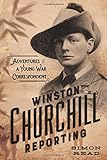
Simon Read. Winston Churchill Reporting: Adventures of a Young War Correspondent. Boston: Da Capo Press, 2015. 328 pp. $26.99 (cloth), ISBN 978-0-306-82381-7.
Reviewed by Edmund Potter (Mary Baldwin College)
Published on H-War (January, 2017)
Commissioned by Margaret Sankey (Air University)
The name Winston Churchill is most often associated with the glories of Britain’s “finest hour” during World War II and the disaster of the Gallipoli invasion in World War I. In each case, Churchill was both innovative and stubborn. He repeatedly took risks, which resulted in very different outcomes. Simon Read, in his recent text, seeks to demonstrate that these traits were already visible in Churchill’s early career as a self-styled reporter.
Winston Leonard Spencer-Churchill was born to the younger of the Duke of Marlborough. When his father died in 1880, Winston was left with a good name but not enough funds to pay for the social lifestyle he thought he deserved. Journalism appeared to offer him the opportunity to travel, make money, and satisfy his desire for military adventure. In 1895, the future prime minister began by reporting on the native Cuban insurgency. He used his name and social connections to attach himself to the Spanish forces. Unlike today’s embedded journalists, Churchill always came well armed and prepared to fight.
Technically, an officer in the 4th Queen’s Own Hussars, Churchill arrived back in England in time to be deployed to India. Initially not thrilled with the posting, in 1897 he was able to use it to his advantage to both fight in and write about the Second Anglo-Afghan War on India’s Northwest Frontier. The following year, against the wishes of Lord Kitchener, Churchill used his influence to get himself attached to the 21st Lancers in the Sudan, where he participated in the last great British cavalry charge. He then moved on to South Africa in 1899, where he was captured by the Boers, who did not completely accept that the now civilian Churchill was not in fact an enemy combatant. His escape helped Churchill sell more books, made him a celebrity, and facilitated his election to Parliament in 1900.
Winston Churchill Reporting: Adventures of a Young War Correspondent is Read’s eighth book in a decade and only the second one not to deal directly with a murder case. Born in Britain, he served as a newspaper reporter before moving to California and turning to write about history. He is, however, careful to insist that this book is not a history. Rather, it is intended as a well-written synthesis of both secondary and primary sources. Read utilizes a form of endnotes, but they are linked only to a source, not a specific set of words. Generally, this works well, but there are moments when the author stumbles. After escaping Boer territory, Churchill sent a snide telegram to the Standard and Diggers’ News in Pretoria. In Read’s work, this section is somewhat confusing, and one needs to go to a troublingly similar passage in Churchill’s granddaughter Celia Sandys’s Churchill Wanted Dead or Alive (1999) to truly understand the dialogue with the Boer paper and why it was important.
Overall, Winston Churchill Reporting is a well-written popular history. Read has done a good job of presenting Churchill’s earlier career and putting it in a clear narrative form. For those who do not know his backstory, this book helps explain how Churchill managed to be at the right place at the right time in 1940.
If there is additional discussion of this review, you may access it through the network, at: https://networks.h-net.org/h-war.
Citation:
Edmund Potter. Review of Read, Simon, Winston Churchill Reporting: Adventures of a Young War Correspondent.
H-War, H-Net Reviews.
January, 2017.
URL: http://www.h-net.org/reviews/showrev.php?id=47061
 | This work is licensed under a Creative Commons Attribution-Noncommercial-No Derivative Works 3.0 United States License. |

