



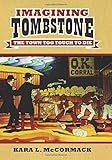
Kara L. McCormack. Imagining Tombstone: The Town Too Tough to Die. Culture America Series. Lawrence: University Press of Kansas, 2016. 216 pp. $27.95 (cloth), ISBN 978-0-7006-2223-8.
Reviewed by Joshua D. Koenig (Western Michigan University)
Published on H-Environment (September, 2016)
Commissioned by David T. Benac (Western Michigan University)
In Imagining Tombstone: The Town Too Tough to Die, Kara L. McCormack examines the history of Tombstone, Arizona, and the efforts made by its citizens to save the town from decay and promote it as a tourist destination that offered visitors an opportunity to experience the historical American West. She contextualizes the town of Tombstone within the fields of the American West, popular culture, mythology, and historic preservation. Through archival and experiential research, she sophisticatedly examines the important connection between the mythical and imagined, and the factual and historic American West. In doing so, the book positions itself among other important works of historic preservation, heritage tourism, and popular culture.
McCormack begins her analysis with an examination of Tombstone’s early history, leading up to the famous gunfight at the OK Corral. She notes that, while the famed gunfight sticks with us through popular culture imagery, the citizens forgot the event as other issues, such as fire and flooding, preoccupied citizens of Tombstone. However, as citizens set out to save the town, they looked to tourism, and as McCormack explains, “Tombstone’s townspeople began to consider how their past could be used to save their future” (p. 7). She stresses the fact that Tombstone’s mythology saved the town but simultaneously has come under scrutiny to maintain historical integrity.
In her first chapter, McCormack highlights the history of Tombstone’s preservation efforts and the decision to recreate a setting from the early 1880s. As the popularity of western mythology intensified, the citizens of Tombstone chose to focus on the story of Wyatt Earp and the famed 1881 gunfight at the OK Corral. McCormack explains that the goal was to provide visitors with an authentic western experience, “but history in and of itself appears almost secondary” (p. 21). She notes that, today, visitors experience a mix of old and new buildings, street performances, locals dressed in period costumes, and a mix of authentic and inauthentic, historical and artificial. Through their preservation efforts, citizens chose to market not only their town but also themselves, because as McCormack explains, it fits with visitor expectations and becomes an integral part of the experience. Thus, she argues that factual history is problematic in Tombstone and that visitors instead experience a rather selected history.
Throughout McCormack’s work, the mythical and imagined W remains central to her argument. Chapter 2 continues with an examination of Tombstone’s preservation history. Here McCormack intertwines historiography with Tombstone’s development and preservation plans. She suggests that the citizens of Tombstone made a conscious effort to display the mythical version of Tombstone because that is what visitors desire. However, she explains that this decision also came with numerous problems.
In the next three chapters, McCormack intensely focuses on the creation of western mythology through an analysis of western popular culture, specifically films and tourist destinations. She contextualizes the reasons why the public possesses certain preconceived ideas about the historic American West and why they expect to see those images through their own experiences. In chapter 3, McCormack analyzes the Earp legend through western films and explores the ways in which this story created the archetypical western hero, which became ingrained in popular culture to symbolize law, masculinity, and manifest destiny. She solidly points out that the evolution of the western film genre produced a lasting effect on the town of Tombstone. She argues that there exists an “inextricable link between popular portrayals of Earp and the gunfight and the ways audiences have imagined Tombstone and the West over time” (p. 80).
Chapter 4 continues her discussion of popular culture, but at an international level. Here, McCormack examines the products of western popular culture, such as film, theme parks, and towns throughout Europe and Japan. She argues that the Tombstone myth not only shaped America’s idea of the West but “figured largely in global conceptions of the Wild West” as well (p. 114). Chapter 5 highlights the fact that even the scholarship exploring Tombstone’s history is problematic and wrought with mythology. Again, through this discussion, McCormack suggests that the imagined West plays a crucial role in visitor expectations, and while these expectations may not be historically accurate, they are, in fact, powerful and cannot be ignored. She ends her work by exploring current issues in Tombstone, including water battles and border wars. McCormack suggests that “violence and wildness are crucial to Tombstone’s public identity” (p. 160).
Imagining Tombstone is a highly informative text, suitable for students, scholars, and nonacademic audiences alike. McCormack provides a significant contribution to the fields of historic preservation, tourism studies, and the American West.
If there is additional discussion of this review, you may access it through the network, at: https://networks.h-net.org/h-environment.
Citation:
Joshua D. Koenig. Review of McCormack, Kara L., Imagining Tombstone: The Town Too Tough to Die.
H-Environment, H-Net Reviews.
September, 2016.
URL: http://www.h-net.org/reviews/showrev.php?id=46940
 | This work is licensed under a Creative Commons Attribution-Noncommercial-No Derivative Works 3.0 United States License. |

