

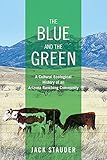
Jack Stauder. The Blue and the Green: A Cultural Ecological History of an Arizona Ranching Community. Reno: University of Nevada Press, 2016. 416 pp. $39.95 (cloth), ISBN 978-0-87417-995-8.
Reviewed by David D. Vail (University of Nebraska at Kearney)
Published on H-Environment (September, 2016)
Commissioned by David T. Benac (Western Michigan University)
Ranching the Wilderness: Contentious and Communal Conservation on Arizona’s Blue River
The American West has long carried cultural mystiques, ecological vulnerabilities, violent conflicts, and cooperative communities. Such scholars as William deBuys (A Great Aridness: Climate Change and the Future of the American Southwest [2011]), David Igler (Industrial Cowboys: Miller & Lux and the Transformation of the Far West, 1850-1920 [2001]), and Nathan F. Sayre (Ranching, Endangered Species, and Urbanization in the Southwest: Species of Capital [2002]) have profiled the environmental, technological, and political connections between cultural visions and environmental realities of western places in the Southwest, Great Plains, or the greater American West. Other historians, such as Mark R. Ellis (Law and Order in Buffalo Bill's Country: Legal Culture and Community on the Great Plains, 1867-1910 [2007]), Mark Fiege (Irrigated Eden: The Making of an Agricultural Landscape in the American West [1999]), and Char Miller (Gifford Pinchot and the Making of Modern Environmentalism [2001]), explore the potent mixtures of celluloid frontier myths, practitioner tensions, community building, and conservation practices that defined western perceptions and policies. Very few, however, have considered these histories through the lens of small western communities and their regional cultural, environmental, and agricultural ecosystems.
In The Blue and the Green, Jack Stauder (professor of cultural anthropology at Cambridge University in England and University of Massachusetts Dartmouth) offers a study that weaves all of these strands together. He argues that remote communities are significant to American West history. Taking this perspective gives “ranchers and their supporters full opportunity to voice their opinions and point of view. To do so is important, because their voice is not frequently heard, either in the media or in academia. But to present the full picture, or whole story, all pertinent viewpoints needed to be presented—those of Forest Service personnel, of environmental activists, of scientific experts of various sorts, of historians, and others who have written about the Western range” (p. xii).
The Blue and the Green begins by surveying the region’s early settlement. Ranchers found cheap land and a river valley primed for production. At the same time, aridity, overgrazing, fence lines, and water rights seemed to stymie those living along the Blue River. Stauder often relies on contemporary ranchers, such as Fred Fritz Jr., who resided on the Blue for eighty years, to reflect on this longer past: “Despite Apaches, rustlers, rough terrain, hardship, and risk, the Blue was irresistible to those who wanted land. It was not of course the beauty of the rugged landscape that drew the pioneers, though its beauty did not escape them.” According to Stauder, for Fritz Jr. and other ranchers, the main appeal for the remote was something simple and scarce—water. Fritz Jr., for example, wrote: “When I was a boy I asked my father why he passed through some of the best range in western New Mexico and eastern Arizona with those long horned cattle ... and then located in the roughest part of Arizona, the Blue River country. His answer was ‘water.’ During my lifetime on the ranch I discovered how right he was” (p. 11).
In subsequent chapters, Stauder connects these personal ranching accounts with United States Forest Service (USFS) policies and explores how both groups addressed the challenges using and preserving lands in the arid West. Chapters on overgrazing, drought, floods, and erosion depict the environmental conditions that persuaded community members toward wise-use conservation of their lands and rivers. As ranchers struggled with unpredictable weather patterns, a restrictive climate, and opaque water laws, their “practitioner conservation” views followed closely with the more scientifically driven policies of President Theodore Roosevelt and Gifford Pinchot, an American forester and politician (p. 53). But, not always. As other luminaries, such as Aldo Leopold, became more involved with the ecological well-being of nearby wilderness areas, including New Mexico’s Gila National Forest, Blue ranchers wondered if their version of conservation fit. Even Leopold had mixed feelings: “The entire area is grazed by cattle, but the cattle ranches would be an asset from the recreational standpoint because of the interest which attaches to cattle grazing operations under frontier conditions. The apparent disadvantage thus imposed on the cattlemen might be nearly offset by the obvious advantage of freedom from new settlers, and from the hordes of motorists who will invade this region the minute it is opened up” (p. 86).
By the 1960s, however, ranchers, forest service personnel, and environmental activists were increasingly at odds. As biocentrism, preservation, and protection shaped many federal policies, perhaps most corrosive for those on the Blue was the 1970 National Environmental Policy Act (NEPA) and its mandate for “detailed” environmental impact statements. In past decades, range science had drawn on professional and practitioner experiences, but no longer. In the minds of many ranchers, new federal standards only reflected environmentalists’ aims. To them, gridlock and anti-government activism seemed the only way to preserve grazing livelihoods.
The Blue and the Green takes a new look at Arizona’s rural grazing history. Through a series of oral histories, scientific reports, and government documents, Stauder connects the remote lives of Blue River ranchers to the larger, unpredictable American West. His inclusion of oral interview transcripts at the end also serves as a rich guide for public historians to learn how to conduct oral interviews that determine environmental or agricultural past. One quibble, however, is the absence of Native American voices. What were the experiences of reservation ranchers? Nevertheless, The Blue and the Green joins a growing ranching and grazing scholarship that connects a complex history of western communities to our complicated present.[1]
Note
[1]. See Daniel T. Gresham, “A Progressive Rancher Opposes the New Deal: The Political Journey of Dan Casement,” Kansas History: A Journal of the Great Plains 39, no. 2 (Summer 2016): 95–113; and John Ryan Fischer, Cattle Colonialism: An Environmental History of the Conquest of California and Hawaii (Chapel Hill: University of North Carolina Press, 2015).
If there is additional discussion of this review, you may access it through the network, at: https://networks.h-net.org/h-environment.
Citation:
David D. Vail. Review of Stauder, Jack, The Blue and the Green: A Cultural Ecological History of an Arizona Ranching Community.
H-Environment, H-Net Reviews.
September, 2016.
URL: http://www.h-net.org/reviews/showrev.php?id=46867
 | This work is licensed under a Creative Commons Attribution-Noncommercial-No Derivative Works 3.0 United States License. |

